Wednesday, September 29, 2010

Riding Out My Illness

I know I have talked a lot about Loli and the wonders that have happened since I met her after giving my speech at the university. I don’t want to drone on unnecessarily but between us we have been working on a program to help me get stronger and to improve my health and it is working. I am writing a book about it called ‘Health Through Horses: a personal journey to recuperation, health and happiness’: The book will include a lot of personal things about my illness and some funny experiences but mostly it is about how Loli and I started to come up with a program that can help so many people recovering from cancer and other illnesses. So I will put here an excerpt from the book on some of my exercises.

MY SELF-HELP PROGRAM: HEALTH THROUGH HORSES

I decided that I couldn’t cure the virus (Note from Editor. Barbara’s virus remains unidentified after ten years) but I could make myself as strong and healthy as possible and knowing the power of the horse and what it can do, I decided to set up a program for myself using all of the knowledge I had learned over the years. With chronic kidney dysfunction and chronic anaemia, I was told they would just get worse and that my body didn’t absorb the iron I was taking in so I would have to inject myself every day. I was also told I would need to eat from a feeding tube for the rest of my life. None of these things were acceptable to me so I wanted to change things and make a difference in my own health.
I started riding at Loli’s once a week on the lunge-line, and in the ring, it soon became clear, I don’t know why, that riding on the lunge-line provided much more benefit. I think the reason being that I didn’t have to think about my reins or steering so all the concentration went into me, Loli was in charge of the horse and watching that my posture was correct. The benefit of riding bareback on the lunge-line is that you don’t need to have any previous experience. You have the sursingle to hold on to; someone in charge of the horse and you can go at your own speed. Start at the walk and when you feel comfortable then you can progress to the trot and so on. I have improved so much both mentally and physically and hope to continue through experimenting with more useful ideas.
I am still slightly anaemic but I don’t have to take iron and I don’t have to inject myself. My kidneys have improved by one point, which doesn’t seem much but really is a huge advancement because they were supposed to be getting worse not better. The side-effects of the steroids are almost non existent except for the continual hunger. My insomnia is finally easing up and letting me sleep a few nights a week. The most impressive result was that of my triglycerides - which turn fat into energy for your muscles. The highest you can go is 200 but mine was over 400 and after three weeks, of riding once a week, I now have my levels down just below 200 and it is still going down. I knew I had to keep a good flow of oxygenated blood running to all of my extremities, because at one point they were going to amputate my toes and the tips of my ears. All of this was avoided by getting a good blood-flow to my extremities; also through my heart and lungs so that was one of the first exercises I started to work on. It was important to help keep the new skin and implants from dying. I use a yoga breathing technique and stretching and opening my chest cavity. I also breathe from the abdomen instead of the chest. I do all of my exercises at the walk, trot and canter in both directions. I still can’t do some of them at the canter but each time I get closer. There are still some places I can’t reach in the stretches but I will get there. That is one of the wonders of this program, you don’t need previous experience and you go at your own pace, meanwhile, just sitting on the horse while it is walking is giving you benefits. After a long time in bed, especially hospital beds, which are known for being uncomfortable, I had a lot of muscle-pain and a bad and weak posture. That was one of the next things I worked on, by stretching above my head with a pole and doing push-ups on the horse’s withers. It will all become clearer when you see the pictures and get a full description of the exercises, now I am trying to tell you what and how I decided to work on different parts of my body. My kidneys bothered me so I had to find a way to strengthen my lower back and stretch my torso so there wouldn’t be so much pressure on them. I needed energy, most of that came from the canter with my arms spread out and my eyes shut. I had to be in a good frame of mind so as not to go into depressions every time I had to change my bandages or see myself in the mirror; I helped achieve this by getting back out into the world and helping other disabled people and the decision to stop dwelling on my own problems. I also had to work on my balance, since I am almost completely deaf, that included a lot of trot, stop, trot, stop plus a series of other things like around-the-world and riding backwards. I needed to build strength in my legs and build muscle-tone, so I put my hands on the rump of the horse and ‘did the bicycle’, foot circles and bringing my knees together and lowering them again. Between each set of exercises I would relax by putting my hands just behind my hips, resting on the horse and sit up straight at a good working walk. To relax my back muscles I lie down with my head on the rump and just go a few times around the ring. It is amazing what a great massage you get from that but you can’t do it at the trot or canter, at least I can’t. I do a lot of stretching, reaching from tail to ear and back again stretching way over my head. I spend about five minutes on each exercise in each direction at each pace. I found that I could isolate muscles that were bothering me by finding the right muscle on the horse and the right pace to make it work and it is incredible how when you get it just right everything just slips into place. Then I do some basic aerobics for fitness and energy. It is very important that your instructor makes sure your arms are at shoulder level when stretched out and that your hands are a shoulder’s-width apart when you work with a pole or other instrument. Always look between the horses ears with your head up even when you are doing twisting exercises to the sides. When I finish my workout, my muscles feel tired but good and relaxed and I have boundless energy and a fantastic positive feeling of well- being. I know I will always have moments of depression and wonder why this should have happened to me. There are times when I just want to give up but then I see all of the things I have to live for and it gives me a renewed strength to carry on. I know I am very lucky to have such a wonderful family and friends as a support group; I probably would have given up if not for them.
It has all been trial-and-error but now it is working well enough with me to get a few doctors interested and that is what we want in this field. I have seen over the last thirty years the benefits horses provide for the disabled but I never put much thought into illness and recovery. Since my illness I neither have the money or the strength to reopen my center ANIMO, but I am helping a few small centers around the area and giving a few speeches. Now, my main concern is to get better myself and if I can help other people in the process, so much the better.

Thursday, September 09, 2010

Little Boy Kitty Lost His Meow

Something fell out of the tree straight into my husband’s arms. When I asked him what it was, he took a look and said “a little boy kitty” and that is how he got his name. Little Boy Kitty was no normal kitten, he was completely black and tiny with the softest fur you have ever felt and he knew from that very second that he fell from the tree that Lenox and this house were his. He wandered around with all of the big dogs and other animals without a care in the world. He knew this was going to be home. As Little Boy Kitty began to grow he also began to speak, or meow, about and to everything and everyone he could find. He became particularly verbal at meal times especially if you were late, according to him. He would weave in and out between your feet, tripping you up and meow to the point that you felt like throwing him out of the door. When I say that he was no normal kitty, I meant it, he never just curled up in a ball and went to sleep or did any of the other things cats normally do, no, he had to stretch out on your chest with his arms wrapped around you like a big hug and he always put his chin right under yours and looked at you with these adorable eyes so you didn’t dare move him. There he would stay until you had to go to sleep, and that is when we finally started to put him out of the bedroom at night, so we could roll over and get some sleep ourselves. As he grew he became more and more verbal. When you would come home he would have to tell you all about his day and who had been mean to him and what bird he had tried to catch, all before you could get the groceries into the house. If we would go away for a few days, when we came home, it was hours of telling us everything that had happened. After a few years it really became quite annoying, his insisting on breakfast while you were in the middle of fixing it. He just never shut-up. Then one day he just lost his meow. He would open his mouth but no noise came out. He was waiting for me at the door as usual and was weaving in and out of my feet waiting for breakfast but there was no noise. I checked his throat and him but there was no meow. It was gone. We looked everywhere but it was nowhere to be found. It had been about a week and still no meow. One day when I went upstairs I saw, sitting next to me on the bed a huge, and I mean huge, bull gecko, one of our house-lizards that usually live behind the paintings. I didn’t want him to sit with me so I told him to shoo, very politely. He was so fat that he couldn’t hold on to the walls or ceiling anymore, without falling, splat onto the floor again, so he had to stay on the floor or bed. He had no intention of moving from his comfortable position on my bed so I became a little more insistent, when all of the sudden he just looked up at me in a deliberate way and said MEOW. WHAT A SHOCK! I came running down stairs to tell Lenox. So we finally found where Little Boy Kitty’s meow went to and to this day Little Boy Kitty still gives us hugs and is still trying to tell us about his day, but he is completely silent and fortunately I haven’t seen that big bull gecko again and I hope I never do.

Thursday, August 19, 2010

Wonders Happen at Loli's

Lenox and I met the most wonderful lady called Loli and her son Alberto just by chance when I was giving a lecture at the University on Animal Assisted Therapy a few months ago. After the lecture she came up and introduced herself, and you could tell just by the way she touched you, that there was something very special about her. She knew nothing about us except the lecture I had given. She invited us to come and visit her and we went the very next weekend. She has a walled in compound full of horses and all sorts of animals from farm to exotic. She is a riding instructress and had very kindly lent her ponies to a group of students from the university to learn and practice Therapeutic Riding, while she taught her regular students in the other ring. Her animals have all been hand-raised since they were tiny and are the most gentle and calm animals I have ever met - along with my own of course.
I have a virus that is unknown and they can’t kill which has left me disfigured and going deaf. I was blind for a year but they gave me transplants and we are just hoping the virus doesn’t eat them as well. Because of the toxic medicine that I take, I have a lot of ups and downs physically and mentally which must be hard for my husband but he is very understanding, and is by my side through it all. Loli picked up on it right away and knew the only solution was to get me back on a horse and ride it out, so to say. It had been almost eight years since I had ridden but I started slow and in a few minutes was galloping with my arms out like I was flying. I haven’t felt that good in years, I had energy that lasted several days and was strong and in good humor. She insisted that we come the next weekend and try some more to see if I got the same effect. It was even better. She treated us to lunch and friendship and made us feel like part of the family and even though it is just Loli and her son who have to care for all those animals, she takes time out for me to make me better. Now we go every week if we can.
We noticed, since I had taught ‘equinoterapia’ for over thirty years, that the new people were missing the basics, which are so important for the safety of the children. If Spain wants to be on an international level, they must learn the basic safety procedures and follow the international rules, because even though they are not required in Spain yet, they soon will be. This brought us even closer together and now we are starting to give courses on the Basics of Therapeutic Riding with the backing of the Spanish Riding Federation. It is a course for professionals, aides and volunteers. We were looking forward to starting in October along with Beatriz the physiotherapist from ANIMO, but things haven't worked out yet. We will be publishing a manual soon with everything you should know before you let a disabled child near a horse and what things can help and what can hinder. Exercises, how to choose the right pony right through to first aid.
Thank you Loli for making me forget about my own problems and help other people again, at the same time ride out my illness.

Tuesday, August 10, 2010

Imagine

Just imagine for a moment that you are in a huge circus tent with hundreds of people and it is silent and completely dark. You can’t see anything, not even the person next to you and the all of the sudden you start to hear one set of castanets and then another until it sounds like there are about ten people playing them and tap dancing. The beat changes and gets faster and then each one starts to do a slightly different beat that blends beautifully into a harmony of wooden castanets. Slowly the lights start to come on very, very slowly the tent starts to light up and you begin to see the things around you, then the spotlight hits the center of the stage and there are four beautiful pure-bred Spanish stallions dancing in place to a beat on a wooden floor just off the ground. The crowd was in shock to see that it was four horses making this music with their feet on the planks each in different time but blending into beautiful harmony. That was the start of a wonderful horse theatre I saw in Madrid. These horses, in the dark, just stood and waited their turn to be told when to start prancing in place, making the typical Spanish sounds of a dancer with castanets. We were all expecting to see a group of Flamenco dancers there. The show just got better and better, there were girls doing ballet holding on to the saddle while a man rode and the ballerina did exactly the same moves as the horse from prancing to flying changes. These horses travel around the world as ambassadors to their country. It is a cultural program paid for by the government; several other countries do the same thing.
The French have Circe du Soleil, which is a travelling horse theatre, paid for and run by the French government. It is a true theatre, and tells a story, in fact each show tells a different story. The ring is round, like a round-about, with a stage in the middle and aisles crossing through the middle for the horses. The timing must be exact or the horses would collide with each other as they cross over each other and on to the round part of the ring, missing each other by a few inches, almost always at a canter, while people jump on and off and do acrobatics, the whole time a story is being told and played out with beautiful costumes. If you ever get a chance to see them go for sure because it was just as impressive as the flying horses, the Lipizzans, from the Spanish Riding School in Vienna; the blood line originally from The Czech Republic, they are also sponsored by the government to show the horses, their beauty and talent to the world. Now most countries have their own breed of horse, every one as gorgeous as the next. They have crossed some of these horses with other breeds to make some of the best horses in the world. I know most of us from California saw the Lipizzans at the Cow Palace, when we were kids, but the French theatre was equally thrilling.
The Portuguese Lusitano horses and the Lipizzans from Vienna and the PRE from Spain are all fantastic horses and all share a common blood-line but each country has kept their own identity. Even the Dutch Friesian horses, that look and act like PRE; only they have a heavier bone-structure. The Lusitano is supposed to have a stronger temperament than the PRE. Besides their beauty, the one thing they all have in common is that you feel like you are floating when you ride them. It is very difficult to explain the fantastic pace of these horses.
I have a very hard time to tell the difference between the Portuguese Lusitano and the Pure bred Spanish horses, they are very similar in build, beauty and temperament.
To see the Pura Raza Española pure-bred Spanish horses there are two big shows every year¸ SICAB in Seville and ECUMAD in Madrid where you can see these horses do things you never imagined a horse could do. Also they have all of the breeders there with horses for sale and all of the foals. A lot of foals are actually born during the fair. There are exhibitions every night and during the day you can go from one arena to the next and watch anything from foals through to freestyle dressage to music.
In order to try a preserve the bloodline the military has a herd of stallions whose job it is to go around Spain to the small out of the way villages and let the farmers breed their mares to a PRE, that way the foal gets half-papers and next time it is bred it will be Pura Raza Española. It costs a fortune to take your mare to a PRE stallion, but the army only charges an honorary fee, so that every one can afford it. There used to be one main problem with this system. That was, how to get your mare to the military station they had chosen, in some way out in the sticks village. None of us had trailers and it would have been about a three-day ride to get to our closest one. U-Haul and Rent-Rite didn’t exist so you couldn’t rent one. They use abandoned buildings and made make-shift stables. Where we were was an old pig sty, cleaned and converted for the mares and their foals, most still had a foal with them because they breed them three weeks after giving birth so that they have a foal every year. The stallions were kept on the other side of the building with a large wall and gate between the mares and the stallions. On this blog page is one of my favourite stories and it is called “Foaling with the Army”. Read it I think you will get a good laugh out of it.
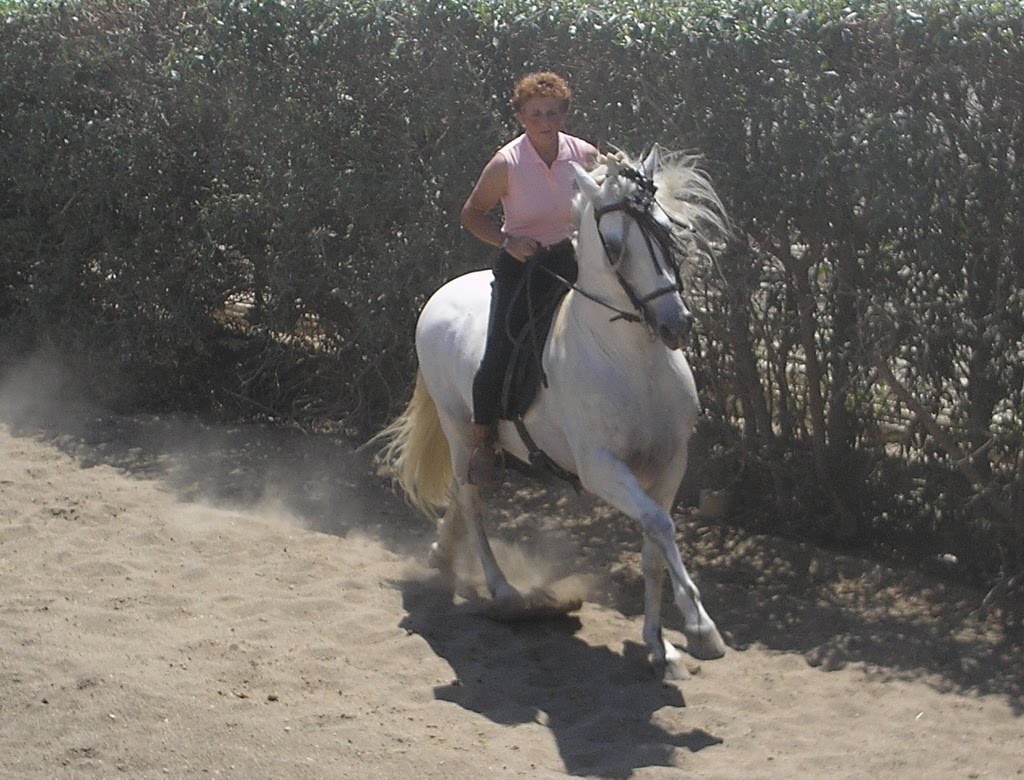
My first picture is a Pura Raza Española and the second is of a Fresian three year old stallion who has already won some local championships in dressage.

Sunday, August 08, 2010

A New Look

That's a Pura Raza Española at the top of the page which I was lucky enough to ride the other day. This blog is about horses (and dogs and rabbits and donkeys...) and about my life with animals in Spain. It's also about 'Animo', an AAT association which I ran in Mojácar some time back. Bits of this blog are in Spanish, but most of it is in English.
The photographs and text found on the Animo blog have written permission from the parents to be used only for the promotion of equinoterapia by Animo. There are also links to other sites that you might find of interest, this does not mean that we follow the same standards or teaching methods, we are all just groups interested in helping the disabled improve their quality of life through working with animals.
Barbara Napier
brbrnapier (at) yahoo (dot) com

Saturday, July 31, 2010

La Hípica y sus Beneficios

La equinoterapia, hípica adaptada, hípica terapéutica, hípica para discapacidades, hípica y hipoterapia, son todos maneras distintas de explicar como la musculatura y paso del caballo puede beneficiar al ser humano, con problemas físicas, mentales, o solo para quedar en forma y pasar bien. Podemos incorporar al caballo en el deporte y en tratamientos médicos. Conociendo bien al caballo y las necesidades de los alumnos, un equipo bien formado puede tratar a personas con y sin problemas. El caballo es un animal muy noble y fuerte, y cuando está tratado bien, hace todo para ayudarnos dentro de cualquier de los campos que elegimos. El paso del caballo es casi idéntico del paso humano y porque nuestro cerebro y sistema neuromuscular está abierta a cambios, es por esta razón, si podemos estimularle correctamente, el alumno puede aprender la sensación de los movimientos normales y con suficiente práctica, partes del sistema neuromuscular puede arreglarse y supeditar la parte dañado. Según la discapacidad del alumno, claro está, hay que elegir la rama mas indicada.
Adultos con o sin discapacidad empiezan con más miedo y suelen ser más rígidos que los niños. Los niños no tiene responsabilidades y mucho menos miedo de lo que puede pasar si se caen. Una vez que un adulto está más acostumbrado al montar al caballo y vea la seguridad que se supone en tener laterales y una guía, se relaje más.
El pasó y travesía que hace el caballo cambia en una forma notable la clase por completo. Si el caballo es violento o vago, el alumno no recibe la estimulación que necesita para hacer sus ejercicios. El caballo hace la diferencia. Hay que elegir un caballo adecuado por cada caso. El profesor de equitación, fisioterapeuta y el coordinador del equipo, entre ellos, tienen que elegir el caballo más adecuado por cada alumno. Cada alumno necesita un movimiento diferente para lograr el objetivo de cada clase. El tamaño del caballo influye mucho también. Si el caballo tiene el lomo un poco redondo, es mejor para hacer los ejercicios a pelo donde se saca provecho del mejor beneficio. Puede ser un poco más difícil para las personas con problemas de abrir mucho las piernas, pero al mismo tiempo ayuda para que las mismas piernas poco a poco abren más durante cada clase.
Los que hacen hípica como deporte, reciben muchos de los mismos beneficios como los que hacen la hípica terapéutica. Pero, claro está que el primero es activo mientras que el segundo es pasivo. No están montando a caballo para aprender montar en sí o convertirse en jinete. Las personas que están recuperando de una enfermedad también reciben mucha ayuda del caballo. El caballo ayuda estimular el sistema circulatorio y quite algunos de las toxinas que quedan dentro del cuerpo después de un tratamiento con medicamento nocivos, dejando al alumno con más energía y sentido de buen estar. Si uno tiene que pasar mucho tiempo dentro del hospital o la casa, el caballo hace masaje a todos los músculos sin que el alumno tenga que mover. El caballo hace el trabajo y el alumno recibe los beneficios. Para personas que pierden su equilibrio, por ejemplo alguien que no ha nacido sorda pero luego queda sorda por una enfermedad o un tipo de Parkinson, hay muchos ejercicios para que el cerebro aprenda de nuevo como recuperar el equilibrio.
Si uno tiene amor por los animales, las clases avanzan más rápidos. La terapia asistida por animales no es para todos, hay muchas personas que prefieren y reciben más beneficio de terapia ocupacional. Pero no hay duda del beneficio de hípica terapéutica. La hípica terapéutica trabaja los músculos, da equilibrio, da energía, mejora el sistema circulatorio, da masaje a los músculos y los órganos, mejora la coordinación entre ojo y mano, y todo lo anterior mientras que el alumno se siente encima de un caballo con un paso bueno, sin hacer mucho esfuerzo propio. Todo el ejercicio, y no sin menos la hípica en general, es buenísima para curar el insomnio, ayuda vencer a los enfermedades y mantener un estado de buena salud físico y mental.

Thursday, July 22, 2010

Terapia Asistida Por Animales

TIPOS DE TERAPIAS

PERROS DE ASISTENCIA:
ANIMALES DENTRO DE HOSPITALES Y HOGARES DE ANCIANOS:
HIPICA TERAPEUTICA:
GRANJA ESCUELAS:
NUCLEO ZOOLOGICOS:

Todos estos tipos de terapias ayudan a las personas en una manera u otra.
Tarda años para aprender como cuidar e incorporar los animales dentro de nuestras vidas: Todo depende en la rama de trabajo que eliges.
Siempre hay que recordar que cuando tratas con animales y humanos pueden suceder problemas si todo no esta bien controlado.
Comida y agua fresca, higiene y cariño son las cosas mas importantes para tener éxito en cualquier campo que tiene que ver con animales y sobre todo, un buen conocimiento de ellos y de su habites.
La mayoría de los niños ya viven dentro de una ciudad o pueblo y no tienen la posibilidad de conocer a los animales de la granja como antes. También deberían de conocer a los animales y insectos que son autóctonos en su zona amen que a las plantas autóctonas.
En terapias como los primeros tres notados arriba tarda mucho tiempo para aprender como manejar y adiestrar los animales por cada caso. Si no lo saben las personas pueden tener infección o alergias: por esto en mucho de las terapias hace falta un certificado medico antes de empezar y una inspección veterinaria. O a lo mejor los dos participantes no hacen buena pareja y hay que buscar otro animal mas adecuada.
Los animales deben de tener su hábitat y comida lo mas natural posible.
Las granjas escuelas y núcleos zoológicos son divertidos y educacional. También pueden ser sitios para la recuperación de animales dañados.
Perros de asistencia ayudan a los discapacitados físicos, ciegos, sordos, con epilepsia, diabetes y pueden detectar comida que causa alergia en una persona. Todo este tipo de perros están trabajando por todo el mundo ya, y con los mismos derechos que los perros para ciegos.
Animales que van a hospitales y centros de ancianos llevan una toalla para no hacer pipi encima del paciente y están cuidadosamente elegido por su carácter tranquillo. Las personas en carga de los animales dentro y fuera del hospital o centro de ancianos tienen que seguir su trabajo para mantener la higiene y temperamento de los animales.
Trabajando con los caballos es imprescindible que haya un equipo bien formado.
Un curso de fin de semana no es suficiente para que uno empiece a trabajar en estos campos.
Todos estos sitios son buenos lugares para personas que quieran trabajar con animales como voluntarios.

Tuesday, July 20, 2010

Some New Arrivals

Congratulations to Pepa and Pepe on the birth of Baby Bambi. Here's another baby, Rad, who has joined the menagerie and has taken a fancy to Lenox. Rad is a coatimundi and a cute as a button.

The Smile

Here's Angel with that type of smile that makes life worth living.

Wednesday, July 07, 2010

A Short Video


We have a short Animo video on YouTube which was made by Daniel. No talking, and the music fits perfectly, because our students are non-verbal.

Saturday, June 12, 2010

Handling a Foal

From the day a foal is born you should start handling it. Brushing it, picking up its feet, and playing with its tail and rubbing its back (but never putting weight on it) and touching it all over especially around both the mouth and the feet. Talk to it a lot and use words that you would like it to know as it grows up. It is very important that this is done regularly. If you just leave the baby with mom until it has to be weaned, you will have a struggle with lots of things and get lots of kicks and bites, but if it is handled from a newborn and shown all around, it should start to follow you as it gets older and can leave mom, especially if you have been making sounds or words for it that mean different things. The foal should be introduced to different areas and objects, the type of thing that can scare a horse when it enters a new environment. Water for example, like the hose and a shower if it is warm enough, and puddles are very important because they can be fun for a foal but terrifying for a yearling. With the hose you start by letting the foal drink from it and getting its feet wet then slowly move down the body until he or she is used to getting wet all over. Most horses love the shower. They love to learn tricks and learn them very easily in exchange for a treat or a cuddle. Going in and out of a trailer is very important too as it is very frightening, but if you just leave an open trailer in the paddock with food in it they will start to go in and out by themselves. Then as they grow older they are not afraid to try new things because they have full trust in you. I lived up in the mountains when my filly was young so we had dirt roads and no traffic. That made a great place to get used to thing because there was no danger. If you live in an area where there is traffic and other dangers than the process is made more difficult. I had a sheep, Negrita, who was inseparable from Casi, my foal, for almost twenty years and she would accompany us on our outings along with my calf, Petite Suisse. They would walk with me way up in the mountains, the three of them running and playing with each other. They never had lead ropes on, they just ran free and because I just talked to them all the time, Casi learned to lunge very fast just by me asking her to change direction or pace or even to back up. That is the way I started riding her as well: I could get her to slow down or gallop full speed and of course stop just by asking her. She knew how to shake hands and just naturally followed me. It is a good idea from time to time when it is windy to just let them loose in the riding ring with things like plastic bags and balloons or flags tied to the fence and just leave them there for a while until they aren’t scared of the objects any more. The more experiences they have and the more confidence they have in you the better horse you will have. The only problem I had with this system is that everyone thought Casi was a spoiled brat, and maybe she was, because for the first five years or so she would only respond to me and no one else could ride her let alone get on her. It wasn’t until my girls started to work with her that she became the best horse I ever had. She knew high school dressage, both Spanish and English; she loved to jump and was the best of my nine horses for the disabled. All because of the trust she had in me.

Wednesday, June 02, 2010

Charlie: Faithful Hound


Charlie is my son’s dog; she is half Greyhound and half Labrador. She is very intelligent and very well behaved. When my dog died a few weeks ago, Charlie knew I was very sad and she has spent a lot of time cuddling with me and following me around. She has become very protective of me and keeps me out of what she thinks is danger which might include a new dog on the property. (Actually, it does! Ed.) She is also very jealous and wants me for herself. Now she sleeps in my room instead of my son’s but he has two other dogs to keep him company. The other night I was working on the computer and she was by my side when all of the sudden she started to cry and paw at my arm. I kept telling her to go lie down but for the first time she wouldn’t listen she just kept persisting. It wasn’t until she started to move in circles and show her teeth and growled that I look to see what was bothering her. A large scolopander had just crossed my slippers and was on his way under the desk. (It’s a kind on huge man-eating centipede Ed) I was so shocked that I didn’t know what to do, but I knew if it got under the desk I could never catch it, so I took a piece of paper and kept moving it to the middle of the room. Meanwhile Charlie was growling and had her hair standing straight up. It was the middle of the night but I started to call to my husband for help because I couldn’t let it escape or it might show up some place else where I wasn’t aware of it and bite me. They are the most poisonous creature we have here in Spain. (Well, after the neighbours. Ed) My husband came quickly but didn’t have his contact lenses in so he couldn’t see it very well, so he went to put them on and to call our son. Between them they captured it (hog-wrestled it. Ed) and took lots of pictures. It was about eight inches long and as wide as my thump (Barbara has a pretty big thump. Ed), with big brown stripes down its yellow body. Once it was caught it started to get really mad and made biting motions so we could see its big fangs. My son now has it in a terrarium and will watch it to learn more about it. In my thirty-five years here I have seen maybe five but they have all been about two or three inches long and yellow.
They can still give you a good bite though which will go sceptic and can be dangerous. So I have to thank Charlie for saving from what could have been a very painful and unpleasant experience. It always amazes me how animals can express themselves when they really need to and I am glad they can because this is not the first time an animal has kept me from harm.

Tuesday, June 01, 2010

Horse, Foal and Friends


Tina and Barbara spent the day at Albero watching Loli with her amazing animals. Our thanks to Alberto for the photographs.


Princesa

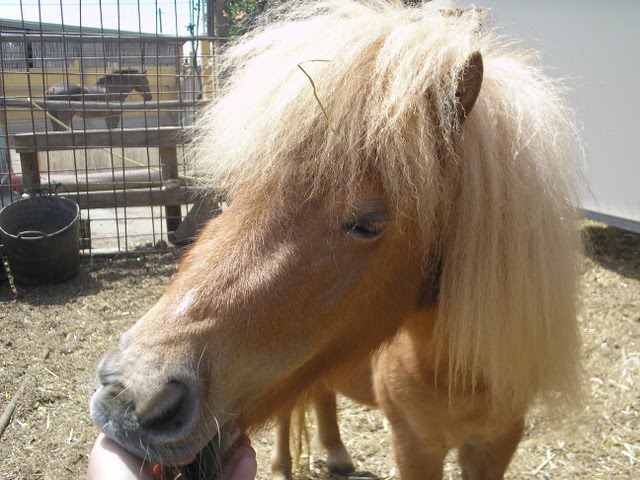
Here's a cute friend called Princesa who is nibbling on my finger (ouch!) as she shows me how she does her hair. Princesa and her friends live in Almería at a stables called Albero. The horses (and a couple of donkeys and a rather odd ostrich called Bola who lays enormous eggs every now and again) are remarkably well looked after and highly trained. It is a splendid place to visit.
Princesa and her friends' job is to help look after some of the young children who visit as well as the disabled riders while they are waiting for their lessons.

Baby takes a Lesson

In our aviary we have Love Birds of every color and they have lots of babies all year long. They usually find a partner and stay with them for life sharing everything from building the nest to caring for the young. While the mother sits on the eggs the father brings her food and water, then, when the babies have pecked their way out of their eggs, the two parents share the feeding of the little ones. At this time, the babies are rather ugly, with bits of bristle and half-formed feathers on their tiny bodies. When the babies are ready to leave the nest, it is a lot of fun to watch them learn from their parents how to fly and eat and where to find water. They grow and learn very quickly and pretty soon they will find a partner of their own and start their own family. They are called Love Birds because once they find a mate it is for life and they like to do everything together. They are very affectionate and spend all day hugging and kissing and feeding each other. They are so close that if one dies usually within a week or so the other dies of sadness, they almost never find another mate. One day a snake got into a nest box with a mother and four babies. He ate the mother and smothered all but one baby. We had never seen anything like it because, out of character, all the birds in the aviary took turns taking care of the baby. They fed him and tried to coax him out of the nest but he did not want to leave. They started putting his food farther and farther from the entrance of the nest. When they finally got him out on to a branch they all stood in a line and tried to teach him how to use his wings. All synchronized they would stretch one wing and then the other while he watched on. He wanted to stay a baby. It looked like a Jane Fonda exercise class to watch. He would get very angry and stomp his feet and scream but the other birds were persistent. They kept moving closer and closer to the food and water trying to get him to care for himself but it was always another temper tantrum. It took him much longer to learn things than the babies with mothers even though all the birds were helping. He finally grew up and learned to do these things himself and then found a partner and started his own family. Besides being very funny to watch, I wanted to put on Jane Fonda Music for them, it is very unusual for this to happen. The father usually tries to take over both roles and is usually quiet successful, but if the baby hadn’t survived the father probably would have died of heart break. They are beautiful and wonderful birds and much more fun to watch the TV. When they are making their nests they take strips of palm branch and stick them in their wings until they can’t carry any more, they do not carry them in their beaks. They look like pretty colored porcupines. Our aviary runs the length of one side of the house so you can watch them while you clean the kitchen or from the bathroom, or of course, from the garden where you will be joined by some curious sparrows and other birds.

Thursday, May 20, 2010

El Albero

After my talk at the University I met a woman called Loli who owns a nearby riding stables and is starting to be the preferred center for students of psychology and physiotherapy to learn Therapeutic riding. Lenox and I spent a very enjoyable morning with her on Tuesday, looking over her small petting zoo. All the animals were in such good shape and so friendly. Later she gave me the honor of riding her prize white Spanish stallion, and then I got to do some vaulting on Nora. A vaulting horse may never change its tempo no matter what the rider or riders are doing.I just started with basic exercises and now I would love to do it every day. What a wonderful feeling and what great exercise! In the afternoon Loli gave her regular classes and I watched and helped in the therapeutic riding side. We had about five children in all. It was hard to help much without knowing them and their history but I lent a hand and gave a few tips. I think it is a wonderful thing Loli is doing and none of it would be possible if her animals were not so well trained and handled. She had some of the cutest ponies I have ever seen and the children were able to climb all over them and they never budged. I was very impressed with the whole day both professionally and emotionally.

Tuesday, April 27, 2010

A Talk at the University

During my recent speech at the University of Almería on the subject of hippotherapy, part of a larger course on sports therapy for the disabled, I showed a short film made in about 1998 which features a small girl called Sofia who suffered from cerebral palsy. She had no control of her head, arms or body. I always rode behind her to support her and help with her exercises. One of the exercises we would do was to try to get the student to touch the nose, this way he or she could try and find the center of their body. Small children do this automatically while playing, they grasp things in their hands and move it to their mouth, and this is the way they find the center of their body. Sofia was not able to do this exercise so we started by crossing her arms over her tummy, first both arms then one at a time. When she was able to complete this task on her own we worked on touching her nose with both hands together by raising them above her head then down to the nose or from the center of her tummy straight to the nose. Finally she was able to complete this on her own. Another exercise we would do was to hold both of her upper arms and lean way back then lift her shoulders while sitting up into a straight position for her (I was still leaning fairly back, if I sat straight up she would be leaning forward and not learn the feeling of sitting upright and the weight of her head would drop down rounding her whole back and neck). This type of sit-up doesn’t only help them find their center, it also strengthens their neck and back muscles.
A man in the university audience asked me what benefit someone with no possibility to ever walk or do anything for herself would get from these exercises. I was glad he asked this because it helps show the difference between hippotherapy and other types of riding for the disabled. In hippotherapy the student almost never learns to ride but gets the benefit to their health from the exercises on a moving horse I explained that touching the nose may someday help her hold a cup or feed herself. During the other exercises, she was being stretched up, finding what was her center and opening and strengthening the chest so she could breath more easily, during the whole time she was doing these exercises on the horse at a walk she was receiving a massage to her muscles and organs, her circulation was made to work harder sending more blood to her extremities, brain and heart and her digestive system was working on its own. After each class she would be put face-down with her belly over the horse and be walked around for a few minutes while one of the side-walkers would pat her back with a cupped hand to remove fluid from the lungs. People in wheelchairs are unable to remove the liquid the way we do by just walking around.
Sofia is a very intelligent girl and very interested in ecology. She can’t speak but she says a lot with her facial expressions. At the end of these vigorous exercises we take a walk out in the country and go places she can’t go in her wheelchair so she gets to enjoy nature that is usually not available to her.
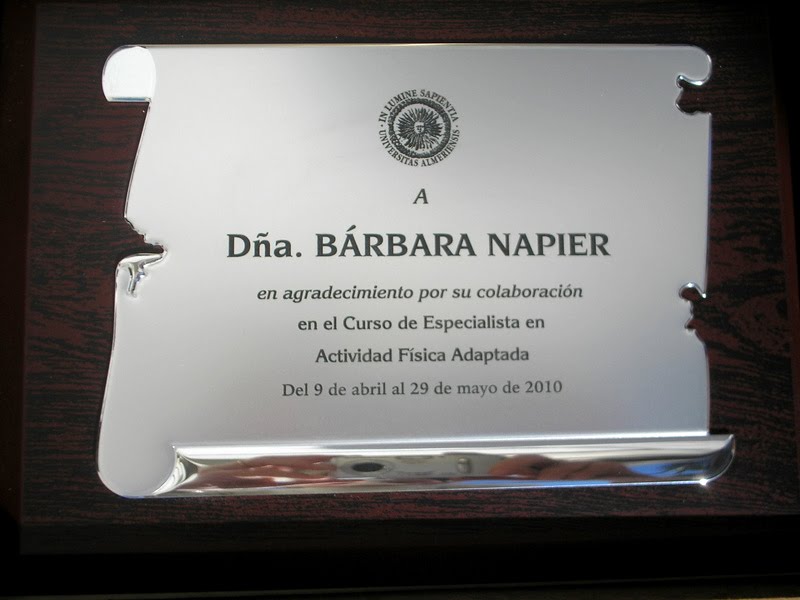
Here is a photograph of the plaque they gave me for my contribution in the field of hippotherapy and I am writing a chapter in their book on the subject because very little literature on this exists in Spanish. I am also planning on being their liaison between the international groups and new groups starting in Spain. They would like to start encouraging more conferences. Now that the medical community is taking an interest in the findings of the benefits of riding we might start making advances in studies and investigations.


Durante mi ponencia en La Universidad de Almería sobre La Hipoterapia, he enseñado una pequeña película con una niña con parálisis cerebral. Sofía no tiene control del tronco ni de sus brazos ó su cabeza. Yo montaba detrás de ella para dar suporte y mantener su posición. Unos de los ejercicios que hemos hecho eran intentar tocar la nariz, para que ella pudiera encontrar su centro. Niños pequeños lo hace mientras que están jugando sin saber que están aprendiendo algo: todo se pone entre las dos manos y lo suben a la boca. Sofía no era capaz de cumplir este ejercicio, entonces hemos empezada cruzando sus brazos por la barriga, los dos brazos juntos hasta cuando lo ha logrado y después un lado tras otra. Una vez que lo había conseguido por si misma, hemos intentado tocar la nariz con las dos manos juntas. Al final ha conseguido hacerlo sola. Los otros ejercicios eran coger sus hombros y casi tumbada, subir nosotros y yo levantando sus brazos por arriba, y volver a tumbarnos. Solo hemos subido hasta que ella encontraba que era recto, yo todavía estaba bastante tumbada. Si hemos llegado hasta que yo estaba recta ella seria inclinada hacia delante y no puede suportar el peso de su cabeza y tampoco podía aprender donde esta la postura recta. Hemos repetido este ejercicio muchas veces.
Este forma de “abdominales” no solo la ayuda encontrarse recta pero también dar fuerza a los músculos de la espalda y cuello.
Un señor me preguntaba que beneficio tiene todo aquello para una niña que no puede hacer nada por si misma. Estuve contenta para recibir esta pregunta ya que demuestra la diferencia entre la hipoterapia y otros tipos de equinoterapias. En la primera, el jinete casi nunca aprende lo que es "montar a caballo" en sí, pero sí saque el beneficio fisiológico de estar sentado en un caballo andando. He explicado que el ejercicio de tocar la nariz es para que un día al lo mejor podría poner un vaso a su boca o comer por si misma. Durante los otros ejercicios, ella estaba encontrando el centro de su cuerpo, cuando su cuerpo estaba estirada durante el ejercicio, su pecho abría para tener mejor respiración, durante todo el tiempo que el caballo estaba andando, ella estaba recibiendo un masaje a sus músculos y órganos, un efecto así como recibimos cuando nosotros estamos paseando, su sistema digestiva estaba funcionando y su sistema circulatorio tenia que trabajar para irrigar sus extremidades, su cerebro, corazón y el resto de su cuerpo. Ellos no pueden hacer esto en silla de ruedas ni tumbada. Después de la clase, ella hacia “jinete muerto” donde colgaba boca-abajo con su barriga encima del lomo del caballo mientras que uno de los laterales la pegue en la espalda con mano hueca. No la pega fuerte solo bastante para quitar el liquido que se acumula en los pulmones que ellos mismos no pueden evacuar. Sofía es una niña muy inteligente y con mucho interés en ecología. No puede hablar pero su cara dice mucho. Después de la clase fuerte hacemos un paseo por el campo donde ella pude ver cosas que son inaccesibles a ella desde su silla.
Aquí hay una foto de la placa que me regalaron por mi trabajo y voy a hacer un capitulo en su libro sobre este tema. Voy a intentar ser el enlace entre los grupos internacionales y los grupos empezando aquí en España. Ya por que el mundo medico está cogiendo interés en los beneficios que el caballo puede dar, a lo mejor podemos empezar a tener estudios e investigaciones sobre los beneficios.

Monday, April 05, 2010

The Bunny-pig (New to Science)


We always had long haired guinea-pigs and they lived in a cage together with a big white male rabbit, Eccles, who was obviously in love with Mrs. Ingypig. They all lived together quite happily for several years and produced lots of baby guinea-pigs. The interesting thing about guinea-pigs is that they are born like popcorn. They just pop out and are miniature guinea-pigs ready to eat and everything. The mother has to take no care of them, whereas rabbits on the other hand are born with their eyes shut and no hair and in a sack that the mother has to remove. They need to nurse for several weeks, needing the mother’s full attention. One day the male guinea-pig died, leaving the rabbit and Mrs. Ingypig alone (at last!). They lived happily together for about a year when one morning I went out to feed them and found Mrs. Ingypig dead with three babies in sacks with their eyes closed and way to big for her to give birth to and a fourth half way born. I think it is scientifically impossible to cross a rabbit with a guinea-pig but it happened. If it had been the other way around they may have survived because a female rabbit would be big enough and would know how to care for the young, whereas the guinea-pig had no idea how to take off the sacks and nurse plus they were way too big for her body. Later we tried putting a male guinea-pig with a female rabbit for several years but there was no chemistry between them and that was the end of the bunny-pig. We almost had a new breed of animal but the circumstances never were right again.

Friday, March 26, 2010

Charity

Charity can mean many things to many people. Charity means to give or help with no thought of reward. The gratification is in the giving. It can be as little as giving a beggar a dime or sponsoring abandoned animals, helping the Red Cross or any other NGO. Charity can mean spending time with an old person or volunteering at a children’s centre. Giving of your time and/or money to disaster relief groups is another good way to help. There are hundreds of associations in your community and starving or abused children all over the world. There are also the veteran’s charities, helping them find jobs or giving psychiatric work to help them over the traumas of war. Everywhere you look there is someone or some group that desperately needs your help. Give what you can whether it is time or money. The meaning of charity disappears if you go around telling people how much you gave or if you expect people to be impressed with your achievement. Just give from your heart and if you are a good person people will know, you don’t have to advertise it.
It is nice to help in your local community but there are a lot of countries where disaster has struck either by force of nature or war; these people are just as needy. Some of us have money and some don’t but everyone can find a few minutes in their day to give to a charity. The reason I am mentioning this subject is because I have seen so many articles printed about people bragging about how much money they have given or what they have done. In my opinion this behaviour takes away from the meaning of charity and is just boasting.

Wednesday, March 24, 2010

Chico


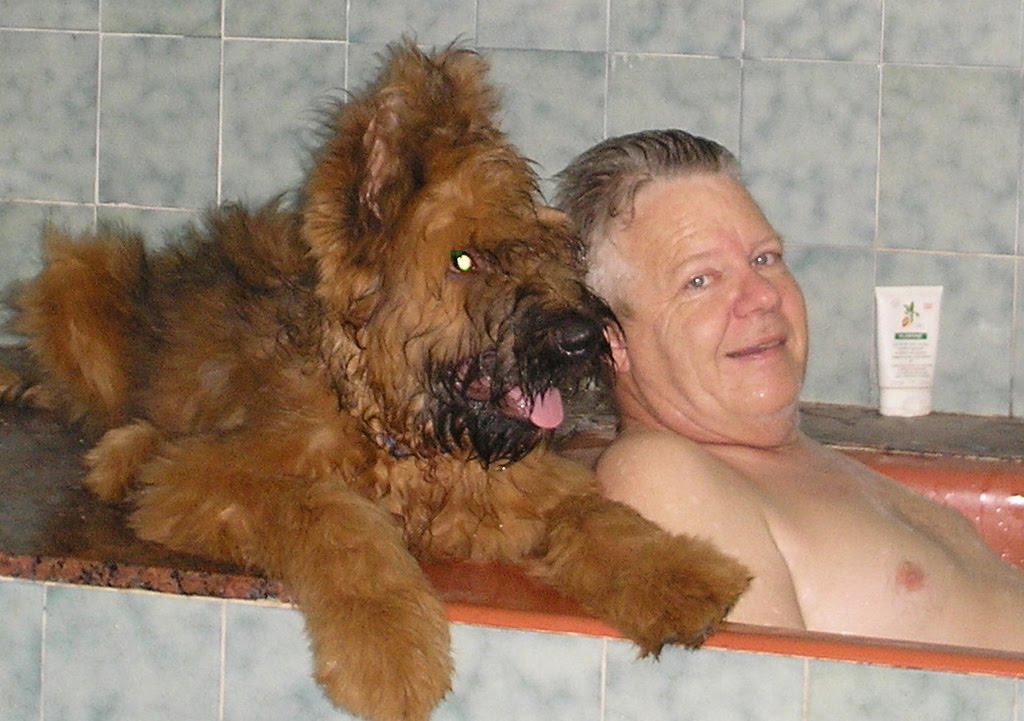
Throughout my life I have had a lot of fantastic dogs. Each one, with their own special character and personality. In one way or another they have all left a special imprint on my life. They have each been different from one another but each one added something to my life. They all had tricks and words that they knew but I had never had a dog with a sense of humor until I met Chico. He was very loyal and guarded the house and us. He had boundless energy and never ate one shoe or piece of furniture in his life. He had a toy-box under the bed and you could ask him to choose one and he would always get the right one out. He loved soft squeaky ones and he never destroyed them, after playing he would always put it back in the toy-box. He never ate or lost one toy from the day we got him. He was a Briard that Lenox bought for me as an anniversary and birthday present. His real name was Hychyko de Dasilva because we had a few minutes to come up with a name that started with H. That is how the breeder kept track of each litter of puppies. The reason I chose Hychyco is because there is a wonderful girl in Belgium called Caroline that trains dogs for the disabled and her association is called Haichicko. I couldn’t think of a better name. Caroline came to Spain several times to help ANIMO show what service dogs can do.

I wanted to spell it the same way she did but the breeder preferred the ys. It sounded the same and had great meaning for me as I thought how much these dogs help us in our daily lives. A Briard is a French sheepdog with long silky hair and not much of an under-coat so they don’t really shed or get there hair in knots. The hair hangs over their eyes and their ears are up and round with long hair hanging over them. Their back feet turn slightly out making them look like a ballerina. They run like rabbits with both back feet together and have the extra toe which for some reason is so important in a sheepdog. Chico died unexpectedly last night; we sat with him and talked to him until he passed away. I hope our voices helped him. I will miss Chico very much, especially his companionship. He was a funny dog but beautiful and well behaved. Maybe one day I will get another puppy because he is the second Briard I have had and as a breed they have really stolen my heart. The only dog that comes close for me is an Irish Wolfhound.
I have found a few cute pictures that can let you see what of character he was. He loved the water. He would be in the pool first thing every morning when you let him out and in the bath with you if he could.