Thursday, February 24, 2011

Horse and Wine Fair

The VII Almería Horse and Wine Fair, the Feria de Caballo y Vino, takes place this year in Almería at the Olympic Stadium from April 28th to May 2nd. There will be a large number of related stands, plus competitions, shows and spectacle! We were at the presentation of this year's poster and were treated to a video of last year's show, which included flamenco dancing and fashion, exhibitions of classical dressage and doma vaquera and the presence of the Royal Riding Academy. The only type of horse at this feria is the Pura Raza Española - a wonderful and beautiful horse. The feria is organised once again by Francisco de Aguilar from the Asociación Almeriense de los Criadores de la Pura Raza Española.

El VII Feria de Caballo y el Vino de Almería se lleva a cabo este año en Almería en el Estadio Olímpico desde el 28 de abril hasta el 2 de mayo. Habrá un gran número de stands, además de concursos y espectáculos. Estuvimos en la presentación del cartel de este año y vimos un vídeo del espectáculo del año pasado, que incluyó baile y la moda, exhibiciones de doma clásica y vaquera y la presencia de la Real Academia de Equitación. El único tipo de caballo en esta feria es la Pura Raza Española - un caballo maravilloso y hermoso conocido por su tranquilidad y buen caracter. La feria está organizada una vez más por Francisco de aguilar de la Asociación Almeriensede los Criadores de la Pura Raza Española.

Friday, February 04, 2011

Courage

As I look at Ken’s close up video-clip of ‘Barbara’, which is posted below, I find it a bit hard to accept that I have been so physically deformed, then I felt proud of myself for coming out of hiding and getting on with my life under these circumstances. I realize that none of this would have been possible if it hadn’t been for the tremendous support, encouragement and loving friendship being constantly sent my way by friends and family. I would like to take this chance to thank all of you for remembering whom I am inside and keeping me so positive and active. I think I have been able to achieve more in the last few years than I have in a long time. It is a wonderful feeling to know that I have so many people who love and care for me, so I will keep fighting this dreadful virus so that I may continue to be a wife, mother, grandmother, and friend to all of you who mean so much to me.

Thank you all, Barbara

Tuesday, February 01, 2011

The Walk, Eat and Drink Trio

I am off to Madrid to see the eye surgeon about my upcoming operation and my friends Ken and Sarah have kindly offered to keep me company on the trip. They have never been to Madrid so I will be able to show them some of the real Spain, unlike the coastal tourist areas. Mojácar Pueblo used to be one of the true wonders of Spain, but every day they take down another beautiful piece of history and they build endless rabbit hutches on the beach. Madrid is full of wonders, but the best part is to just walk and try the fantastic tapas and drinks in some of the oldest bars in Spain. I think one tapa would probably do for the three of us, since between us, big meals are not the order of the day. However we are going to have a great time and I will show them places that most tourists never get to see. I would like to say here a special thanks to Ken and Sarah as they have become such close friends and have helped so much on the ANIMO-ALBERO program. Ken has done all of the photography and Sarah has done all of the lay out and documentation of our progress. They make sure that I get to Loli’s at least once a week because they have seen, first hand, the enormous benefit to my health. They had no idea what they were getting themselves in for the first time they offered to drive me to my riding therapy, but since the first session they have become ‘ANIMO Fan Nº1’. Ken has documented and made videos of my therapy sessions and they have helped with the content of my book Health Through Horses.

Saturday, January 22, 2011

Continuing Investigation Animo-Albero

Since we are still experimenting and learning new benefits that the horse can offer to terminally ill people and people taking toxic medication or coming off cancer treatment and especially with circulation or digestive tract problems, we are keeping careful records of the time ridden and the effect it has on health and blood analysis. We are documenting sessions with both video and written information to discover why some sessions go well and have great lasting effect and some classes do not go so well if the person is too weak. So far we have found the anaemia is the main cause for the weakness and causing a poor lesson, even though there are still many benefits gained. Never push your student if they are tired or weak. We have discovered that a good gallop on the beach or a trail-ride or a lesson in the ring, do not begin to give the same benefits as working on the lunge-line. Usually you can see an improvement in just the first five minutes, in the energy level and feeling of well-being. It is a day or so later that you see the disappearance of red blotches on the skin, improvement in healing of skin grafts and scars. It has come to the attention of the doctor that we are working with, that the ANIMO-ALBERO therapy program somehow seems to do the work for dysfunctional kidneys, eliminating the elements that the kidney is unable to do on its own, thereby also removing the painful side-effects of things like high potassium levels. It also seems to kick start the heart and put it back into normal rhythm and taking it out of an arrhythmic state. The more you ride the longer the effects last. Two to three times a week seems to be the right amount of times to ride for the optimal results and unfortunately if you go a few weeks without riding you do find some of your symptoms starting to return, but you improve immediately as soon as you start riding on a regular basis. The sessions should be between half an hour to an hour. Besides the immediate increased energy level and feeling of well-being one of the great things is the clarity of mind that it gives. When you do not feel well or are on heavy medication you tend to feel a bit confused or foggy and have a hard time concentrating but after one session your mind is totally clear. Most students feel too tired or not in the mood to make the effort to go to their therapy session but once there, they change into a new person, and are so glad that they went, so it is important that you try and encourage them to go because the benefits may save their lives or at least give them a good quality of life without pain for a little while which makes all the difference in trying to lead a normal life with a terminal illness.

Tuesday, January 18, 2011

Odds and Ends

I have received my permission to go to Madrid for my eye operation; they will also be doing biopsies and an exploratory to see if they can find the virus. This is all very positive and the examinations will be during the first week of February, the operation soon after.
On the continuing investigation in the ANIMO-Albero therapy program, we have discovered that many of the benefits that at first we thought were short-term have become long-term, the longer I continue the program, such as heart rhythm and the disappearance of red blotches on the skin, from vasculitis.
After we just started to get grants for these types of alternative therapies, the EU will ban all types of alternative medicine, both practice and herbal, from April of this year. Anything where there is no profit to the pharmacies, FDA or the medical community. This is something I don’t understand and will have to investigate further to keep you informed.
Our manual on the Basics of Therapeutic Riding is just about ready to go to press; it is in Spanish, since there is such a demand for this information in Spanish speaking countries. The manual covers everything you should know before starting up a therapeutic riding center, including all of the forms necessary, games, exercises, how to choose the right horse, first aid and much more.
Yesterday I was too weak and felt a bit dizzy so my class didn’t go very well but I still got some benefits and I feel much better today. Never push your student if they feel tired or weak it can just do damage and even undo some of the good work already done. I am sure my next class will be better.
For any of you that have seen the YouTube videos and don’t understand them, it is just one of my sessions that I thought you might enjoy but I realized that they are very boring if you don’t understand what I am doing and why. The benefits being, better blood circulation, more lung capacity, more energy, healing of scars and removing blotches from vasculitis, more stable heart beat, lowering of levels like potassium and creatina and triglycerides, massage to the organs, improved digestion, increased appetite, lower stress levels and depression. My heart has been weakened by this virus and I can’t do anything like walking or house cleaning for more than about ten minutes without stopping for a rest but I can easily do an hour’s session on the horse and I feel more energetic. The reason for this is that the horse does all of the work and you get the benefits. This program also helps to get rid of the side effects of toxic drug treatment and so many more things. For over a year I had to go to the hospital every three weeks to drain my tear ducts and one day after riding they drained themselves and I have never had to go back to have them drained. That was a benefit I had never even considered. If you haven’t seen the videos on YouTube you can find them in the article below this one.

Sunday, January 09, 2011

Hospital Christmas

Having spent the last three weeks taking care of my mother in the hospital, I haven’t had a chance to go riding or to see my puppy. Before my mother took ill I had been riding twice a week and with no medication I got my blood levels down to within normal range except creatina, which was close to normal. In all, a complete surprise to the medics. Now that I haven’t been riding I can feel all of my levels rising. This week I will start riding twice a week and see if I can live a happy, pain-free life for a while. It was very sweet that my riding instructor (and friend) Loli and her son came to visit in the hospital and brought me a Christmas basket full of my favorite foods, which was great, as I couldn’t leave my mother alone; even to go for a coffee. I am back at home now and will continue with my investigation. I hope to be writing some fun and interesting stories in the near future so don’t think that I have given up, it is quite the opposite. I want to thank my husband for sending in my hospital bear and a cute, “come home soon, I miss you”, card. I have been waiting to hear since the beginning of September when I can go and have my operation on my eyes as they are being destroyed again be the virus. I have also asked for a nutritional supplement as it is getting harder to eat; and after several inspections and blood analyses I still haven’t heard whether I am eligible to receive them. Not very speedy service from the regional health authority! What I am able to eat is getting limited.

In the meantime I will ride and stay as healthy and positive as possible. Happy New Year to all my readers. Don’t forget, AAT works.

Monday, November 29, 2010

ANIMO: National Association for the study and investigation in all types of Animal Assisted Therapy

The ANIMO center ran for almost twenty years with a farm school, hippotherapy for severely disabled children, wild native animal park, classes in sign language, training of assistance dogs, many international conferences with guest speakers from around the globe, courses in therapeutic riding. We introduced the idea of taking animals to homes for the elderly and to hospitals; Spain is still a little reluctant to start that. ANIMO stayed within the international guide lines even though they are not required in Spain yet. Our latest project is the ANIMO-ALBERO project. ANIMO-ALBERO is a revolutionary new program to help people with terminal illness, heart problems or suffering the effects of toxic drug treatment, incorporating the movement of the horse to achieve outstanding benefits to the patient. Some of the information is included in my blog below but we are keeping analysis records and charting progress as well as what we do and for how long. It is an ongoing investigation but has already helped me, where no medical system seemed to be able. I am writing a book covering our program, my illness plus an entertaining view into the Spanish health system, called Health Through Horses. I hope to have a little more information before going to press.
Here are some people who helped get ANIMO off the ground by sharing their knowledge and talent with us and showing Spain just what is available world-wide:

PEOPLE THAT HELPED ANIMO TO SHOW THE BENEFITS OF AAT:
Miguel Ríos - Famous Rock Star gave a benefit concert with a group of children accompanying him in sign language.
Padre Angel - Mensajeros de La Paz, came to ANIMO to learn how to train dogs for the elderly.
International Conferences: Guest Speakers
Susan Duncan - The Delta Society: came to speak with her dog Joe
Sandra Stone
- CHATA; animals in hospital with children
Sister Chiara - RDA; International liaison
Joan Would - Hippotherapist, UK
Caroline Theinpont - HAICHIKO assistance dogs Belgium
Pedro Pablo Martín Lopesino - Director of the ONCE guide dogs, Spain
Miguel Gallardo - Sac Xiroi; Center for AAT and delinquents
Dr.René Garrigue - Handi-Cheval France
Francisco Limonche - Telefonica
The list goes on and I would like to thank every one of them for helping to make ANIMO a success.

Saturday, November 27, 2010

I Believe in Animal Assisted Therapy

It is a good thing I do, as well, since I have dedicated my life to it. I have been going on about the wonders of the horse and how it has been helping me cope with my illness, but it is not the only thing. All along, all of my animals have added so much to the quality of my life since I was a youngster. I always feel happy and fulfilled when in the company of animals. The responsibility you feel taking care of them, learning their psychology and how they think, their unselfish love that never ends, no matter how you feel; all in all they just bring a smile to your face and make you happy, besides all of the other benefits like companionship and stress relief. I was just telling my cousin, Lucia, how much I have been enjoying the full moon and wonderful warm nights because we have a new puppy and he needs to go out several times a night, so as not to have an accident in the house. He is a six week old Briard, and already wakes me to let me know when he wants to go out, he has figured out when the lights go out it is bed-time and only a few more minutes of play are acceptable. He is so expressive and seems to be able to communicate his every desire. Besides being my friend and companion, that makes me go outside to enjoy the world, I plan on teaching him to be a hearing dog for me. As soon as he has had all of his vaccines, I will start taking him everywhere, so that he can get socialized and learn to behave in public places. Even though hearing dogs don’t exist in Spain, I have trained them before and also have a license for him to be able to accompany me to restaurants and other public places during his training phase. Once he is trained, he should have all of the rights awarded to Seeing Eye dogs and other assistance dogs. I am very lucky because in the village where I live, the people are used to me bringing animals places, for training, so that they can make a difference in someone’s life. This puppy has already made a big difference in my life and I hope we will be able to have a long and bonding relationship with each other. His name is Raven and he is black with a little white tuft on his chest. Each dog has its own qualities and abilities. Once you figure out what they are then you can encourage these traits to help them become valuable assistance dogs. I wanted to train my Bearded Collie, Wilber, to be a hearing dog but he had no interest in sounds but in the end his strong point was working with people in wheelchairs and being able to pick things up, take things out of the fridge, he never did learn how to shut the refrigerator though. Also, he would know the names and be able to distinguish between groups of many objects - unless his ball was included in the group, when he’d go straight there. He could push the button to call the elevator and pick up the telephone receiver to give to you when it rang. He was at my side everywhere I went and had a tremendous vocabulary both spoken and in sign language, even though he never became a hearing dog.
Raven is only six weeks old, but already he shows a lot of promise and seems to be very bright. It is too early to start any type of formal training but they can learn so much if you talk to them and use the same words over. They learn through play at this stage because their attention span is short but it all goes into the making of a great dog later in life. It takes a lot of patience and time. You have to be able to dedicate your time to repeat and go over things they know while at the same time keep introducing new words and activities to their lives. By the time he is six months and ready for obedience training it should be relatively easy because he will already know and have practiced the basics. I will just have to wait and see where his strong points are as he grows up, it is no good trying to force them to learn something that they just aren’t good at or like. An assistance dog must be happy at his work and do it out of pleasure and love. Assistance dogs are very well adjusted and used to a change in environment while enjoying the constant companionship, that most family dogs miss out on because they usually have to stay at home, which is also a very important job. Every day now, Raven is surprising me with just how fast he catches on to things and finds his way around. He seems to remember from one day to the next, where things came from and where we go, he is also becoming a little more independent, being able to entertain himself for short periods because he knows where to find us. It rained last night and after his first quick trip out he decided to sleep through the night instead of going out again. I just love this little puppy.

These posters were made by Viv Snailham, a volunteer, supporter and great friend. Sadly, she has passed on and is, no doubt, leading programs for dogs and horses Elsewhere.

Monday, November 15, 2010

A Day at El Albero

On Saturday I went to El Albero with two friends, Ken and Sarah. Ken is a photographer so he got lots of photos of the wonderful things that go on there. We all had a great day with the animals and I did my therapy on Nora, with the help of Loli.
While we were there we got to watch two stallions play like something no one has ever seen before. Having been raised together as foals and then separated when they got older they have a huge unrequited love for each other, so when they sometimes get a chance to be turned out together, the antics never stop and it is spectacular to watch. One is a magnificent Friesian Stallion and the other a petite Moroccan donkey stallion, Ero and Pepe. See them play! Pepe is the proud father of little Bambi who is just too cute for words so I wanted to show you them with some of Ken’s pictures. Later we were entertained by Rad, the little Coatimundi, who duly managed to escape, allowing Ken to get some great shots of Loli on the roof with Rad. Later Ken entered Rad’s house to get some close ups of Loli and her little baby when it turned out that Rad had developed a crush on Ken and his camera. Ken has the battle scars to prove it. Besides the horses and donkeys – the main population – there are peacocks, pheasant, various strains of chickens and an ostrich. After visiting with the animals, and putting mercurochrome on Ken’s nose, we went down to a nearby beach-bar and had a tapa lunch. In all, we had a really great day and I feel so much better. I am forever grateful to Loli and her kindness and interest in getting me well, it is really helping.


Bambi


Loli with Rad

El Albero Centro Ecuestre, Los Partidores, La Cañada, Almería. Ph 699762339 (Español)

Sunday, November 14, 2010

El Caballo de Mis Sueños

This is the horse of my dreams. He is a Friesian stallion called Ero.

ANIMO- Asociación Nacional de Investigación MOjácar

Since I am the president of the non-profit, animal assisted therapy and investigative association, I am going to put it to work, but this time to help me and millions of other people that could benefit from the program I am still developing. Every day I discover new ways to improve my quality of life and make living with a terminal disease bearable. If I can’t kill the disease at least I can make what time I have as happy and pain-free as possible. Since I have seen the effects and the benefits that I receive I know I can help other people to live a more fruitful life under difficult and frightening circumstances. I am going to try and get the provincial TV to come and make a documentary on Loli’s and my program. I don’t want all of this to go unknown. I know it is very revolutionary and people won’t believe it, but I have experienced it and benefited from it, giving myself a few extra years of good quality life, which I wouldn’t have had without it. First I would like to say something about organ donors. I have been one since I got my first drivers license in California. It has always been something that I have felt very strongly about. I know that it goes against the feelings and beliefs of many people, but for those that are willing to be a donor it is important that you have a living will. Indeed, in California, this useful document can be on the back of your license. That way in case of accident the hospitals will know that you are a donor, or with an official living will like I have, then if you go to the hospital a little red flag comes up on the computer stating that you are a donor and what you want done with your remains. A living will also makes clear your wishes of whether or not you would want to be kept alive on machinery or not, that way saving many family traumas in case of coma or a vegetative state. There are many different options to choose from and they all go to help other people that may be suffering and you can change their lives. I never thought that I would be on the receiving end but after being blind for a year, I received an eye transplant from a donor and now have sight again. Without the help of this Good Samaritan, who thought in advance to make their wishes known in case of their death, I would still be blind today. I am very grateful and more than ever want to raise awareness of the benefits of being a donor. Please consider it.

Benefits of the ANIMO-ALBERO therapeutic riding program:
We have already discovered many benefits which I will list but I know we will find many more before we are finished, it is an ongoing investigation.
1. Feeling of well being.
2. Improved circulation.
3. Oxygenated blood flow to the extremities.
4. Massage to all of the organs which helps correct problems like to much potassium, triglycerides, urea, all of which cause pain in the bones and muscles.
5. Improved functioning of the digestive tract.
6. Reduction in ‘purpuras’ or red blotches caused by vasculitis.
7. Elimination of toxins in the blood stream and their side effects.
8. Clearing of fluids from the lungs.
9. Strengthening of muscles and muscle tone.
10. Reduction in medication needed.
11. Increased appetite.
12. Increased energy level.
13. Aides in stopping arrhythmia.
14. Improved balance and posture.
15. Helps to heal wounds.
16. Increases lung capacity.
17. Puts you in shape for pre- and post operations, speeds up recovery time.
18. Reduces tiredness and weakness.
19. Helps the body absorb and use iron for those people with anaemia.
20. Cures insomnia or at least makes a huge difference.

These are just of the things we have found out so far that really work. The horse does the work and you get the benefit, thereby not putting any stress on the heart. There is no need for prior experience.

Animo-Albero


THE ANIMO-ALBERO PROJECT:
The therapeutic riding program, ANIMO-ALBERO has been designed, investigated, studied and practiced by Barbara Napier, the president of ANIMO and Loli Berenguel Gálvez owner of El Albero, together with the help of a few members of the medical community.
The ANIMO-ALBERO Project is an investigation still in progress. With over fifty years experience in Animal Assisted Therapy along with complete knowledge of the horse and the benefits it provides to people with disabilities, the ANIMO-ALBERO project is a revolutionary study into the medical benefits the horse can provide for people suffering from terminal illness, cardio-vascular problems, chemotherapy and radiation treatments, toxic medication and long term convalesce. Also in any lung or heart oriented problem that hinders the healing process or kidney and digestive tract problems. It helps to heal scars due to surgery and keeps implants and transplants healthy. In the ANIMO-ALBERO therapy program, the horse does the work and the patient receives the benefit without any stress to the heart. No prior experience in riding is needed. This program is ideal for pre and post operation preparation and recovery, as well as any problem that needs a good oxygenated blood flow to the organs, skin and extremities. The ANIMO-ALBERO therapy program is fun and easy to do. It has already provided so much information that can improve the quality of life of people suffering from any of the above mentioned problems. We have also found that this program has the ability to reduce the results of blood analysis, lowering levels of things such as potassium, triglycerides, creatine, and urea, while allowing the bloodstream to absorb and utilize iron, to lower cholesterol, reduce arrhythmia, while – unlike many medicines – maintaining other minerals so necessary to keep the body healthy. Other note-worthy benefits are: a feeling of well-being, more energy and relaxed muscles; at the same time reducing depression, anxiety and insomnia.
Even though the effects of the ANIMO-ALBERO therapeutic riding program are short-term, between six to thirty hours, it gives the body time to heal and recuperate, leading to a better quality of life with less pain and trauma to the person. After a lot of investigation and studying of results, we have determined that three times a week for between one half hour to an hour is ideal, keeping the body in shape throughout the whole week, hopefully leading to a termination of the existing problem. However, with practicing our program just once a week (for logistical reasons), the results are still very noticeable. Other benefits that have become apparent are improved muscle- and skin-tone, better balance, eye/hand coordination and mind clarity. All leading to a happier, healthier life style.

EL PROYECTO ANIMO-ALBERO:
El proyecto de hípica terapeutita, ANIMO-ALBERO ha sido diseñado, investigado, estudiado y practicado por Bárbara Napier, Presidenta de ÁNIMO, y Loli Berenguel Gálvez, dueña de centro El Albero, junto con la ayuda de algunos miembros de la comunidad medica.
El proyecto ANIMO-ALBERO es un investigación todavía en progreso. Con mas de cincuenta años de experiencia en Terapia Asistida por Animales y un conocimiento profundo y completo del caballo y los beneficios que da a personas con discapacidades, el proyecto ANIMO-ALBERO es un estudio revolucionario de los beneficios médicos que el caballo puede facilitar a personas sufriendo un enfermedad terminal, problemas cardiovascular, tratamientos de quimioterapia y radiación, medicación toxico y recuperaciones largas. También en cualquier problema del corazón o pulmón que impide el proceso de curación, la arritmia, o problemas de los riñones y sistema digestiva. Ayuda curar cicatrices de cirugía y mantiene injertos y transplantes sanos. En el programa terapéutica ANIMO-ALBERO, el caballo hace el trabajo mientras que el paciente recibe los beneficios sin ningún estrés al corazón ni experiencia previa. Este programa es ideal para ante y post operatorio preparación y recuperación, también cualquier problema que necesita una buena circulación de sangre oxigenada a los órganos, piel y extremidades. La programa terapéutica ANIMO-ALBERO es divertido y fácil en hacer. Ya nos ha dado tanta información que puede mejorar la calidad de vida sufriendo cualquier de los síntomas arriba escritos. También hemos encontrado que este programa tiene la habilidad en reducir los resultados de los análisis sanguíneos como potasio, triglicéridos, creatina y urea mientras que deja el cuerpo absorber y utilizar hierro, baja el nivel de colesterol mientras que mantiene los otros minerales tan necesarios para mantener el cuerpo sano. Otros beneficios notables son; sensación de bienestar, mas energía, relajación del los músculos al mismo tiempo reduciendo depresión, ansiedad y insomnio.
Aunque los efectos del programa terapéutica ANIMO-ALBERO son de corto plazo, entre seis y treinta horas, deja tiempo para que el cuerpo puede curarse y recuperar dando una cualidad de vida mejor con menos dolor y trauma. Después de mucho estudio y investigación en nuestros resultados, hemos llegado al conclusión de lo ideal seria hacerlo tres veces a la semana, en sesiones entre media hora y una hora, dejando el cuerpo con tiempo a recuperarse y renovarse con el motivo de recuperar el funcionamiento de los órganos. Llegando a un terminación del problema existente. Haciendo nuestro programa solo una vez a la semana (por razones logísticas), todavía da resultados impresionantes. Otros beneficios que hemos encontrado son el mejoramiento del tono de piel y los músculos, mejor equilibrio, coordinación entre ojo y mano y claridad del mente, todo llegando a una cualidad de vida sana y feliz.

Fotos: Ken Hogg

Thursday, November 11, 2010

Therapeutic Riding

There are many categories that fall under the term ‘Therapeutic Riding’, such as Sport, Education and Medicine. Then there is Hippotherapy which is a direct medical treatment incorporating the body and movement of the horse to acquire a benefit. Hippotherapy is usually used for students with severe physical disabilities and needs a professional to make and organize the class plan. Many students with severe movement impairment need the use of a back rider who sits behind the student to help keep them in the correct position and to help with the exercises desired by the physiotherapist. The back rider must be a competent rider and understand the disabilities of each student. Hippotherapy is often performed bareback or with a sheepskin to protect against rubbing which can be a big problem for many disabilities and if not done properly, can aggravate the problem and could even lead to amputation. The benefits of any kind of therapeutic riding are many, from improved circulation, the massage of atrophied limbs to massage of internal organs, a sense of caring for another being when you are used to always being the cared for, the freedom of movement and, finally, the elegance of the gait which is impossible to achieve by traditional therapies on the ground. Almost all students achieve a feeling of well-being and a joy in looking down at their surroundings for once rather than their usual ‘up at everything’. They also get the chance to cover terrain that is normally off limits to them. Just the action of sitting on a horse at a walk without doing any specific exercise can provide many of these advantages.

In hippotherapy, unlike the other forms of therapeutic riding, the rider never learns to ride or indeed ever takes control of the horse. The horse emulates the walking movement of the human gait and sends this message to the appropriate part of the rider’s brain so it is clearly important to have a horse with a good stride and in balance. The horse must also be calm and prepared for unusual noises and movements that the disabled person is likely to make. The preparation and exercise of the horse is one of the most important parts of any therapeutic riding whether it be sport or hippotherapy. Everything that will be done during a class must be practiced by the volunteers first, and practiced many times, until the horse is used to the movements and the objects used for the class such as toys, balls, rings and cups.

Before any type of therapeutic riding begins it is important to have a Doctor’s certificate to make sure there are no contraindications. The staff must be well prepared and have regular training sessions which help to prepare the horse as well. The equipment must be clean and sterilized as most disabled people are much more prone to infection. The sessions are usually boring to the horse as it is led around in circles and figure-eights with a leader and side-walkers and will stop at a stand for long periods. Therefore a good ride in the countryside or a good work-out prior to the session is very important so that the horse is calm.

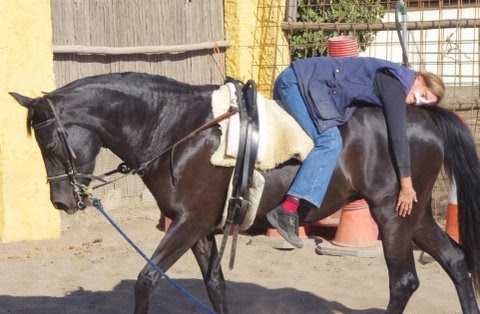
Exercises include things such as reaching for the ears, lying down either front wards or backwards in different positions depending on the desired effect, and face down hanging over the horse, which is used at the end of almost every lesson to help clear the lungs of the fluid which accumulates in people wheelchair bound.

Therapeutic riding has been practiced since the end if the First World War when it was used to help rehabilitate amputees. Many disabled people have gone on to competitions and even the Olympics. RDA (Riding for the Disabled Association) is the most common type of therapeutic riding and is practiced all over the world and almost anyone can participate and achieve great benefits. If you are interested in RDA, the Diamond Centre in England is the main centre for training courses. For information on worldwide therapeutic riding centres the FRDI in Australia (www.frdi.net) has a complete listing of all qualified centres and NARAH in the USA offers university and private course in all of the aspects of therapeutic riding including hippotherapy. Therapeutic riding is relatively new in Spain but is becoming increasingly popular, but please check with an official association, either national or international, before participating because there are a lot of cowboys out there who can do a lot of damage.

ANIMO ran in Southern Spain for fourteen years, as an official non profit organization, but started way before on an informal basis - all with no charge to students - and offered international conferences and courses. All staff including the doctor and physiotherapist plus forty some odd volunteers worked free of charge. We were financed by fund-raisers and by us personally. We worked on our land with our animals, nine horses, four donkeys and a whole array of farm and native wild animals. Most of the animals were abandoned or donated and hand raised by me, as a result they all got along well, could be handled by everyone and could be turned out into a large pen together, making it sort of like a petting zoo. Everything was accessable to all types of disabilities and was also used by the local school. Animo started way before its time and has had to stop practical operations due to lack of funding and official support, but still continues to give courses and information to groups trying to set up. ANIMO continues working in investigation and studies in AAT. Our children played a large role in every aspect of ANIMO from exercising the animals to interpreting conferences. Without our children and their friends, I don’t think it would have been possible for ANIMO to have so many students and animals, we would have had to work on a much smaller scale even with so many volunteers.

Barbara Napier
President of ANIMO

Wednesday, October 13, 2010

Conference Notes

The III Annual Conference on Animal Assisted Therapy in Almería came to a close on Sunday. There wasn’t a large turn out but the people there were all very enthusiastic about their programs and finding out more about other centers and ways that animals can help people in an urban environment. As I have mentioned before each group has its own philosophy and terminology, the important thing is that there is now a growing number of people interested in the way we can incorporate animals into our lives, especially those of the disabled. It mostly covered dogs, cats and horses, with a mixture of presentations on anything from service-dogs trained without food rewards to gooey dog-in-pound stories to hippotherapy to dolphin-therapy followed by a practical presentation from the Guardia Civil to demonstrate how dogs can help find anything from lost people to bombs and drugs, or even, apparently, counterfeit money. Go Rover!
Every day we find more ways in which animals can help us emotionally, physically and with chores we are unable to do because of an impairment of some kind. I was pleased, even though a little embarrassed, to be recognized and called from the audience to speak as the pioneer in this field here in Spain. I am not sure why Spain has been so slow in coming around to the idea since it has been so popular and beneficial in so many other countries for a very long time. My problem, with my center ANIMO, was that I started twenty years too early for Spain and they weren’t ready for the idea, they thought of me as some crazy American that wanted to put disabled people on horses or train dogs for deaf people or take animals into hospitals and residential homes for the elderly. The only program that was known and accepted was the ONCE dogs for the blind and even though they had tremendous backing and funding they were turning out very few dogs a year. If Mojácar had been a little more ahead of its time they would have realized that if we had gone with my plans twenty years ago we could have had one of the best and largest training facilities in Europe for all types of Animal Assisted Therapy which would have drawn a large international group for conferences and courses.
I mention all of this in my article on this blog called Mojácar’s Greed Cost them a Gold Mine. All in all I think it was a good conference and it let us all know what is happening in Almería in these fields, because there still seems to be a terrible lack of communication between groups or much level of practicality. At the end of the conference they didn’t even ask for people’s e-mails or names and addresses to contact them for the next event.

Tuesday, October 05, 2010

Working Pets

This weekend, there's a two-day seminar in Almería about 'Working Pets' or, more properly, El Papel de los Animales de Compañía en el Entorno Urbano. The seminar will examine how pets can help the elderly and the disabled through their companionship. Saturday 9th October from 5.00pm - 8.00pm and Sunday 9.30 - 1.00pm.
The seminar will be held at the Almería Museum (Crta. de Ronda, just up from the train station) and practical demonstrations with the Guardia Civil anti-drug dogs(Sunday 12.00 noon) will be held in the museum grounds. www.iealmerienses.es or write iea@dipalme.org

Thursday, September 30, 2010

Mojácar's Greed Cost Them a Gold Mine

Because of any lack of vision for the future of Mojácar and greediness to put money in their pockets at the moment, instead of thinking of the future gold-mine that lay ahead, Mojácar lost its chance to be one of the leading centers for Animal Assisted Therapy in Europe. Over twenty-five years ago I started, on my own, a farm school and petting zoo which I let the school use for free. Then I started the first AAT program in Spain providing Therapeutic Riding, farm school and native wildlife park. Four times we were donated land, ten hectares each time, only to have it taken away again after all the plans were drawn up and the projects financing granted. It was then used for something else, in two cases totally fictitious, only to get the grant money. I put on five international conferences, with speakers from various countries, and several courses including two for the University of Almería. When the head of the ONCE was at an international meeting for the disabled in Australia, he was speaking to the head of the local organization, who was explaining to him about AAT and all of the benefits and programs around the world, most of whom were at this conference; the head of the ONCE said it was a shame that Spain had no such program, only to be told that one of the best programs in Europe at the time was right here in Mojácar. I had actually met with the head of the ONCE several times to talk about my program but he obviously thought it wasn’t worth the bother. It was actually he who told me after he returned from the conference how embarrassed he was! The disabled organization in Almería (I won’t say ‘who’) actually helped me to get my paperwork and non-profit licence only to steal the grant when it finally arrived for the first training center in Europe for training dogs for the disabled, therapeutic riding and farm school.
It was not just a functioning center and educational place for the school-children but also a place for people to come from all over the world to learn how to work in these fields. The architectural plans actually included a covered riding ring with bleachers and a restaurant overlooking the ring plus stables where people could board their horses, petting zoo, a small veterinary clinic and emergency room, school with accredited teachers and a full course with degree in any of the branches of AAT. It would have been a place for the whole community and tourists to visit. The ring was designed so that it could be used for concerts or football games and may other events. All of the training of the animals and the classes for the disabled had its own separate area within the grounds.
We ran for almost fifteen year starting small until we had over forty students, all Spanish, severely physically disabled, and more than forty volunteers, almost all foreign, including a vet, doctor, physiotherapist and riding instructor and me as the coordinator, all on my own property with my own animals at no cost to the students and no help from the Town Hall. Now that it has become fashionable there are a lot of EU grants available and people without the slightest knowledge of what they are doing are starting up centers all over Spain. If Mojácar had only thought ahead a little we could have been the front-runners in this field for all of Europe and held International conferences to fill the hotels and students to come and study. I travelled all over Europe giving lectures and going to conferences representing Spain and was on the board of directors of the FRDI for four years, still Mojácar never helped. We trained five dogs to start with, to help people in wheelchairs and for the deaf, but had to drop the program due to lack of funds.
Money is available for grants, and there are even agents out there who will help organisations find this funding – for a flat 20%. It is no secret that a lot of ‘charity money’ ends up stolen, and even large and well-known organisations in Spain have been caught. It is almost considered ‘normal’ – so who on earth is going to help fund a group run by foreign residents?
Funding for a charity is key; but it’s also pretty hard to keep afloat if the national and local authorities won’t help.
We held quite a few fundraising events; with the only benefit to ANIMO was the money from the sale of drinks during the day. One such event was Burro Baseball. It was a huge success and the only place in Europe to hold such a game plus we did something to help honour the disappearing Spanish donkey. It was filmed on TV and it did not cost Mojácar one penny and could have put them on the map. We did it for seven years with the help of the American Naval Base at Rota, who provided all of the equipment every year and even one year they sent a bus of twenty-three marines to play against Mojácar. When we started to have a shortage of donkeys to play, Mojácar refused to help and the game was dropped. We also held the first pop concert with Spain’s most famous rock star, Miguel Rios, and a chorus accompanying in sign language which was also televised and Mojácar never paid any attention. Our politicians couldn’t see beyond the ends of their noses. Now it is too late: I had to stop due to lack of personal funding and bad health. I am now back in the game but helping others start their programs.

Wednesday, September 29, 2010

Riding Out My Illness

I know I have talked a lot about Loli and the wonders that have happened since I met her after giving my speech at the university. I don’t want to drone on unnecessarily but between us we have been working on a program to help me get stronger and to improve my health and it is working. I am writing a book about it called ‘Health Through Horses: a personal journey to recuperation, health and happiness’: The book will include a lot of personal things about my illness and some funny experiences but mostly it is about how Loli and I started to come up with a program that can help so many people recovering from cancer and other illnesses. So I will put here an excerpt from the book on some of my exercises.

MY SELF-HELP PROGRAM: HEALTH THROUGH HORSES

I decided that I couldn’t cure the virus (Note from Editor. Barbara’s virus remains unidentified after ten years) but I could make myself as strong and healthy as possible and knowing the power of the horse and what it can do, I decided to set up a program for myself using all of the knowledge I had learned over the years. With chronic kidney dysfunction and chronic anaemia, I was told they would just get worse and that my body didn’t absorb the iron I was taking in so I would have to inject myself every day. I was also told I would need to eat from a feeding tube for the rest of my life. None of these things were acceptable to me so I wanted to change things and make a difference in my own health.
I started riding at Loli’s once a week on the lunge-line, and in the ring, it soon became clear, I don’t know why, that riding on the lunge-line provided much more benefit. I think the reason being that I didn’t have to think about my reins or steering so all the concentration went into me, Loli was in charge of the horse and watching that my posture was correct. The benefit of riding bareback on the lunge-line is that you don’t need to have any previous experience. You have the sursingle to hold on to; someone in charge of the horse and you can go at your own speed. Start at the walk and when you feel comfortable then you can progress to the trot and so on. I have improved so much both mentally and physically and hope to continue through experimenting with more useful ideas.
I am still slightly anaemic but I don’t have to take iron and I don’t have to inject myself. My kidneys have improved by one point, which doesn’t seem much but really is a huge advancement because they were supposed to be getting worse not better. The side-effects of the steroids are almost non existent except for the continual hunger. My insomnia is finally easing up and letting me sleep a few nights a week. The most impressive result was that of my triglycerides - which turn fat into energy for your muscles. The highest you can go is 200 but mine was over 400 and after three weeks, of riding once a week, I now have my levels down just below 200 and it is still going down. I knew I had to keep a good flow of oxygenated blood running to all of my extremities, because at one point they were going to amputate my toes and the tips of my ears. All of this was avoided by getting a good blood-flow to my extremities; also through my heart and lungs so that was one of the first exercises I started to work on. It was important to help keep the new skin and implants from dying. I use a yoga breathing technique and stretching and opening my chest cavity. I also breathe from the abdomen instead of the chest. I do all of my exercises at the walk, trot and canter in both directions. I still can’t do some of them at the canter but each time I get closer. There are still some places I can’t reach in the stretches but I will get there. That is one of the wonders of this program, you don’t need previous experience and you go at your own pace, meanwhile, just sitting on the horse while it is walking is giving you benefits. After a long time in bed, especially hospital beds, which are known for being uncomfortable, I had a lot of muscle-pain and a bad and weak posture. That was one of the next things I worked on, by stretching above my head with a pole and doing push-ups on the horse’s withers. It will all become clearer when you see the pictures and get a full description of the exercises, now I am trying to tell you what and how I decided to work on different parts of my body. My kidneys bothered me so I had to find a way to strengthen my lower back and stretch my torso so there wouldn’t be so much pressure on them. I needed energy, most of that came from the canter with my arms spread out and my eyes shut. I had to be in a good frame of mind so as not to go into depressions every time I had to change my bandages or see myself in the mirror; I helped achieve this by getting back out into the world and helping other disabled people and the decision to stop dwelling on my own problems. I also had to work on my balance, since I am almost completely deaf, that included a lot of trot, stop, trot, stop plus a series of other things like around-the-world and riding backwards. I needed to build strength in my legs and build muscle-tone, so I put my hands on the rump of the horse and ‘did the bicycle’, foot circles and bringing my knees together and lowering them again. Between each set of exercises I would relax by putting my hands just behind my hips, resting on the horse and sit up straight at a good working walk. To relax my back muscles I lie down with my head on the rump and just go a few times around the ring. It is amazing what a great massage you get from that but you can’t do it at the trot or canter, at least I can’t. I do a lot of stretching, reaching from tail to ear and back again stretching way over my head. I spend about five minutes on each exercise in each direction at each pace. I found that I could isolate muscles that were bothering me by finding the right muscle on the horse and the right pace to make it work and it is incredible how when you get it just right everything just slips into place. Then I do some basic aerobics for fitness and energy. It is very important that your instructor makes sure your arms are at shoulder level when stretched out and that your hands are a shoulder’s-width apart when you work with a pole or other instrument. Always look between the horses ears with your head up even when you are doing twisting exercises to the sides. When I finish my workout, my muscles feel tired but good and relaxed and I have boundless energy and a fantastic positive feeling of well- being. I know I will always have moments of depression and wonder why this should have happened to me. There are times when I just want to give up but then I see all of the things I have to live for and it gives me a renewed strength to carry on. I know I am very lucky to have such a wonderful family and friends as a support group; I probably would have given up if not for them.
It has all been trial-and-error but now it is working well enough with me to get a few doctors interested and that is what we want in this field. I have seen over the last thirty years the benefits horses provide for the disabled but I never put much thought into illness and recovery. Since my illness I neither have the money or the strength to reopen my center ANIMO, but I am helping a few small centers around the area and giving a few speeches. Now, my main concern is to get better myself and if I can help other people in the process, so much the better.

Thursday, September 09, 2010

Little Boy Kitty Lost His Meow

Something fell out of the tree straight into my husband’s arms. When I asked him what it was, he took a look and said “a little boy kitty” and that is how he got his name. Little Boy Kitty was no normal kitten, he was completely black and tiny with the softest fur you have ever felt and he knew from that very second that he fell from the tree that Lenox and this house were his. He wandered around with all of the big dogs and other animals without a care in the world. He knew this was going to be home. As Little Boy Kitty began to grow he also began to speak, or meow, about and to everything and everyone he could find. He became particularly verbal at meal times especially if you were late, according to him. He would weave in and out between your feet, tripping you up and meow to the point that you felt like throwing him out of the door. When I say that he was no normal kitty, I meant it, he never just curled up in a ball and went to sleep or did any of the other things cats normally do, no, he had to stretch out on your chest with his arms wrapped around you like a big hug and he always put his chin right under yours and looked at you with these adorable eyes so you didn’t dare move him. There he would stay until you had to go to sleep, and that is when we finally started to put him out of the bedroom at night, so we could roll over and get some sleep ourselves. As he grew he became more and more verbal. When you would come home he would have to tell you all about his day and who had been mean to him and what bird he had tried to catch, all before you could get the groceries into the house. If we would go away for a few days, when we came home, it was hours of telling us everything that had happened. After a few years it really became quite annoying, his insisting on breakfast while you were in the middle of fixing it. He just never shut-up. Then one day he just lost his meow. He would open his mouth but no noise came out. He was waiting for me at the door as usual and was weaving in and out of my feet waiting for breakfast but there was no noise. I checked his throat and him but there was no meow. It was gone. We looked everywhere but it was nowhere to be found. It had been about a week and still no meow. One day when I went upstairs I saw, sitting next to me on the bed a huge, and I mean huge, bull gecko, one of our house-lizards that usually live behind the paintings. I didn’t want him to sit with me so I told him to shoo, very politely. He was so fat that he couldn’t hold on to the walls or ceiling anymore, without falling, splat onto the floor again, so he had to stay on the floor or bed. He had no intention of moving from his comfortable position on my bed so I became a little more insistent, when all of the sudden he just looked up at me in a deliberate way and said MEOW. WHAT A SHOCK! I came running down stairs to tell Lenox. So we finally found where Little Boy Kitty’s meow went to and to this day Little Boy Kitty still gives us hugs and is still trying to tell us about his day, but he is completely silent and fortunately I haven’t seen that big bull gecko again and I hope I never do.