Thursday, May 20, 2010
El Albero
Tuesday, April 27, 2010
A Talk at the University
During my recent speech at the University of Almería on the subject of hippotherapy, part of a larger course on sports therapy for the disabled, I showed a short film made in about 1998 which features a small girl called Sofia who suffered from cerebral palsy. She had no control of her head, arms or body. I always rode behind her to support her and help with her exercises. One of the exercises we would do was to try to get the student to touch the nose, this way he or she could try and find the center of their body. Small children do this automatically while playing, they grasp things in their hands and move it to their mouth, and this is the way they find the center of their body. Sofia was not able to do this exercise so we started by crossing her arms over her tummy, first both arms then one at a time. When she was able to complete this task on her own we worked on touching her nose with both hands together by raising them above her head then down to the nose or from the center of her tummy straight to the nose. Finally she was able to complete this on her own.
Another exercise we would do was to hold both of her upper arms and lean way back then lift her shoulders while sitting up into a straight position for her (I was still leaning fairly back, if I sat straight up she would be leaning forward and not learn the feeling of sitting upright and the weight of her head would drop down rounding her whole back and neck). This type of sit-up doesn’t only help them find their center, it also strengthens their neck and back muscles.
A man in the university audience asked me what benefit someone with no possibility to ever walk or do anything for herself would get from these exercises. I was glad he asked this because it helps show the difference between hippotherapy and other types of riding for the disabled. In hippotherapy the student almost never learns to ride but gets the benefit to their health from the exercises on a moving horse I explained that touching the nose may someday help her hold a cup or feed herself. During the other exercises, she was being stretched up, finding what was her center and opening and strengthening the chest so she could breath more easily, during the whole time she was doing these exercises on the horse at a walk she was receiving a massage to her muscles and organs, her circulation was made to work harder sending more blood to her extremities, brain and heart and her digestive system was working on its own. After each class she would be put face-down with her belly over the horse and be walked around for a few minutes while one of the side-walkers would pat her back with a cupped hand to remove fluid from the lungs. People in wheelchairs are unable to remove the liquid the way we do by just walking around.
Sofia is a very intelligent girl and very interested in ecology. She can’t speak but she says a lot with her facial expressions. At the end of these vigorous exercises we take a walk out in the country and go places she can’t go in her wheelchair so she gets to enjoy nature that is usually not available to her.
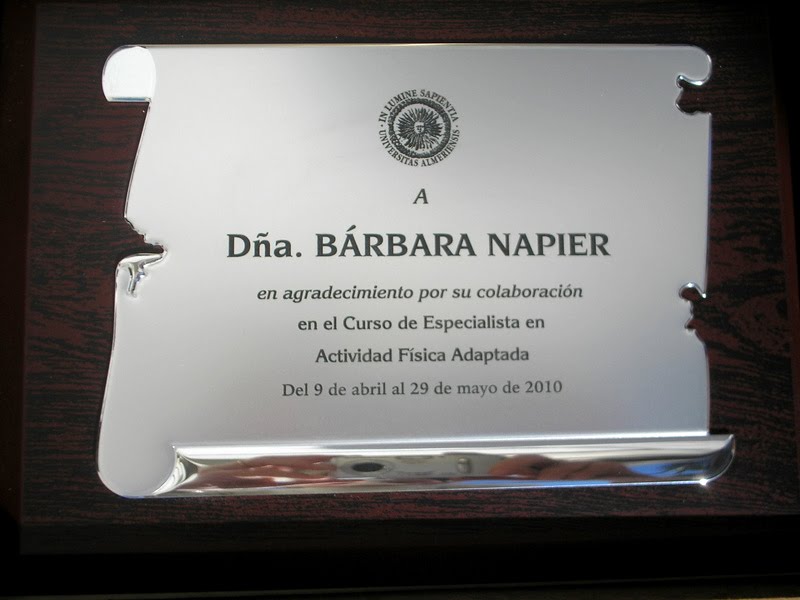
Here is a photograph of the plaque they gave me for my contribution in the field of hippotherapy and I am writing a chapter in their book on the subject because very little literature on this exists in Spanish. I am also planning on being their liaison between the international groups and new groups starting in Spain. They would like to start encouraging more conferences. Now that the medical community is taking an interest in the findings of the benefits of riding we might start making advances in studies and investigations.
Durante mi ponencia en La Universidad de Almería sobre La Hipoterapia, he enseñado una pequeña película con una niña con parálisis cerebral. Sofía no tiene control del tronco ni de sus brazos ó su cabeza. Yo montaba detrás de ella para dar suporte y mantener su posición.
Unos de los ejercicios que hemos hecho eran intentar tocar la nariz, para que ella pudiera encontrar su centro. Niños pequeños lo hace mientras que están jugando sin saber que están aprendiendo algo: todo se pone entre las dos manos y lo suben a la boca. Sofía no era capaz de cumplir este ejercicio, entonces hemos empezada cruzando sus brazos por la barriga, los dos brazos juntos hasta cuando lo ha logrado y después un lado tras otra. Una vez que lo había conseguido por si misma, hemos intentado tocar la nariz con las dos manos juntas. Al final ha conseguido hacerlo sola. Los otros ejercicios eran coger sus hombros y casi tumbada, subir nosotros y yo levantando sus brazos por arriba, y volver a tumbarnos. Solo hemos subido hasta que ella encontraba que era recto, yo todavía estaba bastante tumbada. Si hemos llegado hasta que yo estaba recta ella seria inclinada hacia delante y no puede suportar el peso de su cabeza y tampoco podía aprender donde esta la postura recta. Hemos repetido este ejercicio muchas veces.
Este forma de “abdominales” no solo la ayuda encontrarse recta pero también dar fuerza a los músculos de la espalda y cuello.
Un señor me preguntaba que beneficio tiene todo aquello para una niña que no puede hacer nada por si misma. Estuve contenta para recibir esta pregunta ya que demuestra la diferencia entre la hipoterapia y otros tipos de equinoterapias. En la primera, el jinete casi nunca aprende lo que es "montar a caballo" en sí, pero sí saque el beneficio fisiológico de estar sentado en un caballo andando. He explicado que el ejercicio de tocar la nariz es para que un día al lo mejor podría poner un vaso a su boca o comer por si misma. Durante los otros ejercicios, ella estaba encontrando el centro de su cuerpo, cuando su cuerpo estaba estirada durante el ejercicio, su pecho abría para tener mejor respiración, durante todo el tiempo que el caballo estaba andando, ella estaba recibiendo un masaje a sus músculos y órganos, un efecto así como recibimos cuando nosotros estamos paseando, su sistema digestiva estaba funcionando y su sistema circulatorio tenia que trabajar para irrigar sus extremidades, su cerebro, corazón y el resto de su cuerpo. Ellos no pueden hacer esto en silla de ruedas ni tumbada. Después de la clase, ella hacia “jinete muerto” donde colgaba boca-abajo con su barriga encima del lomo del caballo mientras que uno de los laterales la pegue en la espalda con mano hueca. No la pega fuerte solo bastante para quitar el liquido que se acumula en los pulmones que ellos mismos no pueden evacuar. Sofía es una niña muy inteligente y con mucho interés en ecología. No puede hablar pero su cara dice mucho. Después de la clase fuerte hacemos un paseo por el campo donde ella pude ver cosas que son inaccesibles a ella desde su silla.
Aquí hay una foto de la placa que me regalaron por mi trabajo y voy a hacer un capitulo en su libro sobre este tema. Voy a intentar ser el enlace entre los grupos internacionales y los grupos empezando aquí en España. Ya por que el mundo medico está cogiendo interés en los beneficios que el caballo puede dar, a lo mejor podemos empezar a tener estudios e investigaciones sobre los beneficios.
A man in the university audience asked me what benefit someone with no possibility to ever walk or do anything for herself would get from these exercises. I was glad he asked this because it helps show the difference between hippotherapy and other types of riding for the disabled. In hippotherapy the student almost never learns to ride but gets the benefit to their health from the exercises on a moving horse I explained that touching the nose may someday help her hold a cup or feed herself. During the other exercises, she was being stretched up, finding what was her center and opening and strengthening the chest so she could breath more easily, during the whole time she was doing these exercises on the horse at a walk she was receiving a massage to her muscles and organs, her circulation was made to work harder sending more blood to her extremities, brain and heart and her digestive system was working on its own. After each class she would be put face-down with her belly over the horse and be walked around for a few minutes while one of the side-walkers would pat her back with a cupped hand to remove fluid from the lungs. People in wheelchairs are unable to remove the liquid the way we do by just walking around.
Sofia is a very intelligent girl and very interested in ecology. She can’t speak but she says a lot with her facial expressions. At the end of these vigorous exercises we take a walk out in the country and go places she can’t go in her wheelchair so she gets to enjoy nature that is usually not available to her.
Here is a photograph of the plaque they gave me for my contribution in the field of hippotherapy and I am writing a chapter in their book on the subject because very little literature on this exists in Spanish. I am also planning on being their liaison between the international groups and new groups starting in Spain. They would like to start encouraging more conferences. Now that the medical community is taking an interest in the findings of the benefits of riding we might start making advances in studies and investigations.
Durante mi ponencia en La Universidad de Almería sobre La Hipoterapia, he enseñado una pequeña película con una niña con parálisis cerebral. Sofía no tiene control del tronco ni de sus brazos ó su cabeza. Yo montaba detrás de ella para dar suporte y mantener su posición.
Este forma de “abdominales” no solo la ayuda encontrarse recta pero también dar fuerza a los músculos de la espalda y cuello.
Un señor me preguntaba que beneficio tiene todo aquello para una niña que no puede hacer nada por si misma. Estuve contenta para recibir esta pregunta ya que demuestra la diferencia entre la hipoterapia y otros tipos de equinoterapias. En la primera, el jinete casi nunca aprende lo que es "montar a caballo" en sí, pero sí saque el beneficio fisiológico de estar sentado en un caballo andando. He explicado que el ejercicio de tocar la nariz es para que un día al lo mejor podría poner un vaso a su boca o comer por si misma. Durante los otros ejercicios, ella estaba encontrando el centro de su cuerpo, cuando su cuerpo estaba estirada durante el ejercicio, su pecho abría para tener mejor respiración, durante todo el tiempo que el caballo estaba andando, ella estaba recibiendo un masaje a sus músculos y órganos, un efecto así como recibimos cuando nosotros estamos paseando, su sistema digestiva estaba funcionando y su sistema circulatorio tenia que trabajar para irrigar sus extremidades, su cerebro, corazón y el resto de su cuerpo. Ellos no pueden hacer esto en silla de ruedas ni tumbada. Después de la clase, ella hacia “jinete muerto” donde colgaba boca-abajo con su barriga encima del lomo del caballo mientras que uno de los laterales la pegue en la espalda con mano hueca. No la pega fuerte solo bastante para quitar el liquido que se acumula en los pulmones que ellos mismos no pueden evacuar. Sofía es una niña muy inteligente y con mucho interés en ecología. No puede hablar pero su cara dice mucho. Después de la clase fuerte hacemos un paseo por el campo donde ella pude ver cosas que son inaccesibles a ella desde su silla.
Aquí hay una foto de la placa que me regalaron por mi trabajo y voy a hacer un capitulo en su libro sobre este tema. Voy a intentar ser el enlace entre los grupos internacionales y los grupos empezando aquí en España. Ya por que el mundo medico está cogiendo interés en los beneficios que el caballo puede dar, a lo mejor podemos empezar a tener estudios e investigaciones sobre los beneficios.
Monday, April 05, 2010
The Bunny-pig (New to Science)
We always had long haired guinea-pigs and they lived in a cage together with a big white male rabbit, Eccles, who was obviously in love with Mrs. Ingypig. They all lived together quite happily for several years and produced lots of baby guinea-pigs. The interesting thing about guinea-pigs is that they are born like popcorn. They just pop out and are miniature guinea-pigs ready to eat and everything. The mother has to take no care of them, whereas rabbits on the other hand are born with their eyes shut and no hair and in a sack that the mother has to remove. They need to nurse for several weeks, needing the mother’s full attention. One day the male guinea-pig died, leaving the rabbit and Mrs. Ingypig alone (at last!). They lived happily together for about a year when one morning I went out to feed them and found Mrs. Ingypig dead with three babies in sacks with their eyes closed and way to big for her to give birth to and a fourth half way born. I think it is scientifically impossi
ble to cross a rabbit with a guinea-pig but it happened. If it had been the other way around they may have survived because a female rabbit would be big enough and would know how to care for the young, whereas the guinea-pig had no idea how to take off the sacks and nurse plus they were way too big for her body. Later we tried putting a male guinea-pig with a female rabbit for several years but there was no chemistry between them and that was the end of the bunny-pig. We almost had a new breed of animal but the circumstances never were right again. Friday, March 26, 2010
Charity
Charity can mean many things to many people. Charity means to give or help with no thought of reward. The gratification is in the giving. It can be as little as giving a beggar a dime or sponsoring abandoned animals, helping the Red Cross or any other NGO. Charity can mean spending time with an old person or volunteering at a children’s centre. Giving of your time and/or money to disaster relief groups is another good way to help. There are hundreds of associations in your community and starving or abused children all over the world. There are also the veteran’s charities, helping them find jobs or giving psychiatric work to help them over the traumas of war. Everywhere you look there is someone or some group that desperately needs your help. Give what you can whether it is time or money. The meaning of charity disappears if you go around telling people how much you gave or if you expect people to be impressed with your achievement. Just give from your heart and if you are a good person people will know, you don’t have to advertise it.
It is nice to help in your local community but there are a lot of countries where disaster has struck either by force of nature or war; these people are just as needy. Some of us have money and some don’t but everyone can find a few minutes in their day to give to a charity. The reason I am mentioning this subject is because I have seen so many articles printed about people bragging about how much money they have given or what they have done. In my opinion this behaviour takes away from the meaning of charity and is just boasting.
Wednesday, March 24, 2010
Chico

I wanted to spell it the same way she did but the breeder preferred the ys. It sounded the same and had great meaning for me as I thought how much these dogs help us in our daily lives. A Briard is a French sheepdog with long silky hair and not much of an under-coat so they don’t really shed or get there hair in knots. The hair hangs over their eyes and their ears are up and round with long hair hanging over them. Their back feet turn slightly out making them look like a ballerina. They run like rabbits with both back feet together and have the extra toe which for some reason is so import
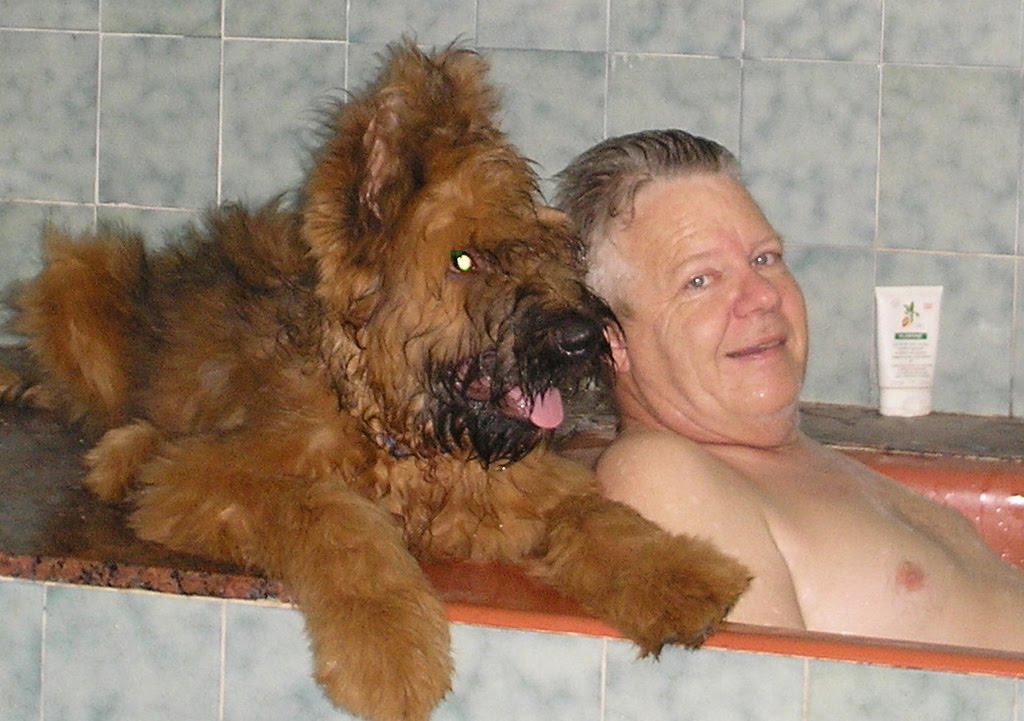
I have found a few cute pictures that can let you see what of character he was. He loved the water. He would be in the pool first thing every morning when you let him out and in the bath with you if he could.
Saturday, March 13, 2010
Cruelty to Animals
We have all seen a lot of cruelty to animals here over the years. I have written about many instances of my children bringing home boxes of puppies thrown out of car windows and puppies put in plastic bags to suffocate, dogs chained to a barrel and not fed or cared for, donkeys carrying loads that are too heavy with no food or water, hanging grey hounds from trees by their neck and the list goes on. The worst of these atrocities, I think, that I have witnessed here, was a box of puppies abandoned in a parking lot. The local children aged about six had cut off their toes and noses with a razor blade and were driving them around the parking lot like little trucks, removing their stomachs in the process. I stopped the boys and collected the puppies.
Here is a picture of one of the puppies with no toes or nose. Because I already had a box of abandoned puppies that were thrown over the bridge I knew I couldn’t take all of them so I went to all the neighbors to ask for help. One restaurant owner said he would take two and I kept the other two. When they were old enough I found good homes for them along with the eight puppies from the box. It takes dedication, money and lots of time to bottle-feed so many animals not to mention the kitten that was left in our driveway which we still have. I am very pleased that we were able to place so many animals but the cruelty or lack of education is astounding even though the education is slowly and reluctantly improving. When I lived in the village the local sport for young boys was to take a piece of bamboo and put a nail on the end and poke the eyes out of the cats. The parents actually seemed proud of Junior for his achievement. Another gem was to wire the animals up with a coat hanger in some imaginative way.
I am glad that animal awareness has improved since I came here because we don’t see so much of the cruelty any more. They still abandon the puppies and kittens though and that goes for the English as well as the Spanish. Because I had so many animals the people, with a conscience, seemed to think that if they dumped the unwanted pets in my driveway they would be taken care of, and they were; but you reach a point where you can’t take any more or find good homes for them and the price of worming and vaccinations makes it impossible these days. I take in way fewer strays than I used to and I guess I have gotten a little harder in my way of thinking. An animal needs lots of love and care but you can only have so many and I have reached my limit.
Here is a picture of one of the puppies with no toes or nose. Because I already had a box of abandoned puppies that were thrown over the bridge I knew I couldn’t take all of them so I went to all the neighbors to ask for help. One restaurant owner said he would take two and I kept the other two. When they were old enough I found good homes for them along with the eight puppies from the box. It takes dedication, money and lots of time to bottle-feed so many animals not to mention the kitten that was left in our driveway which we still have. I am very pleased that we were able to place so many animals but the cruelty or lack of education is astounding even though the education is slowly and reluctantly improving. When I lived in the village the local sport for young boys was to take a piece of bamboo and put a nail on the end and poke the eyes out of the cats. The parents actually seemed proud of Junior for his achievement. Another gem was to wire the animals up with a coat hanger in some imaginative way.I am glad that animal awareness has improved since I came here because we don’t see so much of the cruelty any more. They still abandon the puppies and kittens though and that goes for the English as well as the Spanish. Because I had so many animals the people, with a conscience, seemed to think that if they dumped the unwanted pets in my driveway they would be taken care of, and they were; but you reach a point where you can’t take any more or find good homes for them and the price of worming and vaccinations makes it impossible these days. I take in way fewer strays than I used to and I guess I have gotten a little harder in my way of thinking. An animal needs lots of love and care but you can only have so many and I have reached my limit.
Friday, February 26, 2010
Animo on YouTube
This is a little example of how to prepare a horse for therapeutic riding and a few exercises done by some of our disabled students. The service dogs are from England and show a few ways in which dogs can help us. There are so many different aspects and benefits from Animal Assisted Therapy. The video comes from various sessions held in Mojácar in the late nineties and start with ‘warm-up exercises’ with our kids helping out. Later we see several students, a doctor who wanted to see the effects of hippotherapy for himself, several side-walkers and leaders and our ramp. There’s just music accompaniment here as Amber was using this for a seminar she gave in 2004. The last bit is to do with handi-dogs and comes from a colleague in England.
While this video is no great shakes, we did win a prize with another one – and when we can locate a decent copy, we’ll post it on YouTube as well.
Wednesday, February 24, 2010
Therapeutic Riding
(From the archives)
There are many categories that fall under the term ‘Therapeutic Riding’, such as Sport, Education and Medicine. Then there is Hippotherapy which is a direct medical treatment incorporating the body and movement of the horse to acquire a benefit. Hippotherapy is usually used for students with severe physical disabilities and needs a professional to make and organize the class plan. Many students with severe movement impairment need the use of a back rider who sits behind the student to help keep them in the correct position and to help with the exercises desired by the physiotherapist. The back rider must be a competent rider and understand the disabilities of each student. Hippotherapy is often performed bareback or with a sheepskin to protect against rubbing which can be a big problem for many disabilities and if not done properly can aggravate the problem and could even lead to amputation. The benefits of any kind of therapeutic riding are many, from improved circulation, the massage of atrophied limbs to massage of internal organs, a sense of caring for another being when you are used to always being the cared for, the freedom of movement and, finally, the elegance of the gait which is impossible to achieve by traditional therapies on the ground. Almost all students achieve a feeling of well-being and a joy in looking down at their surroundings for once rather than their usual ‘up at everything’. They also get the chance to cover terrain that is normally off limits to them. Just the action of sitting on a horse at a walk without doing any specific exercise can provide many of these advantages.
In hippotherapy, unlike the other forms of therapeutic riding, the rider never learns to ride or indeed ever takes control of the horse. The horse emulates the walking movement of the human gait and sends this message to the appropriate part of the rider’s brain so it is clearly important to have a horse with a good stride and in balance. The horse must also be calm and prepared for unusual noises and movements that the disabled person is likely to make. The preparation and exercise of the horse is one of the most important parts of any therapeutic riding whether it be sport or hippotherapy. Everything that will be done during a class must be practiced by the volunteers first, and practiced many times, until the horse is used to the movements and the objects used for the class such as toys, balls, rings and cups.
Before any type of therapeutic riding begins it is important to have a Doctor’s certificate to make sure there are no contraindications. The staff must be well prepared and have regular training sessions which help to prepare the horse as well. The equipment must be clean and sterilized as most disabled people are much more prone to infection. The sessions are usually boring to the horse as it is led around in circles and figure-eights with a leader and side-walkers and will stop at a stand for long periods. Therefore a good ride in the countryside or a good work-out prior to the session is very important so that the horse is calm.
Exercises include things such as reaching for the ears, lying down either frontwards or backwards in different positions depending on the desired effect, and face down hanging over the horse, which is used at the end of almost every lesson to help clear the lungs of the fluid which accumulates in people wheelchair bound.
Therapeutic riding has been practiced since the end if the First World War when it was used to help rehabilitate amputees. Many disabled people have gone on to competitions and even the Olympics. RDA (Riding for the Disabled Association) is the most common type of therapeutic riding and is practiced all over the world and almost anyone can participate and achieve great benefits. If you are interested in RDA, the Diamond Centre in England is the main centre for training courses. For information on worldwide therapeutic riding centres the FRDI in Australia (http://www.frdi.net/) has a complete listing of all qualified centres and NARAH in the USA offers university and private course in all of the aspects of therapeutic riding including hippotherapy. Therapeutic riding is relatively new in Spain but is becoming increasingly popular, but please check with an official association, either national or international, before participating because there are a lot of cowboys out there who can do a lot of damage.
ANIMO ran in Southern Spain for fourteen years with no charge to students and offered international conferences and courses. All staff including the doctor and physiotherapist plus 40 some odd volunteers worked free of charge. We were financed by fund-raisers and support from The Entertainer Newspaper. Animo started way before its time and has now had to stop practical operations due to lack of funding and official support, but still continues to give courses and information to groups trying to set up.
There are many categories that fall under the term ‘Therapeutic Riding’, such as Sport, Education and Medicine. Then there is Hippotherapy which is a direct medical treatment incorporating the body and movement of the horse to acquire a benefit. Hippotherapy is usually used for students with severe physical disabilities and needs a professional to make and organize the class plan. Many students with severe movement impairment need the use of a back rider who sits behind the student to help keep them in the correct position and to help with the exercises desired by the physiotherapist. The back rider must be a competent rider and understand the disabilities of each student. Hippotherapy is often performed bareback or with a sheepskin to protect against rubbing which can be a big problem for many disabilities and if not done properly can aggravate the problem and could even lead to amputation. The benefits of any kind of therapeutic riding are many, from improved circulation, the massage of atrophied limbs to massage of internal organs, a sense of caring for another being when you are used to always being the cared for, the freedom of movement and, finally, the elegance of the gait which is impossible to achieve by traditional therapies on the ground. Almost all students achieve a feeling of well-being and a joy in looking down at their surroundings for once rather than their usual ‘up at everything’. They also get the chance to cover terrain that is normally off limits to them. Just the action of sitting on a horse at a walk without doing any specific exercise can provide many of these advantages.
In hippotherapy, unlike the other forms of therapeutic riding, the rider never learns to ride or indeed ever takes control of the horse. The horse emulates the walking movement of the human gait and sends this message to the appropriate part of the rider’s brain so it is clearly important to have a horse with a good stride and in balance. The horse must also be calm and prepared for unusual noises and movements that the disabled person is likely to make. The preparation and exercise of the horse is one of the most important parts of any therapeutic riding whether it be sport or hippotherapy. Everything that will be done during a class must be practiced by the volunteers first, and practiced many times, until the horse is used to the movements and the objects used for the class such as toys, balls, rings and cups.
Before any type of therapeutic riding begins it is important to have a Doctor’s certificate to make sure there are no contraindications. The staff must be well prepared and have regular training sessions which help to prepare the horse as well. The equipment must be clean and sterilized as most disabled people are much more prone to infection. The sessions are usually boring to the horse as it is led around in circles and figure-eights with a leader and side-walkers and will stop at a stand for long periods. Therefore a good ride in the countryside or a good work-out prior to the session is very important so that the horse is calm.
Exercises include things such as reaching for the ears, lying down either frontwards or backwards in different positions depending on the desired effect, and face down hanging over the horse, which is used at the end of almost every lesson to help clear the lungs of the fluid which accumulates in people wheelchair bound.
Therapeutic riding has been practiced since the end if the First World War when it was used to help rehabilitate amputees. Many disabled people have gone on to competitions and even the Olympics. RDA (Riding for the Disabled Association) is the most common type of therapeutic riding and is practiced all over the world and almost anyone can participate and achieve great benefits. If you are interested in RDA, the Diamond Centre in England is the main centre for training courses. For information on worldwide therapeutic riding centres the FRDI in Australia (http://www.frdi.net/) has a complete listing of all qualified centres and NARAH in the USA offers university and private course in all of the aspects of therapeutic riding including hippotherapy. Therapeutic riding is relatively new in Spain but is becoming increasingly popular, but please check with an official association, either national or international, before participating because there are a lot of cowboys out there who can do a lot of damage.
ANIMO ran in Southern Spain for fourteen years with no charge to students and offered international conferences and courses. All staff including the doctor and physiotherapist plus 40 some odd volunteers worked free of charge. We were financed by fund-raisers and support from The Entertainer Newspaper. Animo started way before its time and has now had to stop practical operations due to lack of funding and official support, but still continues to give courses and information to groups trying to set up.
Back-Riding
In some cases a helmet is worn but this is not required in back-riding. In Spain a helmet is not required for any riding, however all our students wore helmets unless there was a medical reason not to. For example a shunt that would be damaged by the helmet or pressure on part of the brain so that the Doctor advised not to use one. The boy in this picture has no control of his head and upper torso so the back-rider maintains the proper position and helps him follow the instructions of the physiotherapist gaining maximum benefit from his sessions.This student was with us for about five years. In this time, his muscle-tone improved greatly as did the working of his digestive system, allowing him to take fewer drugs. His sheer joy while on the horse was well worth it, plus usually after class, we took him on a short ride in the country. At the end of each session, we turned him on his stomach over the horse and walked around for about three minutes to help remove the fluid from his lungs. Depending on the student’s abilities, the lessons can begin with just five minutes and increase as the student develops more stamina and flexibility. Most lessons will last about 45 minutes.
Sunday, February 21, 2010
Animal Assisted Therapy
In April I am offering a course at the University of Almería and helping them write a book in Spanish on the benefits of Animal Assisted Therapy. This field has been very slow starting in Spain but has now become very popular and I felt that there were a few basic guides I could provide from my years of experience. ANIMO does not offer its practical side anymore but we still give technical advice to other centers.
It is a privilege to have or to ride a horse. The horse is a very strong and majestic animal but at the same time very delicate. Just a simple change in their food can cause colic, which can be fatal or leave them foundered. Foundering comes from changing food like from dry food to being put in a lush pasture and it separates the soft part of the hoof from the hard part. This makes the horse walk on his heels because of the severe pain. They then begin to use the wrong muscles to compensate. Unless cared for properly and promptly, it can take years to improve or it may never get better and the horse will always have a limp. So there are many things to think about before you buy a horse. They need good clean food, clean housing and good hygiene, lots of exercise, a turn-out area and most of all lots of love and attention. All of this comes at a price both financial and in time. It is not cheap to have a horse or even to go to classes. However the benefits of riding a horse are so great and every day they are discovering new benefits that the horse can offer us. For this reason it is important that we continue the research and make horses more accessible to everyone. Not only the disabled, where we already know about the benefits, but to everyone. Even medical doctors are starting to study different aspects of the horse-man relationship.
The benefits that animals can provide people have been known for a long time. Just stroking a cat can relieve the pain of arthritis and help relieve stress or riding a horse improves your circulation while at the same time massaging your organs and muscles. There have been very few studies on the benefit riding a horse can have on depression, stress and the menopause. I did a small informal test using my volunteers. We found that out of twenty women, in every case a noticeable difference was made. They all felt less depressed, had more energy and basically just felt happier. I just read a new medical study on the benefits of Animal Assisted Therapy and mentioned in the article was a section on how riding can lower your level of triglycerides. Triglycerides change fat into energy for your muscles. I found out the positive results from my own case just recently. I rode every day for three weeks and my triglyceride level dropped by half. Two-hundred is the top level in a healthy human being and my level was over four-hundred. After riding every day for three weeks it dropped to close to two-hundred, other blood work improved as well.
After working with all types of disabilities and many different types of animal therapy, I decided to concentrate mostly on hippotherapy, which is the medical side of riding therapy. I saw such a change in the students not just physical but mental. It is basically physiotherapy on horse-back, letting the movement of the horse work on areas that the disabled person is not able to achieve in any other way. It is also something that should be included in their regular therapy not done instead of.
Every country and every center have their own methods of working and training the staff and animals. Hippotherapy is different just like styles of riding are different. In our center we had the students ride bare-back. We felt that we got better results from the direct contact or sometimes we used a sheep-skin to help keep students from getting burns or wounds which in some students never heal and can even lead to amputation. That is why it is so important to have a medical certificate before the student ever even goes near the horse and why the classes usually start at around five minutes and work up to around forty-five minutes. There are specially designed saddles with movable parts to help support different parts of the body but we found over all that bareback was the best for our students. Only three of our forty students ever used a bridle and that was because they had enough body control to do so. We usually used a halter and lead line. My grand daughter says riding bare-back helps keep your bottom warm and she is right. We used so many different positions on the horse that a saddle would have just been in the way. We had students facing all different directions, lying down, walking barefoot while the horse was at a walk and around the world just to name a few. Most of our students had such severe physical disabilities that they needed some one to back-ride in order to hold them in the correct position and help them with their exercises. It is very important that your team is experienced with horses because even something as simple as leading wrong can change the whole muscular system of the horse there by not conveying the correct message to the brain and body of the rider. It is important that you try to use both sides of the horse equally. We had one student, a young adult left partially paralysed from a motor-cycle accident who always leant to one side, so we would try and put a cute young helper on his bad side to try and get him to use it more. It was quite an effective strategy. During a session the work is very slow and boring for the horse making figures of eight and serpentines and little circles. After several students the horse may become bored and start acting up a bit this is why it is very important that before each class the horse has a good work-out or gallop in the country-side.
Terminology:
The words that we use in this field change from country to country, and depend on the time for what words are politically correct. It is incorrect now to say that you use an animal for a task because in some countries this signifies mistreatment, you have to say incorporate the animal in the task. I think the correct term for your students, regardless of their disability, is ‘challenged’. They may be visually, physically or mentally challenged etc. Or some times they are referred to as ‘special needs students’. These two expressions seem to cover everyone without offering any offence.
The Center:
If you are planning on starting a center there are a few things you need to keep in mind.
1. Have a good insurance policy that covers the animals as well as students and helpers.
2. Have all parents sign a waver allowing the use of any photographs or videos.
3. Get a complete medical history and have a medical exam before beginning class.
4. Have healthy sound animals.
5. Make sure the center is wheel-chair accessible and that there is a bathroom. All students should ride on an empty bladder. This is very important.
6. Decide on the type of center you want to have and the type of student you want to teach.
7. Where will you get your financing, as this is an expensive consideration.
8. Staff: Physiotherapist, doctor, riding instructor, veterinarian, stable hands and aides.
The benefits that animals can provide people have been known for a long time. Just stroking a cat can relieve the pain of arthritis and help relieve stress or riding a horse improves your circulation while at the same time massaging your organs and muscles. There have been very few studies on the benefit riding a horse can have on depression, stress and the menopause. I did a small informal test using my volunteers. We found that out of twenty women, in every case a noticeable difference was made. They all felt less depressed, had more energy and basically just felt happier. I just read a new medical study on the benefits of Animal Assisted Therapy and mentioned in the article was a section on how riding can lower your level of triglycerides. Triglycerides change fat into energy for your muscles. I found out the positive results from my own case just recently. I rode every day for three weeks and my triglyceride level dropped by half. Two-hundred is the top level in a healthy human being and my level was over four-hundred. After riding every day for three weeks it dropped to close to two-hundred, other blood work improved as well.
After working with all types of disabilities and many different types of animal therapy, I decided to concentrate mostly on hippotherapy, which is the medical side of riding therapy. I saw such a change in the students not just physical but mental. It is basically physiotherapy on horse-back, letting the movement of the horse work on areas that the disabled person is not able to achieve in any other way. It is also something that should be included in their regular therapy not done instead of.
Every country and every center have their own methods of working and training the staff and animals. Hippotherapy is different just like styles of riding are different. In our center we had the students ride bare-back. We felt that we got better results from the direct contact or sometimes we used a sheep-skin to help keep students from getting burns or wounds which in some students never heal and can even lead to amputation. That is why it is so important to have a medical certificate before the student ever even goes near the horse and why the classes usually start at around five minutes and work up to around forty-five minutes. There are specially designed saddles with movable parts to help support different parts of the body but we found over all that bareback was the best for our students. Only three of our forty students ever used a bridle and that was because they had enough body control to do so. We usually used a halter and lead line. My grand daughter says riding bare-back helps keep your bottom warm and she is right. We used so many different positions on the horse that a saddle would have just been in the way. We had students facing all different directions, lying down, walking barefoot while the horse was at a walk and around the world just to name a few. Most of our students had such severe physical disabilities that they needed some one to back-ride in order to hold them in the correct position and help them with their exercises. It is very important that your team is experienced with horses because even something as simple as leading wrong can change the whole muscular system of the horse there by not conveying the correct message to the brain and body of the rider. It is important that you try to use both sides of the horse equally. We had one student, a young adult left partially paralysed from a motor-cycle accident who always leant to one side, so we would try and put a cute young helper on his bad side to try and get him to use it more. It was quite an effective strategy. During a session the work is very slow and boring for the horse making figures of eight and serpentines and little circles. After several students the horse may become bored and start acting up a bit this is why it is very important that before each class the horse has a good work-out or gallop in the country-side.
Terminology:
The words that we use in this field change from country to country, and depend on the time for what words are politically correct. It is incorrect now to say that you use an animal for a task because in some countries this signifies mistreatment, you have to say incorporate the animal in the task. I think the correct term for your students, regardless of their disability, is ‘challenged’. They may be visually, physically or mentally challenged etc. Or some times they are referred to as ‘special needs students’. These two expressions seem to cover everyone without offering any offence.
The Center:
If you are planning on starting a center there are a few things you need to keep in mind.
1. Have a good insurance policy that covers the animals as well as students and helpers.
2. Have all parents sign a waver allowing the use of any photographs or videos.
3. Get a complete medical history and have a medical exam before beginning class.
4. Have healthy sound animals.
5. Make sure the center is wheel-chair accessible and that there is a bathroom. All students should ride on an empty bladder. This is very important.
6. Decide on the type of center you want to have and the type of student you want to teach.
7. Where will you get your financing, as this is an expensive consideration.
8. Staff: Physiotherapist, doctor, riding instructor, veterinarian, stable hands and aides.
Thursday, February 18, 2010
Sympathy
Here's a song which sums up my love for animals and children. It's called Sympathy and was recorded by Rare Bird. Lenox sings it sometimes.
Sam Cooke with Summertime
Jean-Jaques Goldman with Comme Toi
Malicorne with L'Écolier Assassin
Here's Khaled with Chebba Cheb
Celtas Cortos with Odin
El Koala says he's going to build a shed - Opá, yo viazé un corrá
The Horseflies play Hush Little Baby
Carmina Burana O Fortuna
Carmen's Factory Fight
Sad Song from Richard Marx
Nobody Knows with Paul Brady
From Oliver 'Be Back Soon'
Love Song with Randy Newman
Warren Zevon
Some of these are songs that Lenox would sing to me when I was in the hospital or feeling down the rest are some of my favorites. Carmina Burana my father used to play every Sunday, and for El Koala you really need to be Andaluz to understand it but he is very funny. The reason I put things like Sympathy on here is because Lenox can sing them so much better than the versions you hear that it makes my hair stand on end.
(Sorry Darling, I've added one of mine here: Abdullah Ibrahim and Carlos Ward).
Sam Cooke with Summertime
Jean-Jaques Goldman with Comme Toi
Malicorne with L'Écolier Assassin
Here's Khaled with Chebba Cheb
Celtas Cortos with Odin
El Koala says he's going to build a shed - Opá, yo viazé un corrá
The Horseflies play Hush Little Baby
Carmina Burana O Fortuna
Carmen's Factory Fight
Sad Song from Richard Marx
Nobody Knows with Paul Brady
From Oliver 'Be Back Soon'
Love Song with Randy Newman
Warren Zevon
Some of these are songs that Lenox would sing to me when I was in the hospital or feeling down the rest are some of my favorites. Carmina Burana my father used to play every Sunday, and for El Koala you really need to be Andaluz to understand it but he is very funny. The reason I put things like Sympathy on here is because Lenox can sing them so much better than the versions you hear that it makes my hair stand on end.
(Sorry Darling, I've added one of mine here: Abdullah Ibrahim and Carlos Ward).
Saturday, February 13, 2010
Animo
This is my ANIMO logo. I thought you might be interested
in how it came about. ANIMO -Asociación Nacional de Investigación Mojácar. We had a contest of my disabled students to come up with a logo and got lots of suggestions. Animo in Spanish also means to caress, love, encourage and animate someone so we felt it was appropriate; we just had to come up with the right words to spell ANIMO.
The word-design was eventually made by Lenox, on the spur of the moment at the lawyer's office, when he turned the letter 'a' into a wheelchair. Because it dealt with Animal Assisted Therapy, especially dogs and horses, we wanted them to show. The little man in the middle is the symbol of our town, the Indalo. It is a god holding up a rainbow, or so they say, and was found in a cave painting near here. The horse-shoe is upside down for most of you but that is because here in Spain they believe that the horse-shoe should go that way because it takes the luck from the ground and then returns it, as opposed to the way we think that if it goes the other way the luck will stay in. There are seven studs in the shoe which is very important for the Spaniards. All horse-shoes should have seven holes for luck. I am very pleased with the logo and it has served us well. I don't think anything else could visually describe what we did and how we felt as well as this. 'Animo' - as in 'cheer up!' - is one of the most common words that I heard when I was in the hospital. Everyone from the janitor to the doctors would say 'animo' when I went for operations or tests or anywhere.
Tuesday, February 09, 2010
Chicken Luck
Most Animal Stories Have Sad Endings:
It is true that a lot of animal stories have tragic endings so I try not to include many of them but there are a few that stand out both as sad and happy. One day I was given twelve laying hens in a row of wire cages where the eggs just rolled down a slope into a tray. There were two hens in each box, not really even big enough for one hen. They had had their beaks and nails cut off so they couldn’t hurt each other. As pleased as I was with the gift I couldn’t bear to see them confined this way, having never experienced scratching in the dirt or stretching their wings. The row of cages was put into my large bird pen where we had once had ducks and turkeys and birds of all kinds. It was my favourite spot on the property, full of trees with a pond and waterfall and birds of all kinds mixing with the exotic plants. I even had a hammock hanging between two trees so I could just lay there and ponder. Several times the fox got in and killed most of the birds and the few remaining birds went into the peacock aviary. We cemented under the fence, filled any holes and made it fox-proof. I didn’t get any more birds because the whole place just didn’t have the same magic about it. It was a few years later when these hens arrived and we hadn’t seen a fox in years. After a few weeks of feeling sorry for the chickens I decided to let them out into the real world. They were stunned. They didn’t know what to do or where to go so they just followed me everywhere. Little by little they started to stretch their cropped wings, scratch with their cut nails and pick at things with their beaks. They were truly in heaven. I was so pleased at having finally let them go, as I watched them try out and learn what the world was about. It was so funny that I stayed there most of the day. Some of the hens even tried a dirt bath. When I finally came into the house, I spent hours telling Lenox how wonderful it was to see them free and having room to move and about how funny they all were as they tried new things. I was very pleased with myself until the next morning when I went out to feed them and found that a fox had killed all twelve without even taking one to eat. I was so devastated that all I could say was “well at least they had one great day of freedom”. The poor things - they had no wings to speak of and certainly didn’t know how to use what they had or some could have flown up into the trees to get away.
After another fox attack, even more devastating, the only bird left was a guinea-fowl, she was the sole survivor of a fox attack that killed over twenty birds. We called her a Jeannie-bird because of the awful noise she made and she lived right under our alcoholic neighbour Jeannie’s bedroom window. We put her in with the peacocks, which lived in a large aviary, to see if she could survive. Not only did she survive but she flourished. Peacocks, like turkeys, aren’t very smart and often kill their young by accident or maybe a male kills them. Once our Jeannie-bird moved in that was no
more. She took mothering very seriously. The chicks all ate before the peacocks, they were kept gathered in her clutches and in general she cared for every baby in the aviary. After the fox problem was solved by not having any more birds out, the neighbour’s dogs took a shine to checking us out from time to time and killing anything they could. We had two wonderful chickens that we kept in the garden, known to us as Scrambled and Poached, that we put away every night so they would be safe, but unlike the fox, dogs in packs don’t care whether it is day or night and they raided and killed our two chickens. We finally realized that if we wanted a chicken the only way was to let it out in the garden when we were there and put it in the aviary when we weren’t. Prunella was our chicken and you have seen her in pictures on this blog. She was a delight. One day a friend came with her dog that jumped out of the car and attacked Prunella right under our noses. She didn’t look like she had a chance for survival so the contrite dog owner left and rushed back a few hours later with another hen to replace her. You can’t just replace one pet with another that looks the same, they all have special qualities and Prunella was a cracker. Remarkably, Prunella did survive the attack and her new friend is called Henrietta. They both lay eggs and wander the garden with our dogs for protection during the day. They are very good gardeners by the way, scratching at the ground and pecking at bugs and weeds. They are put away when we go out and at night.
But animal stories often have sad endings. The pack of dogs came back down a few days ago during lunch time and they took poor Prunella from us. Now Henrietta lives alone, she still lays two eggs a day and spends most of her time in an aviary and at night in her coop. We don’t want to lose her because I don’t think I have much luck with chickens.
I love rabbits and we have had many, large Angora, miniatures, country and pet shop leftovers; most however came from farmers that raised them to eat and usually let me take one or two home out of sympathy. Even though we vaccinated, a horrible man-made disease called myxomatosis took several of our rabbits.
The miniature travelled with Jessica everywhere even in her pocket on the airplanes coming and going to school. The enormous white Angora was free to live in the house, sleep in bed with the girls and basically live like one of the family. Most people don’t know but rabbits are very easy to house-break. All you do is put down a kitty-litter box and they will use it. Our Angora lived inside for many years until she had finally nibbled on too many wires for us to put up with, like the telephone wire and the cables to the lights, so we decided to move her outside to a run we set up just outside the front door so that we could still spend lots of time with her. Even though vaccinated she got myxomatosis from being on the ground where they pick up the disease from wild animals. So my next two rabbits were not going to have that happen to them. I had a huge cage built up off the ground and put fresh straw in every day so they would stay clean and away from the ground and any contact with wild bunnies. It turns out that straw carries the disease so I lost them too. Nowadays, from bitter experience, I am much more knowledgeable about rabbits. Several years back, while in Pamplona, I was allowed a hospital rabbit. His story is on this blog so I won’t go into the details but I can tell you that he has outlived just about any other rabbit: he is a family favourite who lives in an elevated run just outside the kitchen door so we can talk to and play with him all the time and he uses newspaper as bedding. His potty corner is always The Euro Weekly, a local freebie without much merit. So rabbits can be great pets, don’t under-estimate them, they are very smart and affectionate and if well cared for can live a long time. This story is dedicated to the memory of Pepe, a rabbit friend of ours, who lived with a little girl in Madrid and was the biggest rabbit we’ve ever seen, well at least his ears were huge and he was like a puppy, always scratching at the door and wanting to come sit on your lap and watch the telly. I am sorry to say that he got too fat for his breed and is no more. All of my grandchildren call rabbits ‘Pepe’ so when they see one on the road or in the country they say “look, there goes Pepe”. I don’t have the heart to tell them he is gone.
When we left America for England I had to leave my sheep behind. I was so distraught that shortly upon arrival my parents bought me an apricot miniature poodle called Chaussette. It wasn’t the same but it helped. Chaussette had a wicker basket and everywhere we moved the first thing unloaded from the truck was her bed, then she felt safe and at home because we moved almost every year. She was a feisty little thing, I remember my father taking a fire poker to her in the hall because she wouldn’t take her food outside and no-one could touch her. I had her from early childhood through university. I don’t think I remembered life without her. One day I came home from work and she was having a nervous break-down in the driveway. Then I saw it. The neighbor’s puppy had stolen her bed and eaten most of it. She died a few days later. I know it is a sad story but she had the longest happiest life of any dog I know, and this is a section about how most animal stories have a sad ending.
It is true that a lot of animal stories have tragic endings so I try not to include many of them but there are a few that stand out both as sad and happy. One day I was given twelve laying hens in a row of wire cages where the eggs just rolled down a slope into a tray. There were two hens in each box, not really even big enough for one hen. They had had their beaks and nails cut off so they couldn’t hurt each other. As pleased as I was with the gift I couldn’t bear to see them confined this way, having never experienced scratching in the dirt or stretching their wings. The row of cages was put into my large bird pen where we had once had ducks and turkeys and birds of all kinds. It was my favourite spot on the property, full of trees with a pond and waterfall and birds of all kinds mixing with the exotic plants. I even had a hammock hanging between two trees so I could just lay there and ponder. Several times the fox got in and killed most of the birds and the few remaining birds went into the peacock aviary. We cemented under the fence, filled any holes and made it fox-proof. I didn’t get any more birds because the whole place just didn’t have the same magic about it. It was a few years later when these hens arrived and we hadn’t seen a fox in years. After a few weeks of feeling sorry for the chickens I decided to let them out into the real world. They were stunned. They didn’t know what to do or where to go so they just followed me everywhere. Little by little they started to stretch their cropped wings, scratch with their cut nails and pick at things with their beaks. They were truly in heaven. I was so pleased at having finally let them go, as I watched them try out and learn what the world was about. It was so funny that I stayed there most of the day. Some of the hens even tried a dirt bath. When I finally came into the house, I spent hours telling Lenox how wonderful it was to see them free and having room to move and about how funny they all were as they tried new things. I was very pleased with myself until the next morning when I went out to feed them and found that a fox had killed all twelve without even taking one to eat. I was so devastated that all I could say was “well at least they had one great day of freedom”. The poor things - they had no wings to speak of and certainly didn’t know how to use what they had or some could have flown up into the trees to get away.
After another fox attack, even more devastating, the only bird left was a guinea-fowl, she was the sole survivor of a fox attack that killed over twenty birds. We called her a Jeannie-bird because of the awful noise she made and she lived right under our alcoholic neighbour Jeannie’s bedroom window. We put her in with the peacocks, which lived in a large aviary, to see if she could survive. Not only did she survive but she flourished. Peacocks, like turkeys, aren’t very smart and often kill their young by accident or maybe a male kills them. Once our Jeannie-bird moved in that was no
But animal stories often have sad endings. The pack of dogs came back down a few days ago during lunch time and they took poor Prunella from us. Now Henrietta lives alone, she still lays two eggs a day and spends most of her time in an aviary and at night in her coop. We don’t want to lose her because I don’t think I have much luck with chickens.
I love rabbits and we have had many, large Angora, miniatures, country and pet shop leftovers; most however came from farmers that raised them to eat and usually let me take one or two home out of sympathy. Even though we vaccinated, a horrible man-made disease called myxomatosis took several of our rabbits.
The miniature travelled with Jessica everywhere even in her pocket on the airplanes coming and going to school. The enormous white Angora was free to live in the house, sleep in bed with the girls and basically live like one of the family. Most people don’t know but rabbits are very easy to house-break. All you do is put down a kitty-litter box and they will use it. Our Angora lived inside for many years until she had finally nibbled on too many wires for us to put up with, like the telephone wire and the cables to the lights, so we decided to move her outside to a run we set up just outside the front door so that we could still spend lots of time with her. Even though vaccinated she got myxomatosis from being on the ground where they pick up the disease from wild animals. So my next two rabbits were not going to have that happen to them. I had a huge cage built up off the ground and put fresh straw in every day so they would stay clean and away from the ground and any contact with wild bunnies. It turns out that straw carries the disease so I lost them too. Nowadays, from bitter experience, I am much more knowledgeable about rabbits. Several years back, while in Pamplona, I was allowed a hospital rabbit. His story is on this blog so I won’t go into the details but I can tell you that he has outlived just about any other rabbit: he is a family favourite who lives in an elevated run just outside the kitchen door so we can talk to and play with him all the time and he uses newspaper as bedding. His potty corner is always The Euro Weekly, a local freebie without much merit. So rabbits can be great pets, don’t under-estimate them, they are very smart and affectionate and if well cared for can live a long time. This story is dedicated to the memory of Pepe, a rabbit friend of ours, who lived with a little girl in Madrid and was the biggest rabbit we’ve ever seen, well at least his ears were huge and he was like a puppy, always scratching at the door and wanting to come sit on your lap and watch the telly. I am sorry to say that he got too fat for his breed and is no more. All of my grandchildren call rabbits ‘Pepe’ so when they see one on the road or in the country they say “look, there goes Pepe”. I don’t have the heart to tell them he is gone.
When we left America for England I had to leave my sheep behind. I was so distraught that shortly upon arrival my parents bought me an apricot miniature poodle called Chaussette. It wasn’t the same but it helped. Chaussette had a wicker basket and everywhere we moved the first thing unloaded from the truck was her bed, then she felt safe and at home because we moved almost every year. She was a feisty little thing, I remember my father taking a fire poker to her in the hall because she wouldn’t take her food outside and no-one could touch her. I had her from early childhood through university. I don’t think I remembered life without her. One day I came home from work and she was having a nervous break-down in the driveway. Then I saw it. The neighbor’s puppy had stolen her bed and eaten most of it. She died a few days later. I know it is a sad story but she had the longest happiest life of any dog I know, and this is a section about how most animal stories have a sad ending.
Tuesday, February 02, 2010
Girl with a Bunny
This and related photographs have written permission from the parents or guardians to be used on this blog for the promotion of animal assisted therapy. They are not to be copied or reproduced.
Monday, February 01, 2010
Spiders and Insects
Spiders have a head and an abdomen with eight legs, while an insect has a head, thorax and abdomen with six legs. My husband has always been fascinated by bugs of all types and knows most everything about them. He has tried to pass this passion on to our children. Daniel caught on at a very early age and he and his father would spend hours in the garden looking at bugs. Daniel has maintained his interest and increased his understanding of these creepy-crawlies. He and his father s
till show each other bugs they have found. I use the word bugs so that I don’t have to keep differentiating between spiders and insects. When Daniel was in his twos he could tell the difference between a good spider and a bad one. We found this out one night when he came into our room, late at night, to tell us there was a bad bug under his bed. We were sure it was a Wolf Spider; they are very ugly and hairy but harmless. We went to look and sure enough he had a tarantula under his bed. How he knew the difference I will never know. When Lenox didn’t know what the bug was he would give it a name and it sounded very real and are called that to this day. Like one the girls found upside-down in the ash tray and asked daddy what it was, he said, without hesitation, that it was an ash bug and so it became. Lenox has named several bugs here one of his favourites he says reminds him of me. It is the golden splendour beetle. When you touch it, it lets out a shriek, rolls over on its back and puts its legs in the air. I have no idea how that reminds him of me or what the beetle is really called.
I don’t know if they have them everywhere but here we have stink bugs. They look like little beetles and come in three fragrances, pine, lemon and shit. This keeps any predator from eating more than one, so by preserving the species.
I can take bugs or leave them as long as they aren’t in my bedroom. Living in the country it is inevitable that you will get bugs in the house. That is one of the great things about Geckos because they eat the bugs, until the little lizards get so fat that the stickers on their feet don’t work so well and they fall to the floor or onto the bed. They also shit like birds and it is very hard to clean. Geckos usually hide behind pictures or mirrors, and make a little screech noise during mating season. They are considered good luck to have in your house here in Spain. It even used to be the custom to bring a gecko to a house- warming to start the house on the right foot. Whenever I see a spider I ask my son or husband to please release it into the garden, which they do while having a long discussion on the wonders of the thing. My husband has a thing about mothers. A mother spider will carry hundreds of babies on her back until they are ready to go out on their own. Lenox has a strong feeling that they should be left alone until such time but all I can think about are the hundreds of new spiders I will have in my room.
Our daughter, Amber, suffers from severe arachnophobia. If she sees a spider, she becomes hysterical, can’t breath and has an instant panic attack. Insects don’t bother her so much. Our house is so big that the children lived on one side and we live on the other. One night she saw a spider. It was in her room, in the corner of the ceiling and she had a panic attack. She was screaming for an hour or so and couldn’t breathe. We couldn’t hear her. Finally she screwed up the courage to slide passed the spider and run to our room for comfort. Before we could comfort her we had to slap her a few time to get her to breathe and then came the cuddles. She said she had been screaming and crying for hours and why hadn’t we come to rescue her. We just hadn’t heard her. Our other daughter Jessica can take them or leave them. They don’t bother her but she has no real interest in them. She will however gladly move one outside for you.
When we first lived here there were always hundreds of different bugs hanging around the front door by the light at night. Lenox would spend ages examining each one. Now they
have mostly all gone away and we just have flies and mosquitoes.
Scorpions are still about in abundance and they belong to the spider family or arachnids. They can give you a very nasty sting. Most people I know here have had that experience once or twice. You actually are a bit of an outcast if you are a country person and haven’t had your scorpion sting yet.
Don't worry about this beetle, he's from the Amazon. Cute, isn't he?
till show each other bugs they have found. I use the word bugs so that I don’t have to keep differentiating between spiders and insects. When Daniel was in his twos he could tell the difference between a good spider and a bad one. We found this out one night when he came into our room, late at night, to tell us there was a bad bug under his bed. We were sure it was a Wolf Spider; they are very ugly and hairy but harmless. We went to look and sure enough he had a tarantula under his bed. How he knew the difference I will never know. When Lenox didn’t know what the bug was he would give it a name and it sounded very real and are called that to this day. Like one the girls found upside-down in the ash tray and asked daddy what it was, he said, without hesitation, that it was an ash bug and so it became. Lenox has named several bugs here one of his favourites he says reminds him of me. It is the golden splendour beetle. When you touch it, it lets out a shriek, rolls over on its back and puts its legs in the air. I have no idea how that reminds him of me or what the beetle is really called.I don’t know if they have them everywhere but here we have stink bugs. They look like little beetles and come in three fragrances, pine, lemon and shit. This keeps any predator from eating more than one, so by preserving the species.
I can take bugs or leave them as long as they aren’t in my bedroom. Living in the country it is inevitable that you will get bugs in the house. That is one of the great things about Geckos because they eat the bugs, until the little lizards get so fat that the stickers on their feet don’t work so well and they fall to the floor or onto the bed. They also shit like birds and it is very hard to clean. Geckos usually hide behind pictures or mirrors, and make a little screech noise during mating season. They are considered good luck to have in your house here in Spain. It even used to be the custom to bring a gecko to a house- warming to start the house on the right foot. Whenever I see a spider I ask my son or husband to please release it into the garden, which they do while having a long discussion on the wonders of the thing. My husband has a thing about mothers. A mother spider will carry hundreds of babies on her back until they are ready to go out on their own. Lenox has a strong feeling that they should be left alone until such time but all I can think about are the hundreds of new spiders I will have in my room.
Our daughter, Amber, suffers from severe arachnophobia. If she sees a spider, she becomes hysterical, can’t breath and has an instant panic attack. Insects don’t bother her so much. Our house is so big that the children lived on one side and we live on the other. One night she saw a spider. It was in her room, in the corner of the ceiling and she had a panic attack. She was screaming for an hour or so and couldn’t breathe. We couldn’t hear her. Finally she screwed up the courage to slide passed the spider and run to our room for comfort. Before we could comfort her we had to slap her a few time to get her to breathe and then came the cuddles. She said she had been screaming and crying for hours and why hadn’t we come to rescue her. We just hadn’t heard her. Our other daughter Jessica can take them or leave them. They don’t bother her but she has no real interest in them. She will however gladly move one outside for you.
When we first lived here there were always hundreds of different bugs hanging around the front door by the light at night. Lenox would spend ages examining each one. Now they
have mostly all gone away and we just have flies and mosquitoes.Scorpions are still about in abundance and they belong to the spider family or arachnids. They can give you a very nasty sting. Most people I know here have had that experience once or twice. You actually are a bit of an outcast if you are a country person and haven’t had your scorpion sting yet.
Don't worry about this beetle, he's from the Amazon. Cute, isn't he?
Sunday, January 31, 2010
Learning Something New
I always felt it was important for our children to try new things. When they were little, Mojácar had very little to offer so I tried to provide experience in as many aspects of life as I could here at home, usually with a group of their friends. We had riding, trampoline, art, cooking, swimming, dance and a petting zoo, where they all had their responsibilities. When they were a little older we even sent them to boarding school, much against my wishes, but there were no opportunities here to learn and experience new things like art, music or mountain climbing. We chose a school not just on its academic record but on extracurricular activities. Until a child tries something they have no idea whether it might become a passion or even a future career. I took advantage of the abilities and hobbies of just about everyone in Mojácar. One seemingly useless sport we took up was roping. A German girl here had worked in the American rodeo in Germany and was kind enough to come teach us how to rope. There were no cows here so it seemed rather futile but I thought you never know when it might come in handy. We used to go out in the back field and lasso beach balls and chairs. It was a lot of fun but not very practical until the girls had to leave Spain and moved to live in a Midwestern state in America. They started riding with a woman who was a roper and had four horses. The locals were quite shocked, and I think, so were the girls, when they knew how to handle a rope and swing it properly over their heads. They may have been a bit out of practice but the skill was still there. So you see no matter how mundane or silly something seems it is worth trying to learn it. You never know when it might come in handy. I know the girls enjoyed riding but I was not a teacher and just rode bareback which is the way the girls learned. They even did jumping and dressage bareback. Later when they went to school and joined the riding team there wasn’t a pony that could throw them, they both went on to be Three-Day-Event champions and now still enjoy riding for pleasure and relaxation.
Thursday, January 28, 2010
Foaling with the Army
When we all started having horses around here, after buying it, you either had to ride your animal home or it went into a big flat-bed truck with sides, where they were just thrown from side to side and dumped off on a hill, somewhere near enough that you could ride it home from there. When I bought Honda, the mule, she was driven to Vera and I had almost a day’s ride to get her home, but it was the closest hill they could find to put the tail gate on. I even brought some of the smaller donkeys home in my Nissan Vanette. Most of us had campo horses without papers or breeding, it wasn’t until later that things started to move up-market. Once a year, the Spanish military would bring some stallions to Albox and farmers could take their mares there to be bred to a pure-bed stallion giving the foal half papers and so on. The trouble was getting to Albox which is at least 40 kms away from where we live. The mares were put into a pigsty that had been cleaned for the purpose and the stallions were kept well locked away on the other side. They of course had the poor old teaser (an unfortunate and ultimately frustrated second-rate stallion) that had to see if the mare was receptive to the idea and then he was put away while the real stallion came out to take his place. The mares couldn’t wear hind-shoes and their legs were tied so they couldn’t kick the valuable stallion. The unlucky teaser had to go back unsatisfied only to come out and repeat his performance. It all seemed a bit awkward, with all the help they received and the lack of nature taking its place, but to protect the valuable stallions that is the way it worked.
One year a group of us decided to try this government service and found a German girl with an old clapped out trailer. With my horse having never seen a trailer and Casi suffering from claustrophobia, it was not an easy task to get them in. It took hours. We finally got my old Spanish mare called Mora in but there was no way Casi would go near it. Every one tried their trick but no-go. Because Casi was so spoilt and hand- raised - I didn’t ride her until she was nine - I finally got her in by having her shake hands all the way up the ramp. Well, it worked. When we arrived I told them Mora would be easy but that Casi was a special case and very sweet and innocent. Please be kind to her. It turned out to be the other way around, Casi was uncontrollable and Mora was so horney that she actually jumped through three pigsties with horses in them to go straight to the stallions, much to the amazement and ribald amusement of the military. Casi on the other hand broke people’s fingers and wouldn’t go near the stallions; she was a ‘right pain’ for the military. After a few weeks we were allowed to take our mares home. With all the military, farmers, gypsies and horse people they thought getting Casi in the trailer would be a breeze. With all the know-how and tricks and me in floods of tears at the horrible things they were doing to my little baby they had no luck. When I finally got a word in I said let me show you and I had her shake hands all the way up the ramp. That was a first for all of them. Mora had a beautiful foal and Casi was still a virgin. I know there is a much simpler way and more natural to accomplish this and it happened right here. Our daughters were riding in the ring when a man came up on a beautiful black stallion, to see if I wanted to buy him, although it turned out later that he was stolen.
I told the man to let me bring my girls in and their horses and he could show me what the stallion could do, even though I wasn’t in the market for another horse, but it never hurts to look. The man didn’t wait very long and came up the hill just as Amber and Mora were entering the corral. With Amber still riding and tacked up, Mora backed up, lifted her tail and the stallion mounted her right then and there with a very frightened little girl on top and there was no pulling the two horses apart. After thanking the man and telling him we weren’t interested we were blessed with another black foal eleven months later. So you see it can be done in a much easier way if you have a horney horse.
Then there is conception without a stallion or at least that is how it seemed. Our horse Nata was bought home by Lenox one day, having sworn that he could never be talked into buying a horse, but who had got drunk in a bar and came home with an albino mare for the girls. Thus we acquired Nata. After a year or so she seemed to be changing shape and losing weight and I was afraid she was very ill. The vet could find nothing wrong with her so we thought we would just watch her closely for a while. One morning I went to feed the horses and standing in the driveway was a new-born, peach coloured palomino with a long curly mane. I didn’t know where she had come from as we had no pregnant mares and no near-by stallions. When I checked Nata it turned out to be her foal whom she had rejected, so for a week we had to restrain Nata, both front and rear, put the foal between our legs and milk her ourselves. After a week she took to mothering. I think the whole thing was as much of a shock to her as it was to us. It turned out that the kids had ridden over to Manolo Coronado, a very famous painter, in Vera and they tied the horses up to go inside for some refreshment. When they returned all seemed fine, everyone was where they were supposed to be, we just never saw what happened when the kids were inside. Manolo had one of t
he few pure-bred stallions in the area, Galión, and it seem he jumped the fence for a quick-one while the kids weren’t looking and then returned to his stall. Eleven months later that is how Salsa, shown in this painting came about. Later as our horses got more up-market people started getting trailers and taking them for breeding and to shows or courses.
Vets were few and far between in those days so you had to depend on old remedies and common-sense plus experience. My mule had cataracts so a gypsy told me to grind up cod-bones and take a piece of bamboo and blow it into her eye and the cataracts would disappear. For colic, a bottle of lemonade down the throat. I actually found that ‘gripe water’ (a popular British mothers’ remedy for colic made from dill water) was very effective so always had some on hand. For hoof-rot an old man came out and put agua fuerte (nitric acid) in rags, flooded them and then nailed an open tin can to the horse’s foot. I have to say it was a bit off the wall but it worked. After we got a few vets in the area things didn’t change all that much. Two of my horses hated vets - they could smell them for miles, even I couldn’t catch them. We even built a ‘box’ to lock them in while eating so no one could get kicked and the horse couldn’t move. Javier the Vet was clever. To get near to my two cranky mares, he took riding lessons on them and did a lot of grooming, then when it came time for injections and inspections he would just get them out and start brushing and do what needed doing and the horse was none the wiser.
I have some great pictures for this story but you will have to be patient until I find them.
One year a group of us decided to try this government service and found a German girl with an old clapped out trailer. With my horse having never seen a trailer and Casi suffering from claustrophobia, it was not an easy task to get them in. It took hours. We finally got my old Spanish mare called Mora in but there was no way Casi would go near it. Every one tried their trick but no-go. Because Casi was so spoilt and hand- raised - I didn’t ride her until she was nine - I finally got her in by having her shake hands all the way up the ramp. Well, it worked. When we arrived I told them Mora would be easy but that Casi was a special case and very sweet and innocent. Please be kind to her. It turned out to be the other way around, Casi was uncontrollable and Mora was so horney that she actually jumped through three pigsties with horses in them to go straight to the stallions, much to the amazement and ribald amusement of the military. Casi on the other hand broke people’s fingers and wouldn’t go near the stallions; she was a ‘right pain’ for the military. After a few weeks we were allowed to take our mares home. With all the military, farmers, gypsies and horse people they thought getting Casi in the trailer would be a breeze. With all the know-how and tricks and me in floods of tears at the horrible things they were doing to my little baby they had no luck. When I finally got a word in I said let me show you and I had her shake hands all the way up the ramp. That was a first for all of them. Mora had a beautiful foal and Casi was still a virgin. I know there is a much simpler way and more natural to accomplish this and it happened right here. Our daughters were riding in the ring when a man came up on a beautiful black stallion, to see if I wanted to buy him, although it turned out later that he was stolen.
I told the man to let me bring my girls in and their horses and he could show me what the stallion could do, even though I wasn’t in the market for another horse, but it never hurts to look. The man didn’t wait very long and came up the hill just as Amber and Mora were entering the corral. With Amber still riding and tacked up, Mora backed up, lifted her tail and the stallion mounted her right then and there with a very frightened little girl on top and there was no pulling the two horses apart. After thanking the man and telling him we weren’t interested we were blessed with another black foal eleven months later. So you see it can be done in a much easier way if you have a horney horse.
Then there is conception without a stallion or at least that is how it seemed. Our horse Nata was bought home by Lenox one day, having sworn that he could never be talked into buying a horse, but who had got drunk in a bar and came home with an albino mare for the girls. Thus we acquired Nata. After a year or so she seemed to be changing shape and losing weight and I was afraid she was very ill. The vet could find nothing wrong with her so we thought we would just watch her closely for a while. One morning I went to feed the horses and standing in the driveway was a new-born, peach coloured palomino with a long curly mane. I didn’t know where she had come from as we had no pregnant mares and no near-by stallions. When I checked Nata it turned out to be her foal whom she had rejected, so for a week we had to restrain Nata, both front and rear, put the foal between our legs and milk her ourselves. After a week she took to mothering. I think the whole thing was as much of a shock to her as it was to us. It turned out that the kids had ridden over to Manolo Coronado, a very famous painter, in Vera and they tied the horses up to go inside for some refreshment. When they returned all seemed fine, everyone was where they were supposed to be, we just never saw what happened when the kids were inside. Manolo had one of t
Vets were few and far between in those days so you had to depend on old remedies and common-sense plus experience. My mule had cataracts so a gypsy told me to grind up cod-bones and take a piece of bamboo and blow it into her eye and the cataracts would disappear. For colic, a bottle of lemonade down the throat. I actually found that ‘gripe water’ (a popular British mothers’ remedy for colic made from dill water) was very effective so always had some on hand. For hoof-rot an old man came out and put agua fuerte (nitric acid) in rags, flooded them and then nailed an open tin can to the horse’s foot. I have to say it was a bit off the wall but it worked. After we got a few vets in the area things didn’t change all that much. Two of my horses hated vets - they could smell them for miles, even I couldn’t catch them. We even built a ‘box’ to lock them in while eating so no one could get kicked and the horse couldn’t move. Javier the Vet was clever. To get near to my two cranky mares, he took riding lessons on them and did a lot of grooming, then when it came time for injections and inspections he would just get them out and start brushing and do what needed doing and the horse was none the wiser.
I have some great pictures for this story but you will have to be patient until I find them.
Sunday, January 17, 2010
Saturday, January 09, 2010
Who Makes the Rules?
What makes the perfect dog? That depends on who you are talking to. If it is someone who is into showing and pure bred dogs, then they will have a totally different idea than someone who wants companionship. The Kennel Club sets strict rules about how each breed of dog should look. Should it have a tail? How long should the muzzle be? What and where is the correct coloring? I have no idea who comes up with all theses rules but it has led to terrible over-breeding causing lots of problems in certain dogs. Too narrow a head on Collies and Dobermans, hip problems on almost all big dogs and so on. I have been very lucky in having a lot of pure-bred dogs but they were all rejects and not suitable for showing or breeding. My best friend when I was young joined 4H-Dog and got a Dalmatian to breed and show but when her parents spent a fortune on this dog they didn’t know all the rules. The dog was fabulous in character and body-build, she had a beautiful shiny coat and lots of spots. When my friend went to her first show she was immediately disqualified and told not to bother trying to show her or breed her. It turned out that a few hairs on a spot on her ear touched a spot on her eye.
This is apparently a no-no. So all her time and money for a show dog were wasted but she still had a fabulous friend. My Bearded Collie had a similar problem and was donated to me. His name was Wilberforce: we called him Wilbur. He was brown and white and his ears were half brown and half white matching perfectly with his head but ears are only allowed to be of a solid color to make the dog have any value.
Who decides these things? Wilbur turned out to be my demonstration dog for service-dogs. He appeared in many international events and fairs on disabilities and even participated in a commercial for Telefonica. He was a fabulous dog all the way around, but because of his ears being of two colors he was considered useless and to be put down. Again I ask who decides these things? I had four Belgian Shepherd pups given to ANIMO for training as service dogs because a black male had mated with a salt and pepper bitch making them not saleable and not breed-able. My children each took one and trained them to do different tasks to help disabled people. One was very good at getting horses out of their stalls and leading them to the ring for people in wheel-chairs and so on. We were never able to finish training the Belgian Shepherds due to my children growing up and going away to school and lack of funding. But they went to a fabulous home where they were easily trained to totally different tasks as work dogs on a farm, protecting and taking care of the property, animals and children.
The town hall had a dog show during fiesta and we decided to enter these five dogs, not knowing it was an official kennel-club show. One of the shepherds, a salt and pepper won best of breed and I never saw a judge so embarrassed, as when our black one went in to find out it was the brother of the one she just awarded best of breed to. When it was Wilbur’s turn we were just sent straight out of the ring, after the judge had reached between his back legs only to discover that he was castrated and, then of course, his ears were two different colors. How many fabulous dogs go to waste just because of their coloring or some other invented flaw? A lot of rules are changing now about cutting ears and tails and they are trying to solve the over-breeding problem but really don’t you think a good dog is a good dog no matter how it looks? One of our best dogs was a tiny mutt, we had for twenty-one years, and her name was Freetxua. It started as Free To A Good Home but the longer she stayed with us it just became Freetxua. I have mentioned her in several of my earlier stories because of some of the spectacular things she did even though every one would have to admit she looked like two different dogs glued together. Not so cute but a family favorite.
This is apparently a no-no. So all her time and money for a show dog were wasted but she still had a fabulous friend. My Bearded Collie had a similar problem and was donated to me. His name was Wilberforce: we called him Wilbur. He was brown and white and his ears were half brown and half white matching perfectly with his head but ears are only allowed to be of a solid color to make the dog have any value.
The town hall had a dog show during fiesta and we decided to enter these five dogs, not knowing it was an official kennel-club show. One of the shepherds, a salt and pepper won best of breed and I never saw a judge so embarrassed, as when our black one went in to find out it was the brother of the one she just awarded best of breed to. When it was Wilbur’s turn we were just sent straight out of the ring, after the judge had reached between his back legs only to discover that he was castrated and, then of course, his ears were two different colors. How many fabulous dogs go to waste just because of their coloring or some other invented flaw? A lot of rules are changing now about cutting ears and tails and they are trying to solve the over-breeding problem but really don’t you think a good dog is a good dog no matter how it looks? One of our best dogs was a tiny mutt, we had for twenty-one years, and her name was Freetxua. It started as Free To A Good Home but the longer she stayed with us it just became Freetxua. I have mentioned her in several of my earlier stories because of some of the spectacular things she did even though every one would have to admit she looked like two different dogs glued together. Not so cute but a family favorite.
Friday, January 08, 2010
Animal Expressions and Actions
If you live around animals long enough you learn to interpret their facial expressions, body language and the amazing tasks they perform. The reason I thought of this is because yesterday I walked into our bedroom and our dog Charlie, a greyhound lab cross, was sitting on the floor and by her expression I immediately knew she had done something wrong so I started to look around the room to see what she had done all the while she was lying closer and closer to the ground, her eyes down and her ears pulled way back, then I spotted it. She had been lying on the bed, which is a definite no-no. I could see the mark on the bed and felt it and it was still warm. When she heard me open the door she jumped down in the hope not to get caught.
On asking her “did you do that?” she couldn’t get any closer to the ground. I told her nicely not to do it again but to her it meant don’t get caught next time. As a family we always raised Great Danes and they love to put their posterior on chairs and beds while their feet remain on the floor, it is a trait that runs in a few breeds other than Danes. The reason I bring this up is because my father showed me a cartoon once that showed a man arriving at the door with his brief case and a Great Dane blowing on the sofa where he had been sitting. It captured their personality with one little drawing.
Two examples of heroic deeds by animals happened here in this house. There are millions of other stories out there but these happened here. We had a ginger cat that decided to move in with our neighbor because the food was better and he got a lot more attention. They made a great pair. The only time he would come over to visit was when she was away. One day he came to the window and began to cry and would not stop. I went out to see if he was alright and he just kept crying and moving towards the lady’s house looking back to make sure I was following him. He never stopped crying or looking back until we got to the house the gate was locked but he kept insisting so I climbed the gate and sure enough our neighbor was very ill and in need of help, which we were able to get her but we would not have known if the cat hadn’t of been so persistent. The other pertains to one of our daughters, who was exercising our neighbors horse. She had not ridden the horse many times and was in our ring not theirs. After a hard work-out she was cooling the horse off in a walk with the reins loose when a dog jumped out of the bushes and bit the horse in the heel. Scared and hurting the horse began to buck and run throwing our daughter off. The horse left at full speed after the dog leaving our daughter out of hearing range and with a totaled knee. She couldn’t get up and was in terrible pain. To her surprise a few minutes later the horse returned to where she was, lowered her head and let my daughter grab the mane and pulled her to her feet then supporting her so she could hop all the way home where we then had to take her to the hospital for a new knee. All our daughter kept saying amongst the floods of tears was, “well it was so kind of her to come back for me”. We really couldn’t believe it ourselves because it wasn’t even one of our horses. There are so many stories of animals saving families from fire or accidents that it makes you wonder. That is one of the reasons I went into Animal Assisted Therapy because once you know how to interpret an animal’s body language it is amazing the bond you can make and the benefit you can receive. That is why service dogs for veterans and riding therapy are becoming so popular and even being studied scientifically. So if you have a pet be sure to take good care of it because it may just be your best friend.
On asking her “did you do that?” she couldn’t get any closer to the ground. I told her nicely not to do it again but to her it meant don’t get caught next time. As a family we always raised Great Danes and they love to put their posterior on chairs and beds while their feet remain on the floor, it is a trait that runs in a few breeds other than Danes. The reason I bring this up is because my father showed me a cartoon once that showed a man arriving at the door with his brief case and a Great Dane blowing on the sofa where he had been sitting. It captured their personality with one little drawing.Two examples of heroic deeds by animals happened here in this house. There are millions of other stories out there but these happened here. We had a ginger cat that decided to move in with our neighbor because the food was better and he got a lot more attention. They made a great pair. The only time he would come over to visit was when she was away. One day he came to the window and began to cry and would not stop. I went out to see if he was alright and he just kept crying and moving towards the lady’s house looking back to make sure I was following him. He never stopped crying or looking back until we got to the house the gate was locked but he kept insisting so I climbed the gate and sure enough our neighbor was very ill and in need of help, which we were able to get her but we would not have known if the cat hadn’t of been so persistent. The other pertains to one of our daughters, who was exercising our neighbors horse. She had not ridden the horse many times and was in our ring not theirs. After a hard work-out she was cooling the horse off in a walk with the reins loose when a dog jumped out of the bushes and bit the horse in the heel. Scared and hurting the horse began to buck and run throwing our daughter off. The horse left at full speed after the dog leaving our daughter out of hearing range and with a totaled knee. She couldn’t get up and was in terrible pain. To her surprise a few minutes later the horse returned to where she was, lowered her head and let my daughter grab the mane and pulled her to her feet then supporting her so she could hop all the way home where we then had to take her to the hospital for a new knee. All our daughter kept saying amongst the floods of tears was, “well it was so kind of her to come back for me”. We really couldn’t believe it ourselves because it wasn’t even one of our horses. There are so many stories of animals saving families from fire or accidents that it makes you wonder. That is one of the reasons I went into Animal Assisted Therapy because once you know how to interpret an animal’s body language it is amazing the bond you can make and the benefit you can receive. That is why service dogs for veterans and riding therapy are becoming so popular and even being studied scientifically. So if you have a pet be sure to take good care of it because it may just be your best friend.
Tuesday, January 05, 2010
The Worst Dog in Town
When Win Wells the famous playwright and artist became ill he asked me if I could come take care of his house and animals while he was in England in hospital. He had two cats and two dogs. I didn’t mind as it was almost next door to my house and he said I could bring my small animals which consisted at that time of a strange abandoned dog that was nursing an interesting mixture of two baby bunnies and two new-born kittens. Plus I had my Great Dane, Nisha, who had come from the USA with me a couple of years previously. Who was, I freely admit, rather large. What Win had neglected to tell me was that all of his animals were pregnant and within a week of moving in, I had no less than 27 animals to deal with. The only male was a small brindle mutt named Elmer, who enjoyed a reputation for being quite the worst dog in town. I couldn’t believe that he was that bad and thought a little socialization was all he needed. I was wrong. I took him to the plaza on a lead and he attacked every dog he saw no matter the size, and Elmer was very small; he humped everyone and peed on everything. He was completely unmanageable. I ended up having to shut him in the phone booth so I could finish my coffee. I tried a few more times and the same thing happened so I started to leave him at home.
In another story on this blog I talk about Foxy the abandoned dog that nursed the two kittens and two rabbits so I won’t go into that here. About a year later Foxy was returned to her rightful owner whom we bumped into one day quite by chance on the beach. It turned out it was a custody battle in a broken relationship, so the man had thrown out the dog and it somehow had ended up at my house. We were sad to see her go but you could see how thrilled the lady was to have found her dog she thought was long gone.
I luckily found good homes for all of Win’s baby animals and I kept my two bunnies and kittens, one of which was called Cookie who I loved and she was very special and I have written about her too.
As time went on it was clear that Win’s health would not allow him to return to Spain, so he and his partner sold or rented the house, I don’t remember which, but I told the new people that the house came with two dogs and two cats one of which was Elmer the brindle mutt. Every day on my way home the people would be on the balcony and they would call down to me to say they couldn’t deal with Elmer and would have to put him down. I knew I couldn’t have him, I already had too many animals, and the last thing I needed was the worst dog in town. After a few weeks as I was walking home one evening they told me it was his last day so I broke down and said open the door and I will take him. He ran out the door and down the stairs like a jack rabbit and was at my side in a flash. When I arrived home with Elmer my father was furious because that was the last thing we needed. My father said he was my responsibility and one wrong step and he was gone. Well, I think Elmer listened to this very carefully because from that moment on he became a dream dog. The kind everyone wants. I don’t know what made the instant change in his personality, maybe he realized that this was his last chance but Elmer became the perfect dog. I remember once, around the same time, my mother had a horrible cat called Nando who was about as bad as Elmer and one day she picked him up by the scruff of the neck and said next time I will throw you over the cliff. At that moment too, Nando became cat perfect and never looked back. It is funny how we had the two worst animals in town and just like that they became the kind of animal every one wants around. They both lived a long and happy life with us.
In another story on this blog I talk about Foxy the abandoned dog that nursed the two kittens and two rabbits so I won’t go into that here. About a year later Foxy was returned to her rightful owner whom we bumped into one day quite by chance on the beach. It turned out it was a custody battle in a broken relationship, so the man had thrown out the dog and it somehow had ended up at my house. We were sad to see her go but you could see how thrilled the lady was to have found her dog she thought was long gone.
I luckily found good homes for all of Win’s baby animals and I kept my two bunnies and kittens, one of which was called Cookie who I loved and she was very special and I have written about her too.
As time went on it was clear that Win’s health would not allow him to return to Spain, so he and his partner sold or rented the house, I don’t remember which, but I told the new people that the house came with two dogs and two cats one of which was Elmer the brindle mutt. Every day on my way home the people would be on the balcony and they would call down to me to say they couldn’t deal with Elmer and would have to put him down. I knew I couldn’t have him, I already had too many animals, and the last thing I needed was the worst dog in town. After a few weeks as I was walking home one evening they told me it was his last day so I broke down and said open the door and I will take him. He ran out the door and down the stairs like a jack rabbit and was at my side in a flash. When I arrived home with Elmer my father was furious because that was the last thing we needed. My father said he was my responsibility and one wrong step and he was gone. Well, I think Elmer listened to this very carefully because from that moment on he became a dream dog. The kind everyone wants. I don’t know what made the instant change in his personality, maybe he realized that this was his last chance but Elmer became the perfect dog. I remember once, around the same time, my mother had a horrible cat called Nando who was about as bad as Elmer and one day she picked him up by the scruff of the neck and said next time I will throw you over the cliff. At that moment too, Nando became cat perfect and never looked back. It is funny how we had the two worst animals in town and just like that they became the kind of animal every one wants around. They both lived a long and happy life with us.
Subscribe to:
Posts (Atom)