Monday, February 20, 2012

Cookie (Not Pattie)

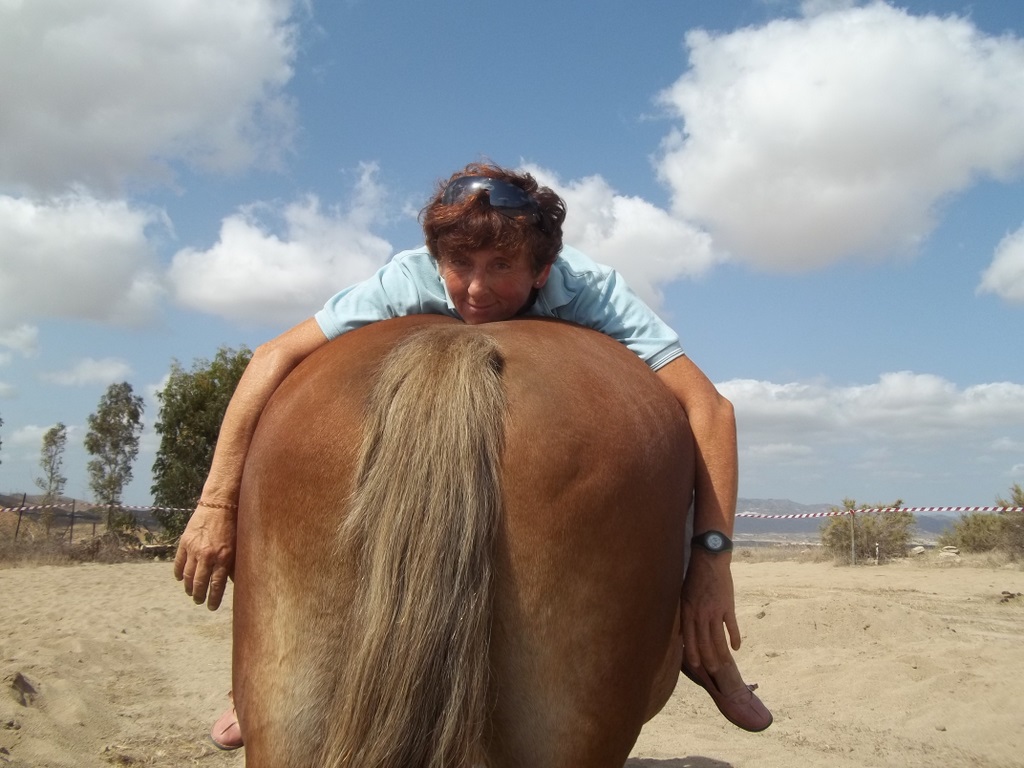
This is a picture of Cookie, a Hispano Breton mare, used as a brood mare in the Pyrenees to breed foals for the equivalent of veal horse meat. When they get older and are unable to breed they are used – as often as not – for dog food. This fabulous horse was bought and saved by the Center for Equine Therapy Cadí Moixeró for the modest price of one euro a kilo. Beth and Trini of Cadí Moixeró have been so convinced of the incredible therapeutic value of these horses that they gave one to me for both my therapy and that of many others and to promote the use of these fine animals for therapy instead of meat. Horse meat is very popular in France and many other countries and these cold blooded horses have the most meat on their bones which also makes them the perfect therapy horse. Because of their size, strength and good nature they are suitable for just about any type of therapeutic riding. Cookie has finished her training and is now helping children with severe Cerebral Palsy, Autism, and a host of other special needs. They can carry a tremendous weight yet they are not so tall as to prohibit the use of side walkers and back riders which are so important when dealing with wheelchair-bound people, who tend to be heavy and need assistance in order to participate in hippotherapy. Their loving, gentle nature makes them ideal for people who are afraid of horses, those who may have psychological problems and for activities to stimulate eye/hand coordination and other sensorial activities.

::::: :::::

We have now resumed Animo and are looking – as charities do – for your support. Become a member of Animo for 20 euros a year and receive an Animo Card and regular updates, photos and news of our activities.

Write to animoalbero@hotmail.es or brbrnapier@yahoo.com

Friday, February 17, 2012

The Wisdom of the Ancients

"Once I am in the saddle I never willingly dismount, for, whether well or ill, I feel better in that position. Plato recommends it as good for your health, and Pliny says it is good for your stomach and your joints." Montaigne.

Thursday, February 09, 2012

Animo Meeting

Barbara gave a talk today about animal assisted therapy to a group from the Club Taurino de Mojácar at the Bar La Finca.
Her talk touched on two different points - her own experiences and medical problems together with her remedies plus the larger subject of what Animo is now doing.
Animo, as Animo-Albero, currently meets every Sunday in Almería at the Centro Ecuestre Albero where a group of professionals help disabled children with hippotherapy using techniques pioneered in Spain by Barbara over twenty five years ago.
Today's talk was aimed at informing the local Mojácar public about the activities of the national association as well as offering membership in Animo and - as always with charities - collecting much-needed funds.

::::: :::::

We have now resumed Animo and are looking – as charities do – for your support. Become a member of Animo for 20 euros a year and receive an Animo Card and regular updates, photos and news of our activities.
Write to animoalbero@hotmail.es or brbrnapier@yahoo.com

Saturday, February 04, 2012

Only a Mother Could Love

Here is Cariño enjoying some lunch. Horses are beautiful creatures and always take a good picture. Well, almost always.

Tuesday, January 31, 2012

For the Love of Animals

Loli from the Centro Ecuestre Albero in Almería, the new centre for Animo, relaxing with her friends Naza and Smoking ('Esmokin') the Lamb.

Monday, January 30, 2012

Frisona Has Arrived!

D. Diego Mañas Romera from the Yeguada Valdesol, based in Sorbas, breeders of fine Pura Raza Española horses, today donated a Friesian mare to Barbara in her capacity as the outgoing president of Ánimo. Our grateful thanks to him and his associates.

Friday, January 27, 2012

Frisona

Sad and lonely after losing her foal in November. Now she will come live with me for love and attention. Frisona will be in tiptop shape in no time and so will I. We both need each other.
Here's a fine video of Frisona: http://www.youtube.com/watch?v=Q-1S3q_6BqY&feature=related

Friday, December 16, 2011

Horses in My Garden


Over a several year period, starting about eight years ago, when I had to spend a lot of time in the hospital, I had to find good, loving homes for all of my horses and other animals. All of my animals played a big part in ANIMO, as well as playing a large part in my life and that of my children. The loss of my animals was almost as hard as or harder than learning to live with a terrible disfigurement and a terminal disease. Since I started riding again over two years ago, thanks to the kindness of Loli Berenguel in Almería, my health has improved considerably and so has my life. After a lot of investigation, Loli and I have been able to develop a therapy that removes the side effects of medication and seems to slow down the progression of the illness. The only drawback for me was that I had to travel almost an hour each way to get to my therapy. Now thanks to my friends at Cadi Moxeroi and another participant in our therapy investigation who started out as a volunteer to take me to my riding therapy, I now have two horses at home. Now I am able to ride every day which has improved my blood analysis drastically plus my mental and physical state. Just spending time with the horses has improved my whole outlook on life and the way I live it. If it hadn’t of been for the encouragement of my husband, children and a few special friends, I probably wouldn’t have been here today to write this. Now I have so much to look forward to every day and I am living every day as fully as possibly.
The photograph was taken a few days ago, just before Christmas, in my garden.

Thursday, December 01, 2011

Graduate students from Gallaudet University, Washington DC, come to ANIMO to learn about therapeutic riding and other animal assisted therapies


During the summer we had four students from Gallaudet, all graduate students in Education or Mental Health. We all had a fantastic time as they learned everything from being a groom and riding lessons to helping train horses for therapy. We also went over the benefits of therapeutic riding and the different special needs it can benefit. It was a great opportunity for me to learn ASL (American Sign Language) and practice it. It has been proven that in many learning disabilities, if they can have visual and auditory stimulus, they are able to take in and understand more so the sign language was a big help for me in my work at ANIMO. The students all worked or were studying in different fields of Mental Health within the deaf community and felt that therapeutic riding would be very useful for everything from abused children and women to autism. Megan had a one month intensive course for which she earned a certificate and became a valuable member of out team and family.

P.S. Megan—I’m still waiting for your essay on your time here and what you learned and liked about Spain and AAT. We want you to come back soon. We miss you.

Megan and I developed a special relationship and shared so many laughs and experiences including a very funny last supper. Now we have horses at home and are starting a new project on therapeutic riding and infantile cancer for a presentation in May of next year to the National Child Cancer Association Congress. I could use your organization skills and a big hug. Mima

(Heh! I was just able to sign this last paragraph)

Saturday, November 26, 2011

The Friesian

This is a 4 year old Friesian stallion we saw in Seville this week. Out of the ten available, we chose this one. He has a magic quality and a character that goes with his looks. Gorgeous isn't he?

Tuesday, November 15, 2011

The Animo Course in Almería

We have written up our Animo course, held this past weekend in Almería at the Centro Ecuestre Albero, over on our sister blog Animo AAT. The course dealt with the basics of therapeutic riding, since little is known about the international norms here in Spain and we also learned how to work and communicate together in a multidisciplinary team. The course was a big success (and our thanks to the Red Cross for their special demonstrations) and we plan further courses in the future.
This was Animo's first course to be offered in its new headquarters, the Centro Ecuestre Albero.
Barbara Napier
Loli Berenguel

Beatriz Prevosto
== You can contact us at: animoalbero@hotmail.es

Thursday, November 10, 2011

Raven the Poster Dog

All this rubbish about taking a mongrel dog home from the pound. Here's Raven, a Briard. They say these are the most beautiful dogs of all - and in this candid picture, you won't help but agree!

Sunday, November 06, 2011

Arturo the Donkey

One year, we went to the feria de bestia in Albox. Sheep, horses, pigs and, look, a little donkey. We called him Arturo and brought him home in the Nissan.

Friday, October 28, 2011

Curso básico de Equitación Terapéutica

INTRODUCCIÓN

Bajo la coordinación de la Vocalía de Paraecuestre de la Federación Andaluza de Hípica se CONVOCA el Curso básico de Equitación Terapéutica.

CONDICIONES DE LA CONVOCATORIA

Requisitos:

Los solicitantes deberán poseer la Licencia Deportiva Territorial en vigor, expedida por la FAH antes del comienzo del curso.

Fecha:

12 Y 13 DE NOVIEMBRE 2011

Horario:

9:00-19:00

Lugar:

Centro Ecuestre Albero, Los Partidores, La Cañada, Almería

Ponentes:

Bárbara Napier.

Dolores Berenguel

Cruz Roja

Coordinadora:

Vocal de Paraecuestre: Alma Narbona.

Plazas:

Limitado a dieciséis. (16)

Inscripciones e Información :

Vía email a brbrnapier@yahoo.com y alberocentroecuestre@hotmail.com

Fecha límite: 10 de noviembre 2011 .

Contactos:

Bárbara Napier: 649471219

Matricula: 100€

Wednesday, October 26, 2011

Visiting a Neighbour's Ranch

We went to see some horses yesterday, at a large lettuce farm between Cuevas and Pulpí. I know the owner from years back and he has - besides any number of thousands of hectares of lettuce - around a dozen Pura Raza Española horses (and a donkey). Here I am riding a nine year old mare. Riding this kind of horse is like floating through the air. A real pleasure.
Back in Mojácar, we now have the stables in good shape and one horse staying with us, Cuki, a Hispano Bretón which came here from Catalonia and our friends at Cadi Moixero.

Friday, September 23, 2011

Therapeutic riding: Hispano Bretón

The therapeutic riding cooperative Cadí Moixeró brought two beautiful examples of Hispano Bretones to ANIMO for us to try. They meet all of the requirements you could ask for in a therapeutic horse. They are calm, willing, friendly, strong and have a body build and gait that is ideal for bareback riding and all types of therapeutic riding. Sadly, these beautiful horses are generally bred for meat because of their large build. Due to their kind and easy-going nature and broad sofa-like back they are perfect for everything from early stimulation in babies to back-riding for every type of disability. We will be doing demonstrations and courses hoping to promote the animal as a beneficial therapeutic animal. Here are a few pictures of their first day here. After a fourteen hour trailer ride all the way from the Catalonian highlands, and in a new place with people they didn't know, they performed perfectly.


There's a short piece on YouTube, prepared by Ken.

Friday, August 26, 2011

Finding the Mid-line


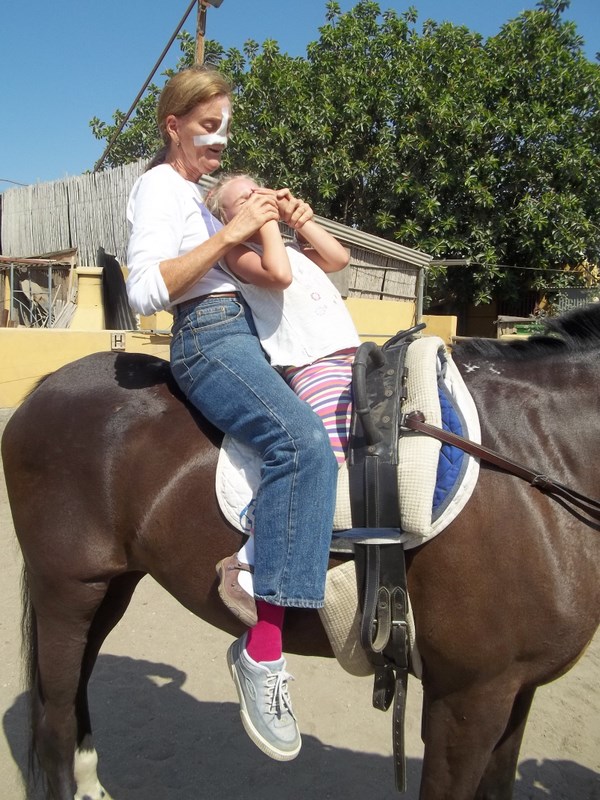
Step number one in any therapeutic riding is to help your student find their mid-line or center. Until they have an idea of what their center feels like they cannot move on to other exercises like reaching from one side to the other. They need to find their mid-line in order to walk, bring a cup to their mouth or get the feel of what it is like to walk and be in balance for those that are wheelchair bound or have an awkward gait. This is something most children learn from birth, slowly learning to bring things together to their mouth. If your student can already do this then you can move on to other activities.
The first step is to get them to relax and be in a good position; ankle, hip, shoulder and ear in line. This is done with a back rider who supports the feet, keeping them in line to achieve the most benefit; while holding lightly on to their wrists and stretching out, in front, up and across the chest, ending by touching the nose with both hands.
This is very difficult for some children especially with Cerebral Palsy. Never force the movement. If they go rigid or limp, start again by crossing the arms over the chest until they relax and continue the series over again.
You may not be able to accomplish this in one or two classes. Once they have achieved the goal, praise them and do something like a short trail ride or something for fun. When they are able to do this on their own they are ready to start games and exercises where they cross the body to retrieve or place objects. The back rider must lean slightly back so that the child's head is supported. If the head drops, ask them to try and lift it themselves, if they can't give a little help.
The goal is to get both hands together to the nose by themselves or with the minimum of help.
This is a riding therapy demonstration on Nora at Centro Albero, with Loli Berenguel Gálvez as the instructor, Marla as the student and me as the back rider.

Wednesday, July 20, 2011

From My Book

This is a piece from the final chapter of my work-in-progress Riding for my Life.

I have had my last operation, which was on my eyes. The membrane around my eyes and under my eye lids were replaced with placenta but unfortunately after a month the new membrane is dissolving leaving my eyes uncovered and open to any food or drink that I have. I am now too high of a risk to operate any more. I have been off all medication since September 2010, and have been in better shape than I have been in years. I do not recommend that anyone stop their medication without their doctor’s approval, but anyway, I did. The reason I stopped is because for over three years I was taking so much medication for so many different things and none of them were stopping the problems: but they were killing me. Doctors and friends are shocked when they see me now because I am in so much better condition, both mentally and physically. I have more energy, less pain and am more productive. My insomnia has been gone for over a year and I have no visible signs of vasculitis. I have a post-cancer patient who is also participating in this study, who has different problems yet many of the same symptoms as I do. He also has suffered from depression and Short Fibre Neuropathy, for which there is no medication. For the first time in fifteen years he is pain free and has his depression under control. The side effects of the cancer treatment are disappearing and his general quality of life has improved to the point that he wants to get his own horse so that he can ride more often. This is far from the end of the investigation or my practice of the ANIMO-ALBERO therapeutic riding program. That is just really beginning. Every day we are finding so many ways in which the horse can help people suffering from circulatory problems or the side effects of medical treatments, to reduce pain, to prolong a better quality of life and to help people deal with their fear when suffering with a terminal disease. We have now found that with a few months of continuous therapy the effects are long term and not short term as we had originally thought. I know that this program does not eradicate the disease and I don’t want to give anyone false hopes, but by just practicing this therapy twice a week, I have improved my quality of life and am living almost pain free; allowing me to be a wife, mother, grandmother and friend once again. This is something that was stripped away from me by Rhodatarula, Wegener’s disease plus a series of misdiagnoses; also by the ten years that were taken away from me by the more than thirty operations that left me so physically disfigured that I suffered severe depression and wouldn’t socialize for over three years. One trip to visit our daughter, Jessica, and grandchildren in Oklahoma; a trip that I thought would be my last, changed my life around 180 degrees. A little pinto gelding, by the name of Pronto owned by Patsi Smith, was the beginning of my new life and the investigation into the ANIMO-ALBERO program. I hadn’t ridden in over eight years and was coaxed into going riding with my children. I found that not only did I feel more energetic and happier but I somehow found a hidden strength inside of myself. This strength and self confidence made me start to go out with the family - not worrying about what people thought - and I found to my surprise that everyone was so nice to me and that my scars and bandages didn’t seem to make a bit of difference to them.
It is my dream, that one day the medical profession will take note of the work that we are doing and that thousands of people may benefit from what we have discovered and that the investigation continues for years to come.
Note: It is vital that family, friends and caregivers encourage their patients to go to therapy, no matter what kind it is. Usually the patient is too tired or doesn’t feel up to it but I can tell you from experience, that once you go you feel much better. I learned this way back when a volunteer, Sarah, that took me to my riding therapy, told me that even though I didn’t feel like riding, we would go and if I didn’t want to ride we could come back home again. It is a lesson I have never forgotten and am forever grateful to her.

This is me riding a beautiful Friesian mare called Frisona, who comes from the Yeguada Valdesol in Sorbas, Almería.