Wednesday, September 30, 2009
The Chicken Kitten
When the girls were little they were always bringing animals home that they had found abandoned; of course I did too. Then on the way home from school, they saw a box making noises in the bushes, on investigating they found a litter of new born kittens. We kept them warm and fed them, the whole while looking for good homes for them. One day we noticed that one of the kittens was missing. It was a mystery, how could such a tiny creature get out of the box? We looked everywhere and were surprised when we found him sitting under a chicken who also happened to be sitting on a batch of duck eggs. This chicken was very maternal and since we had no cockerel she made due with other babies. As the ducklings started to hatch and follow the chicken, so did the kitten. The kitten would eat tomatoes and avocado skins and the leftovers that chickens eat. We tried to give him cat food but he wouldn’t have it. He never became tame. We could touch him but not pick him up. All his kitten brothers found good loving homes but the chicken kitten stayed with the chickens and ducks for over two years when he finally fell in love with a cat from the neighborhood. He left to make a home for his own new family. We would catch a glimpse of him from time to time in the bird-pen, he must have come to visit his mother and siblings and to show off his offspring. His female cat would never go in the pen she just sat on the roof of the garage and watched. Just another story of identity crisis amongst my animals and it proves the point that your real parents are the ones that care, nurture, love you no matter what and are there when you need them.


Friday, September 25, 2009
Shearing the Sheep
 Sheep shearing has long been a skillful craft. They even have international competitions. Usually shearing is done with electric shears but here in the south of Spain the shepherds use home-made scissors with very sharp points that I have never understood because it is so easy to puncture the skin with these things. Mind you, they are probably about as fast with these hand shears than any expert with electric ones. I sheared my own sheep with normal scissors and it took forever and my sheep looked like a poorly cut poodle, but the wool soon grew out again. A professional would not come for so few sheep so I was forced to do it myself. Each sheep had its own special trick to standing still while I labored away with my scissors. Negrita, the black sheep seen here in a very old picture on a picnic with Lenox, would only let me shear her. As a present for me a local shepherd was having his sheep done and thought he would give me a gift of shearing Negrita. After several hours and several men they gave up and said they had never come acr
 oss an animal like this one. Lucía Amalita is the other sheep, while still in the baby phase, shown here watching TV with Freetxua. Every feed I would hold Lucia like a baby and bottle feed her, for way too many months - but that’s me: all the while singing her a little song I made up. When it came time to shear her she wouldn’t stand still so I started to sing her song to her and then she was ok. When she was half finished and I was exhausted my son and his friends said they would finish her. I told them they would have to sing her song or she would run away. The big tough boys just laughed at me, knowing that they out-weighed her ten to one. After a lot of screaming and laughing I heard one of them break into song and not long after appeared a well-shorn Lucia.
The Running of the Calves
My birthday falls on San Fermín, the seventh of July, which is the day of the running of the bulls in Pamplona. Since there are no bulls in Mojácar we would celebrate every year with my calf Petite Suisse. The Gypsies, from the next village, would come with their musical instruments and sing and dance. Gypsies in Spain live in villages or towns and do not travel from place to place like other Gypsies. They are famous for their Flamenco dancing and music which Spain has adopted as its own. Friends from the area would gather in groups and make their own special paella. Everyone had their own secret ingredient, mine was California vegetarian. Everyone sang, danced and ate until very late: it was an all day event. At the end there would be a competition for the best paella, then we would let Petite Suisse loose and one by one, people would take turns with their red towels and try to get her to chase them. She usually stayed stuck to my side so I had to run too.
Our house was at the top of the mountain with spectacular views and unknown to us, it was also a ‘must see for the tourists’ according to the hotel in town. One year a group of people that no one seemed to know arrived and ate and drank, danced and chased my calf, all in all, they agreed, the best part of their holiday. We all kept asking each other who they had come with. No one knew them, it was then that we discovered they were trippers and thought this was something put on by the hotel.
 travel from place to place like other Gypsies. They are famous for their Flamenco dancing and music which Spain has adopted as its own. Friends from the area would gather in groups and make their own special paella. Everyone had their own secret ingredient, mine was California vegetarian. Everyone sang, danced and ate until very late: it was an all day event. At the end there would be a competition for the best paella, then we would let Petite Suisse loose and one by one, people would take turns with their red towels and try to get her to chase them. She usually stayed stuck to my side so I had to run too.
Our house was at the top of the mountain with spectacular views and unknown to us, it was also a ‘must see for the tourists’ according to the hotel in town. One year a group of people that no one seemed to know arrived and ate and drank, danced and chased my calf, all in all, they agreed, the best part of their holiday. We all kept asking each other who they had come with. No one knew them, it was then that we discovered they were trippers and thought this was something put on by the hotel.
Wednesday, September 23, 2009
House Guests
 Most people knock these beautiful nests down because the birds, swifts, have three or four families a season and always come back to nest where they were born, hence every year more than the year before. We love to watch them build their nest and watch the little ones grow and learn to fly and then see them and their new families the next year. When they leave here they fly all the way to Africa and then back to home in early spring. It is true, they make a terrible mess on the patio, walls and the beams but we feel it is well worth the work it takes to restore the house when they have gone, just to enjoy their company while they are here. The nests are made of mud, interlaced like a basket. We have a pool were they get their water but I don’t know where they find water to make the mixture in the rest of the desert. After they move out, sparrows and other birds take advantage of the ready made homes and sometimes even decorate them. We found one with feathers, grasses, rolling papers, plus bright and shiny objects, all dangling from horse hair. It was quite a sight. The swifts sit on the telephone wires or in trees because they are not comfortable on the ground, their body weight is almost too much for them to lift off again. They catch all of their food, like flies and mosquitoes, whilst in flight and they swoop and veer like expert pilots. They have all left now so we can repaint and clean while we wait for next spring.
Monday, September 21, 2009
Riding with Boars
 That's Theodore, our wild boar, as a youngster. He loved to participate in everything we did. Here he is having a riding lesson with Jessica. Theodore started life in the Pig's Bathroom but as he grew, moved in with his wife Rachel. In order to feed these hungry animals we depended a lot on an exquisite Italian restaurant that was so kind as to fill a garbage can full of left-overs every day. They were so careful to keep out any objects like plastic, cigarette butts or metal. The wild boar dined on pasta, fish, salad and lots of cheese and bread. After a while we had to stop with the Italian food because the vet said they were getting way to many carbohydrates. Theodore grew to over 200 kilos and was the size of my kitchen table but he remained very friendly even to the children who came to visit, whereas Rachel was only friendly to family and had to be kept in her pen when the other animals were turned loose to play together or socialize with visitors. Sometimes Theodore would just wander over to the house from the stables and lie on the patio in the sun along with the dogs and cats. The day our new next-door neighbors moved in they saw a sight that might have almost made them change their minds. The other neighbors and I were walking around with bananas, avocados and grapes, a wild boar's favorite food, calling out their names. They had both escaped from their pen with their four new babies and were roaming the neighborhood introducing their litter to everyone. It was quite a sight to see this boar family making the rounds.
Friday, September 18, 2009
Looking at the River but Thinking of the Sea
 This one is about Spain in the early 80’s and our three children, Jessica, Amber and Daniel. We live in what was once one of the most beautiful places on earth, Mojácar. It is a Moorish village set on a mountain overlooking the sea with a river-bed running alongside and down the valley from other beautiful little villages that are scattered about in the mountains. An archeological and historical treasure-mine. Our house sits between the river and the village, on top of faint remains of an old Phoenician city. At the back of the house we have Old Mojácar, a tall, flat-topped mountain where they say Mojácar used to be thousands of years back and, on its lower slopes, there is also the site of a Roman cemetery. Roman pottery and Moorish coins and turquoise we easily found everywhere, even our wild-boar, Theodore, used to encounter pieces when rooting through the dirt and put them in his bath for us to find. A walk down the river or along the beach after a storm and you could come away with a jar full of turquoise.
Many of the villagers from these mountain villages had never actually been to the beach or set their big toe into the sea. It was enough for them to just see it from afar and wonder. They were all working people that lived off the land and there is no vacation from animals and crops. Even though the main mode of transport was the donkey and the trip by donkey only took a few hours - I made it many times myself - most of them never showed enough curiosity to make the effort.
One day, while on a trip to Granada which is the big city nearby, we passed many rivers until we came to one that threw the children into a frenzy of excitement. This river had water in it. You may not find that so wonderful but for our children it was the first time they had seen water in a river. Up until then, they knew that a river was for galloping your horse full speed for miles or learning to drive in Papa’s old Lada, for sheep and goats to graze or even for throwing escombro or rubble in English. The very idea that water came from the mountains in the river and went to the sea was unfathomable. The river wasn’t the only first for the day: in the city of Granada they saw for the first time stoplights, rode up and down escalators and elevators in huge shops full of all their dreams. They were so excited about the escalator that it never even occurred to them that you could actually buy some of these wonderful items. We left without having to spend anything. About ten years later Mojácar put a stoplight on the beach: it was never turned on and it wasn’t at an intersection but the school children would take a field trip down to look at it each year. After that Granada trip, we started taking the children on more excursions and exposing them to the real world. We still worried about Jessica when she later went to America because of things like walking on sidewalks, unheard of in Spain, or stopping at crosswalks again something never done in Spain, or talking to strangers, which is a must in Spain. She managed to handle all of these obstacles with ease so I guess the trips paid off in the end.
Once Spain gets a handle on some new thing they go crazy. First it was safety railings on the freeway with reflectors – we reckoned that the Governor’s brother had the company that made them - then came the roundabouts, which here include ‘through lanes’, abrupt turns, various signs hidden by bushes and pedestrian routes (inevitably ignored by the local transients) which are splashed through the whole ensemble. Lenox and I wanted to do a coffee-table book of Spanish roundabouts. The best one we saw – in Guadix – had seventeen ways around and through it but Mojácar is now proud to have some of the most unusual and useless roundabouts and traffic feeds imaginable. Then the road-designers introduced the sleeping policemen or speed bumps; after a trip to town you need new shocks on your car to deal with the stress of all the bumps. It is all in the learning process and in the interest in modernization and the search for tourist dollars.
Thursday, September 17, 2009
Casi una Yegua

Casi, which means almost in Spanish, meaning she was ‘almost a mare but never quite’ - in my mind anyway - was one of the first members of my animal family when I came to Mojacar. Casi was a three week old foal that I bought on an installment plan along with her mother Oli.
Oli or Olivera, because she lived in an olive orchard, belonged to a farmer who just used her as a brood mare and to keep the weeds down around his trees.
We have a local tradition here called the ribbon race. In the ribbon race all the single men get on horse-back with a pencil in their hand and gallop at full speed up the street to try and grab the ribbon of the girl of their dreams. All eligible girls, hand embroider beautiful ribbons with their names and other ornate decorations. A ring is then attached and it is all rolled onto a wire that is hung across the street. The girls all t urn out either in traditional Mojacar outfit or in the most glamorous flamenco dresses. The bachelors must show their manliness by galloping up the street and put their pencil through the ring on the ribbon. If they manage to snag a ribbon, the band plays, fireworks go off and the ribbon is placed on the bachelor by the girl along with a kiss and a present. In the old days it was kind if a Spanish Sadie Hawkins, because the boy won the hand of the girl whose ribbon he won. In reality there are one or two men that are great at this game and win most of the ribbons.
Back to Casi and Oli. I was told that Oli could not be ridden because many a man had tried to borrow her for the annual ribbon race and no one could even get a saddle or bridle on her let alone ride her. She was thirteen when I bought her. I went down with my western hackamore and jumped on bareback. No problems at all. I rode her home with Casi following where of course my father was waiting with one of his amusing remarks. Casi always seemed so petite to me, although she was in reality a good sixteen hands by the time she was five years old, and she came everywhere with me along with the calf Petite Suisse, and Negrita the lamb. We would walk in the mountains and take picnics. They never had halters or lead lines, we just talked and they seemed to understand. As the years went by and Casi grew, our girls wanted to start riding her but I was so over protective and never thought she was ready. I never wanted to put a bit in her mouth because I was afraid to damage her. One Christmas, when she was nine, my present to myself was to sit on her back. She was so pleased and seemed to say ‘Well it’s about time!’. From then on I rode her everywhere with no tack and just talking to her. When our girls, already national three-day-event champions, wanted to ride her I decided she should go to a trainer to learn a few aids and to wear a bridle and saddle: I didn’t want her to get mad at me. I rode her out to a stables where she immediately had a claustrophobia attack upon being put in a stall. Remember she had always roamed free on our farm. I was forbidden to go visit her because she went crazy when she would hear my voice. It made me so sad to think of her locked up but dad said she was probably worried about me being locked up in a similar fashion. After three weeks the trainer told me to take her away and sell her for meat and buy a proper horse. He was a great trainer and treated her well but she was so spoiled that he couldn’t even get her to take three steps forward. I rode her home and that is when the girls took over and turned her into the best all round horse. She could jump anything, even flying over the jumps in the paddock for her own pleasure; she learned classical and Spanish dressage; she was a great barrel racer, sorry Patsy, yes bareback, and the only horse in ANIMO that knew the difference when to listen to leg aids and when to ignore them. I continued to ride by just talking to her.
Oli or Olivera, because she lived in an olive orchard, belonged to a farmer who just used her as a brood mare and to keep the weeds down around his trees.
We have a local tradition here called the ribbon race. In the ribbon race all the single men get on horse-back with a pencil in their hand and gallop at full speed up the street to try and grab the ribbon of the girl of their dreams. All eligible girls, hand embroider beautiful ribbons with their names and other ornate decorations. A ring is then attached and it is all rolled onto a wire that is hung across the street. The girls all t
 urn out either in traditional Mojacar outfit or in the most glamorous flamenco dresses. The bachelors must show their manliness by galloping up the street and put their pencil through the ring on the ribbon. If they manage to snag a ribbon, the band plays, fireworks go off and the ribbon is placed on the bachelor by the girl along with a kiss and a present. In the old days it was kind if a Spanish Sadie Hawkins, because the boy won the hand of the girl whose ribbon he won. In reality there are one or two men that are great at this game and win most of the ribbons.
Back to Casi and Oli. I was told that Oli could not be ridden because many a man had tried to borrow her for the annual ribbon race and no one could even get a saddle or bridle on her let alone ride her. She was thirteen when I bought her. I went down with my western hackamore and jumped on bareback. No problems at all. I rode her home with Casi following where of course my father was waiting with one of his amusing remarks. Casi always seemed so petite to me, although she was in reality a good sixteen hands by the time she was five years old, and she came everywhere with me along with the calf Petite Suisse, and Negrita the lamb. We would walk in the mountains and take picnics. They never had halters or lead lines, we just talked and they seemed to understand. As the years went by and Casi grew, our girls wanted to start riding her but I was so over protective and never thought she was ready. I never wanted to put a bit in her mouth because I was afraid to damage her. One Christmas, when she was nine, my present to myself was to sit on her back. She was so pleased and seemed to say ‘Well it’s about time!’. From then on I rode her everywhere with no tack and just talking to her. When our girls, already national three-day-event champions, wanted to ride her I decided she should go to a trainer to learn a few aids and to wear a bridle and saddle: I didn’t want her to get mad at me. I rode her out to a stables where she immediately had a claustrophobia attack upon being put in a stall. Remember she had always roamed free on our farm. I was forbidden to go visit her because she went crazy when she would hear my voice. It made me so sad to think of her locked up but dad said she was probably worried about me being locked up in a similar fashion. After three weeks the trainer told me to take her away and sell her for meat and buy a proper horse. He was a great trainer and treated her well but she was so spoiled that he couldn’t even get her to take three steps forward. I rode her home and that is when the girls took over and turned her into the best all round horse. She could jump anything, even flying over the jumps in the paddock for her own pleasure; she learned classical and Spanish dressage; she was a great barrel racer, sorry Patsy, yes bareback, and the only horse in ANIMO that knew the difference when to listen to leg aids and when to ignore them. I continued to ride by just talking to her.
Tuesday, September 15, 2009
The Pig's Bathroom
Ever since I have lived in Spain, I have been given many orphaned baby animals to raise. In this drawing are Mop-Mop the piglet and Arturo the baby donkey, each have their own interesting stories but the story of how the pig's bathroom came to be called just that, starts with Spanish plumbing. 

In Spanish cortijos, if you were lucky enough to have indoor plumbing, it consisted of a toilet set over a hole in the floor and an open cement ditch that ran under the house to a pozo negro or black hole. After many years we finally discovered this original solution to waste disposal and decided to modernise by installing outdoor pipes and cutting off the ditches under the floor except for one interior bathroom that was unfortunately unreachable without taking out the bathroom, which, in the end, is what we did. We turned a huge marble bathroom into a half bath with sauna. Well, we had wanted the sauna but didn't have enough electricity so we ended up with a half bath and large cement floor with a drain in the middle. The birth of the 'Pig's Bathrom' came when a farmer handed me a day-old piglet to raise. She was pink and black and we called her Mop-Mop because that was the sound she made and you also had to follow her around the house with a mop mop. I turned the shower into a bed by filling it with straw and that is where she slept until she was old enough to join the larger animals. From that day until the present all baby animals are raised by starting out in the Pig's Bathroom, before graduating to the main house and associating with dogs and cats etc. The next step is to the bird sanctuary, which is a large fenced in area with housing and gardens. A safe and fun place for animals such as pigs and sheep to grow up before moving into the stables with adult animals, maybe even some of their own kind. Mop-Mop was just the first of a long line of animals to reside in the Pig's Bathroom. Before the birth of the Pig's Bathroom, the children would wake up to find a new born something-or-other in bed with them to stay warm until I could arrange appropriate food and lodging. On entering the house, Lenox would alway take a look at the door to the bathroom and if it had the latch on he would gasp "now what do we have"? They were wonderful times and even though we don't seem to be raising any babies lately it is still called the Pig's Bathroom.
Arturo, the baby donkey in the drawing, was given to me by a local T.V. station. We were at a horse auction and I saw a baby donkey but they wanted twenty-five thousand pesetas for him, which I didn't have. Someone else showed interest in the donkey but then I learned they wanted him for lunch so I began to cry. The T.V. crew was nearby and saw me. On hearing the sad tale of the donkey's future they said that they would buy him for me on the one condition than I named him Arturo. On asking why, they said it was the name of the local mayor that they hated because he was a jackass and they felt this a very appropriate donation to a worthy cause. It was also tax deductable because they gave him to ANIMO. Arturo lived in the petting zoo and later joined the forces of riding for the disabled and of course burro-baseball.
Sunday, September 13, 2009
Station of Happiness
The father of a great friend of ours, who had retired from farming, decided to give his beautiful, strong, healthy donkey to our small son, Daniel. Another farmer craftily convinced the old man to switch donkeys with his old one so he could still farm and since the donkey was going to a two-year-old he wouldn’t know the difference. The day finally came when the truck arrived in our drive and the donkey was unloaded. Daniel took one look at her, with love in his eyes, and said I am going to call her Station of Happiness. We have no idea where he got that name from but it didn’t seem to fit, in our eyes anyway, the donkey was thirty some years-old and a bag of bones that could barely walk. But Daniel loved her. After about a year of tons of food and loving care she became a very respectable example of a donkey.  This is a picture of Daniel and Station of Happiness in a turn-out class at the Mojacar fiesta horse-show. He and Station are turned out in authentic agüero get-up. An agüero is a water-boy who brought water from the natural springs in the mountains in four clay water vessels carried in hand-made baskets made out of esparto-grass. The agüero would go door to door selling fresh water to the people in the village.
Needless to say Daniel and Station won the competition for many years.
Station of Happiness became a valuable member of ANIMO taking disabled students that for one reason or another needed the strength, height and pace of a donkey. She even played in our yearly Burro-baseball fundraising game. That is another story all together because it is at one of these events the Jessica met her husband Matt, a marine stationed in Rota, and fell madly in love. I will leave that story for Jessica to tell.
This is a picture of Daniel and Station of Happiness in a turn-out class at the Mojacar fiesta horse-show. He and Station are turned out in authentic agüero get-up. An agüero is a water-boy who brought water from the natural springs in the mountains in four clay water vessels carried in hand-made baskets made out of esparto-grass. The agüero would go door to door selling fresh water to the people in the village.Needless to say Daniel and Station won the competition for many years.
Station of Happiness became a valuable member of ANIMO taking disabled students that for one reason or another needed the strength, height and pace of a donkey. She even played in our yearly Burro-baseball fundraising game. That is another story all together because it is at one of these events the Jessica met her husband Matt, a marine stationed in Rota, and fell madly in love. I will leave that story for Jessica to tell.
Family Traditions
Traditions were very important in Spain. They still remain an important part of country life but have been mostly forgotten in the cities. The wearing of black is one of them. When someone dies the women wear black as a sign of mourning, the length of years required to stay in black depends on the closeness of the relation who died. If it is your husband then you are in black for life. So by the time a young girl reaches her twenties it is likely that she will be in black for the rest of her life because between two years for this uncle and five years for that sibling they all start adding up.
Another tradition is ‘La Matanza’. Every family under the law of Franco was entitled to their own ‘domingero’. A domingero is a small building and piece of land in the country with a place to keep your tools, feed for the animals and a kitchen big enough to entertain the whole family including granny and the cousins. It is here where you grow your vegetables and fatten your pig. The whole family contributes leftovers to fatten the pig and make sure it is eating the right kind of food to give the desired taste to the pork. The matanza happens once a year. It is a day that I try and stay inside because the whole procedure is rather gruesome. I am a vegetarian but I approve of this tradition because I feel that if you are going to eat meat you should know where it comes from and that is not a plastic wrapped package from the super-market. For the matanza the whole family unites for about twenty-four hours, eating and drinking the whole time. The men kill and prepare the pig. This means putting the pig on a huge wooden table, slitting the throat and draining the blood into a bucket to be used in the making of morcilla and the like. The sound is like something you have never heard before. Turre is a definite no-go place on the day of the matanza because all the tables are put in the street in front of the houses to wait for the pig. After they have bled the pig they take a blow-torch and burn off all the hair before hanging it from the ceiling in the living room so as to be able to cut it into pieces each to be used for a different delicacy. While this is being done the women start preparing the insides for things like sausages and sobreasada. Not one part of the pig goes to waste. The hams are hung for eating the next year. During this marathon no one sleeps because it is important to get all the parts of the pig used before it is damaged by the heat. The vet must be called to test the meat to make sure it is disease free. During this time big round loaves of bread are baked in a large dome-shaped clay oven, last year’s home-made wine, actually stomped by your own feet in a wooden vat, is brought out and the olive oil that you just got back from the olive press is used. The olive press is used by all the farmers. Each farmer is given a number of order where you are given a time and day, maybe even in the middle of the night, to bring your olives for pressing. This way you are assured to get olive oil only from your own olives. In exchange the olive press gets several liters of each person’s olive oil.
I don’t understand enough about Catholicism to understand this one but it is very impressive. One dark night on the first day of lent, the priest carries a sardine around all the streets in the town and the whole village follows behind him crying and wailing like the Moroccan women do. They all dress in black and carry candles. It is really very frightening the first time you see it. Then apparently they bury the sardine. It is a funeral. No one has been able to tell me the significance of this tradition.
Another is to hang a chicken from a wire in the plaza then the men are blindfolded and with a large stick try to hit the chicken. The one that kills the chicken gets to take it home for supper. This tradition started along time ago when food was scarce. It is sort of like a Mexican piñata without the candy. Many tourists complained and said it was disgusting but no one made them come and watch. This tradition has died out recently.
La Vieja is an interesting tradition. It is not an official holiday but no one is expected at school or work. The whole family, cousins and all, make a picnic and head for the hills or beach. The children take wooden crosses and make a paper doll over the top and fill the head with sweets. They call it ‘La Vieja’, the old lady. At some point during the afternoon all the children start throwing rocks at the vieja until she breaks open and then they eat the candies. I don’t know why they made it an old lady to throw rocks at. A great time is had by the whole family.
The Romeria is another family outing where everyone puts on their flamenco dresses and riding gear and either rides horses or rides in huge wagons all decorated with flowers like in a parade. The whole group follows a long route and ends up in a suitable destination where they eat a large paella. They stop at a few homesteads along the way and have refreshments.
The Lost Art of Hay Surfing
Every farm in southern Spain has something called an 'era' which is a flat dirt circle, I think called a threshing circle in English, where the hay would be put after being cut with a scythe. A wooden board with rows of knife-like wheels underneath was pulled by a donkey and driven with long-reins by the farmer. Weight must be applied to the board in order to cut the hay, hence the children. There are actually several different boards with different types of knifed wheels for each phase of cutting. It was a very exciting time for the children when the farmer called them to come and sit on the board while he went round and round. It takes several days to cut the hay into small pieces and release the grain from the stalk. It is a sticky job, in the heat you get covered in pieces of hay and it is a bit like a ride at an amusement park, bumping up and down it is a rough ride especially when the hay is in the center at the beginning, it gets to be a smoother ride as the hay gets spread around the circle. The board sometimes even flips over. No harm is done because you just fall into a huge pile of hay. You must watch your fingers though and can’t hold on to the board for risk if being cut by one of the blades. When the threshing is done you must wait for a windy day and with a naturally grown pitch-fork, you throw the hay in the air. These pitch-forks grow on a tree in the shape of a fork and after being whittled down a little make the perfect pitch-fork. On the windy day, and after hours of rep
 eating this procedure of throwing the hay in the air, the cut hay is on one side of the era and the grain on the other, it is quite ingenious really, each to be stored and used throughout the year. I would like to have shown you a picture of the pitch-forks but ours burnt in the recent fire. We have an era on our property and across the street is an era that is shared by three houses: it is communal property and doesn’t belong to any one of the houses but to all three. It is things like this that make buying land in Spain difficult. For example a long time ago your grandfather may have traded a donkey for the large algarrobo tree on the corner of his property, the donkey is long since dead but the tree on your land now belongs to someone else.
Another tradition is ‘La Matanza’. Every family under the law of Franco was entitled to their own ‘domingero’. A domingero is a small building and piece of land in the country with a place to keep your tools, feed for the animals and a kitchen big enough to entertain the whole family including granny and the cousins. It is here where you grow your vegetables and fatten your pig. The whole family contributes leftovers to fatten the pig and make sure it is eating the right kind of food to give the desired taste to the pork. The matanza happens once a year. It is a day that I try and stay inside because the whole procedure is rather gruesome. I am a vegetarian but I approve of this tradition because I feel that if you are going to eat meat you should know where it comes from and that is not a plastic wrapped package from the super-market. For the matanza the whole family unites for about twenty-four hours, eating and drinking the whole time. The men kill and prepare the pig. This means putting the pig on a huge wooden table, slitting the throat and draining the blood into a bucket to be used in the making of morcilla and the like. The sound is like something you have never heard before. Turre is a definite no-go place on the day of the matanza because all the tables are put in the street in front of the houses to wait for the pig. After they have bled the pig they take a blow-torch and burn off all the hair before hanging it from the ceiling in the living room so as to be able to cut it into pieces each to be used for a different delicacy. While this is being done the women start preparing the insides for things like sausages and sobreasada. Not one part of the pig goes to waste. The hams are hung for eating the next year. During this marathon no one sleeps because it is important to get all the parts of the pig used before it is damaged by the heat. The vet must be called to test the meat to make sure it is disease free. During this time big round loaves of bread are baked in a large dome-shaped clay oven, last year’s home-made wine, actually stomped by your own feet in a wooden vat, is brought out and the olive oil that you just got back from the olive press is used. The olive press is used by all the farmers. Each farmer is given a number of order where you are given a time and day, maybe even in the middle of the night, to bring your olives for pressing. This way you are assured to get olive oil only from your own olives. In exchange the olive press gets several liters of each person’s olive oil.
I don’t understand enough about Catholicism to understand this one but it is very impressive. One dark night on the first day of lent, the priest carries a sardine around all the streets in the town and the whole village follows behind him crying and wailing like the Moroccan women do. They all dress in black and carry candles. It is really very frightening the first time you see it. Then apparently they bury the sardine. It is a funeral. No one has been able to tell me the significance of this tradition.
Another is to hang a chicken from a wire in the plaza then the men are blindfolded and with a large stick try to hit the chicken. The one that kills the chicken gets to take it home for supper. This tradition started along time ago when food was scarce. It is sort of like a Mexican piñata without the candy. Many tourists complained and said it was disgusting but no one made them come and watch. This tradition has died out recently.
La Vieja is an interesting tradition. It is not an official holiday but no one is expected at school or work. The whole family, cousins and all, make a picnic and head for the hills or beach. The children take wooden crosses and make a paper doll over the top and fill the head with sweets. They call it ‘La Vieja’, the old lady. At some point during the afternoon all the children start throwing rocks at the vieja until she breaks open and then they eat the candies. I don’t know why they made it an old lady to throw rocks at. A great time is had by the whole family.
The Romeria is another family outing where everyone puts on their flamenco dresses and riding gear and either rides horses or rides in huge wagons all decorated with flowers like in a parade. The whole group follows a long route and ends up in a suitable destination where they eat a large paella. They stop at a few homesteads along the way and have refreshments.
The Lost Art of Hay Surfing
Every farm in southern Spain has something called an 'era' which is a flat dirt circle, I think called a threshing circle in English, where the hay would be put after being cut with a scythe. A wooden board with rows of knife-like wheels underneath was pulled by a donkey and driven with long-reins by the farmer. Weight must be applied to the board in order to cut the hay, hence the children. There are actually several different boards with different types of knifed wheels for each phase of cutting. It was a very exciting time for the children when the farmer called them to come and sit on the board while he went round and round. It takes several days to cut the hay into small pieces and release the grain from the stalk. It is a sticky job, in the heat you get covered in pieces of hay and it is a bit like a ride at an amusement park, bumping up and down it is a rough ride especially when the hay is in the center at the beginning, it gets to be a smoother ride as the hay gets spread around the circle.
 The board sometimes even flips over. No harm is done because you just fall into a huge pile of hay. You must watch your fingers though and can’t hold on to the board for risk if being cut by one of the blades. When the threshing is done you must wait for a windy day and with a naturally grown pitch-fork, you throw the hay in the air. These pitch-forks grow on a tree in the shape of a fork and after being whittled down a little make the perfect pitch-fork. On the windy day, and after hours of rep
 eating this procedure of throwing the hay in the air, the cut hay is on one side of the era and the grain on the other, it is quite ingenious really, each to be stored and used throughout the year. I would like to have shown you a picture of the pitch-forks but ours burnt in the recent fire. We have an era on our property and across the street is an era that is shared by three houses: it is communal property and doesn’t belong to any one of the houses but to all three. It is things like this that make buying land in Spain difficult. For example a long time ago your grandfather may have traded a donkey for the large algarrobo tree on the corner of his property, the donkey is long since dead but the tree on your land now belongs to someone else.
Sidewalking
 Sidewalking: The object of sidewalking in hippotherapy is to give as little support as possible while maintaining the correct posture and helping the student complete the given exercise. The ankle, hip, shoulder and ear should always be in alignement to achieve maximum benifit. The sidewalkers must also have enough knowledge of horses to read the signs, such as ears back or tense muscles, so as to prevent an accident.
ANIMO has written permission to reproduce these pictures in order to promote hippotherapy. They may not be used by anyone other than ANIMO.


Friday, September 04, 2009
Charge Accounts
To start this story I need to give you a little background on what life was like in Mojacar in the early 80’s. Food was bought every day from the market. Maria, the lady that sold fruit and vegetables, was illiterate and couldn’t count so she had three rocks one worth five pesetas one 25 pesetas and the third 50 pesetas so anything you bought had to weigh the same as her rocks. If you wanted two bananas she would give you seven for the same price because two bananas didn’t weigh the same as her rock. Everything worked on the honor system and most people paid when their crops came in. For example if you went to a bar you could just keep eating and drinking and when you finished the bar-keep would ask what you had had and charge accordingly: it was up to you. The accounting system for charges was for each family to have a jar and when you made a purchase a certain number of garbanzo beans were placed in your jar. When you came to pay they would count the beans and you would pay so much. On day in the shop at the fountain some chicken got loose and knocked over some jars and ate the garbanzos but no one panicked, the shop-keep just asked how much you thought you owed and you paid that much. Everyone was happy.
Every morning before nursery school I would take Ami to the shop to buy her snacks but we had to choose carefully because she was hyperactive and affected by food. We didn’t know if it was the coloring or the Es or sugar so we tried to go for the most natural foods. In the end it turned out that it was preservative in meats like salami and hot dogs that affected her not colorings. The lady in the shop was very curious because she had never heard of food causing hyperactivity. One day when I went to the shop the lady told me I had a bill of six thousand pesetas. When I asked for what, having never charged before she told me that Amber had brought her whole nursery school class to the shop and let them buy what they wanted and then she said to put it on my tab. I was furious and amused. How could this lady let Amber buy sweets when she saw every morning how hard it was to find something Amber could eat and, secondly, how could she open an account for a three year old with out even talking to me? Also where was the teacher, that the whole class could take an excursion to the shop? It was actually very safe for the children to wander in those days because on every corner was an abuela or tita or chacha who were always looking out for everyone.
Nowadays many children have food allergies or sensitivities but in those days it was not so well known. Amber would get so hyper that her breathing would accelerate and her pupils dilate and she was speeding around so fast she couldn’t concentrate but the worst part of it was the withdrawal. When the effect of the preservatives wore of she would sink into a deep depression. Since I had always worked with children with these kinds of problems I at least knew how to start eliminating foods to find the culprit, in her case preservatives. It turned out that Daniel had the same reaction, one bite of salami would send him flying for about eight hours but he never suffered from the withdrawal.
One night when we came home, Daniel was flying around the room and the babysitter beside herself, Amber burst into tears and said is that what I’m like when I eat salami? It was a big eye-opener for her. The babysitter said she had only given Daniel one bite of chorizo because she knew he wasn’t to have any but she didn’t believe that it was true. She found out the hard way. Both the children outgrew their reaction to preservatives by the age of eleven or twelve.
By the way I also had to go around the village and cancel all of Ami’s accounts.
Tuesday, September 01, 2009
Prunella
 Picture: Grandad with Chicken
This is a picture of Prunella our chicken (with Grandad). She got a bit singed and egg-bound thanks to the fire but is now back to full time gardening and egg laying. She is a wonderful pet and wanders free with the dogs and cats while we are outside but we put her in the aviary to protect her from neighborhood dogs at night. Until Prunella moved in we had never seen a Love Bird ground feed. Anything that fell on the floor was left but now that they share their quarters with Prunella they have started feeding off the ground. It is interesting to watch how one animal’s behavior can change that of another. Look at Grandad for example...
Fire, Bestia, Ecologists and Hunters
Until not so long ago, wild fires were almost unheard of because there was very little brush or weeds to fuel a fire. All the horses and donkeys were tethered to eat around the farm and the sheep and goats free-ranged with a shepherd. The herds were allowed everywhere except for farmed land. They passed miles through the valleys in the winter and in the mountains in the summer. Now to save the remaining wild-life, the career ecologists won't let you clear the brush or make fire trails. They actually fine you for doing so. Well this last fire literally cooked their goose because now there is no more wild-life left to protect. To add to the destruction after the fire the local hunters went out into the bleak and empty landscape and shot every living thing that had lost its home or nest. Modern times are really taking a toll on this beautiful land.
Monday, August 31, 2009
Pipsqueak
One day, in my aviary of Love Birds, I found an egg that had fallen out of a nest and the baby was half way out. After carefully removing the rest of the shell I put him in a box of cotton-wool and fed him with a bobby-pin. I made his food out of everything his mother ate plus some bread and milk all ground up in a blender. 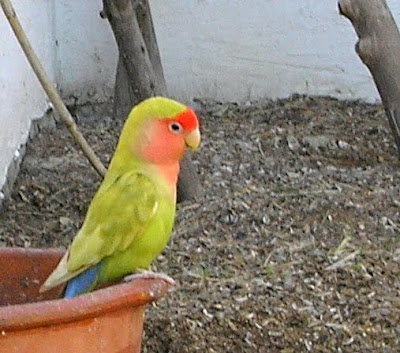 Having to eat every two hours he came everywhere with me and was quite popular. As he grew the gullet that used to fill up with food and look so ugly, began to disappear and his feathers began to grow. Pipsqueak, as we called him, turned into a beautiful yellow bird with blue tail feathers. He lived free in our bedroom and sat on my shoulder every morning to make coffee. The aviary runs the full length of one side of the house so you can watch the birds from several rooms. It was better than Dallas, the mothers teaching the babies to fly, the building of nests, the fight for residential counsel-flats or flower-pots and especially the flirting. Love Birds are monogamous and will even pine to death if they lose a mate. Both parents take part in the raising of the young and look like hedgehogs when they fill their feathers with bits of palm leaves to build the nest.
Every once in a while I would take Pipsqueak out to the aviary to meet some of his own kind but he always flew straight back to me, not wanting to have anything to do with the other birds. After two years of constant companionship, I put him in the window to chat with the others, when his behaviour became very agitated. He kept squeaking and flying back and forth to the window then my shoulder. I took him inside the aviary where he promptly left me and joined a blue Love Bird. Pipsqueak never came back to sit on my shoulder or come in the house. After a while I could't even tell him from the other yellow ones. With my feelings very hurt I asked my father why he thought that he wouldn't even come see me inside the aviary. As always with my father's quick wit, he said "well if your mother looked like that would you want to introduce her to your friends?" He didn't mean it in a hurtful way he just meant that with me being so big and of another species I was quite a spectacle. By the way it turned out Pipsqueak was a girl and had batches of green and red Love Birds.
 Having to eat every two hours he came everywhere with me and was quite popular. As he grew the gullet that used to fill up with food and look so ugly, began to disappear and his feathers began to grow. Pipsqueak, as we called him, turned into a beautiful yellow bird with blue tail feathers. He lived free in our bedroom and sat on my shoulder every morning to make coffee. The aviary runs the full length of one side of the house so you can watch the birds from several rooms. It was better than Dallas, the mothers teaching the babies to fly, the building of nests, the fight for residential counsel-flats or flower-pots and especially the flirting. Love Birds are monogamous and will even pine to death if they lose a mate. Both parents take part in the raising of the young and look like hedgehogs when they fill their feathers with bits of palm leaves to build the nest.
Every once in a while I would take Pipsqueak out to the aviary to meet some of his own kind but he always flew straight back to me, not wanting to have anything to do with the other birds. After two years of constant companionship, I put him in the window to chat with the others, when his behaviour became very agitated. He kept squeaking and flying back and forth to the window then my shoulder. I took him inside the aviary where he promptly left me and joined a blue Love Bird. Pipsqueak never came back to sit on my shoulder or come in the house. After a while I could't even tell him from the other yellow ones. With my feelings very hurt I asked my father why he thought that he wouldn't even come see me inside the aviary. As always with my father's quick wit, he said "well if your mother looked like that would you want to introduce her to your friends?" He didn't mean it in a hurtful way he just meant that with me being so big and of another species I was quite a spectacle. By the way it turned out Pipsqueak was a girl and had batches of green and red Love Birds.
Honda
 When I moved back to Mojacar in 1980, I dreamt of having a stable of beautiful Spanish horses and giving each the name of a car like Morgan, Alfa or Jag but as it turned out my first purchase was a black mule whom I named Honda because she was cheap and reliable. The drawing of the cart above is the old cart I turned into a mule-taxi and Honda and I took people up and down the beach or from bar to bar. Being the first taxi in Mojacar I was issued with licence plate No. 1. The plate was made by the famous playwrite, artist and local resident Win Wells because the town had no such facilities. I'm sorry there are no pictures to show but I only had a poloroid which a good friend had bought me because I wasn't making any money seeing as all my clients were friends and I couldn't charge them but they all bought the pictures and that was my income and probably the best job I have ever had.
Things were very primative then: the beaches virgin, the people friendly. The weather was always beautiful and modern conveniences were unheard of. In those days the local doctor still made his rounds of the farm areas on horse-back for which I accompanied him many times.
To do the laundry, one went to the Arab fountain at the base of Mojacar, where water ran 24 hours a day and went down troughs that you had to stand in up to your knees and rub bar soap on the worn rock wash-boards. The used water continued down to irrigate the farm-land, each according to his 'hours'. It was always a fun time because we would load up Honda, go to the shop at the fountain, buy a melon to put in the icy water until we had finished washing clothes - the rinse-cycle was acomplished by our children standing up to their waists in the fountain and stomping up and down on the laundry until the soap was out. Then we would wash our hair and share out the melon. It was a great social meeting place; then we would go home with all the gossip of this interesting and relaxed little community.
One day when Amber was in nursery school, in the plaza of Mojacar, there was a terrible ruckus - it turned out that Honda and our Great Dane had gone walkabouts and ended up in the village. Not knowing what to do they got three-year old Amber out of school to deal with the situation. She tied the mule to the iron grates on the window of the school and took the dog inside. When I went to pick her up she rode the mule home. She was considered quite the little heroine because the locals were scared to death of both animals.
Friday, August 28, 2009
How the Cow Jumped Over the Moon
 This is a photograph of a family portrait I once commisioned. It was painted by the French artist Jean-Marc Faure. From the left, there is Negrita the sheep, Petite Suisse the cow, three horses Cura, Oli and Casi (la potra: the foal) and in the foreground, Lorca our first Briard.
The subject of this story is Petite Suisse and how my father learned where the childrens' poem of the cow that jumped over the moon came from.
When we first moved to Mojácar there was no fresh milk, what we had was milk with the cream taken out, pork fat and formaldahide added. Of course there was no refrigeration so it made sense.
I had made it known amongst the local farmers that I was in the market for a cow and it became a standard joke, but after a few years I was sitting having lunch at the Focus, one of our hang-outs, when a man arrived and asked if I was the lady that had ordered the cow. Being rather taken off guard I said "well yes", so he said, good because he was the cow salesman; that she was in a truck in the parking lot and I was to take her so he could continue delivering the rest of the calves. I looked in the truck full of calves and had no doubt which one was mine. Seven day old Petite Suisse. To the amazement of the many onlookers, I picked her up, put her in my car and took her home. My father, who by this stage of my life, was not surprised by anything I brought home, said "is she just visiting or is she here for good?" Without another word he left and came back with baby bottles and UHT milk. She roamed free with all the other animals and, as is so common in my animals, she suffered an identity crisis. She thought she was a dog or at least she acted like a puppy, running down to the car to greet you, jumping up and even coming into the house. As she grew in size and affection we started having to contain her a bit which turned out to be harder than you might think. You always see cows so peacefully in a field with a small fence around it and never trying to leave but Petite Suisse wanted to be with us at all times. We started with collars and ropes, then moved to chains and finally to the stables with their typical stable door, built to keep a stallion in, only to get home to find her waiting on the terrace. Her escape was remarkable and that is when my father said he now believed the poem of the cow that jumped over the moon, because the space of the open door was smaller than she was and higher than her head. Soon after, one time while I was filling her water bucket, an old habit of hers was suddenly repeated as she jumped joyfully into my arms. Unfortunately, she weighed in at around 300 kilos and the two of us fell into a nearby manure pile, sliding merrily down to the bottom. My father was luckily on hand to dig me out.
She never produced milk, of course, because of the absence of bulls in the area. She was a wonderful pet.
Life Returns
 These are the new shoots on a burned eucalyptus one month after the Mojácar fire (which burned several thousand acres, including most of our land). For one month there were no mosquitos or flies or fleas to bite us. Sadly we lost a lot of the more attractive local wildlife like the hares, wild tortoises (tortuga mora) and the local lizards. We saw frightened birds flying off with their wings on fire. We hope that the swifts who nested under our beams managed to fly to safety. We were visited by a few of them in the following days, but they should be in Africa by now.

The house (which miraculously survived the fire) was filled with frightened tree rats, snakes and centipedes but only the centipedes survived the smoke and intense heat. Here is a picture of one my son found in his bed today. These three-inch long fellows give a really nasty bite.

The capers are already growing out of the black ash and the cactus are shedding their skins like snakes to find a new green cactus underneath. The roots of hundred year-old carob trees burnt underground for weeks and the trees will return. The last picture is of the corner of our terrace where you can see the contrast of the green and the burnt on either side of the two wooden horses.

Saturday, May 02, 2009
La Hipoterapia

Quiero aclarar algunos puntos sobre la hipoterapia, ya que esta poniendo muy de moda y centros están abriendo por todo los sitios. La hipoterapia es una terapia para hacer conjunto con las otras terapias no en vez de ellas. La hipoterapia es una forma de equinoterapia médica. Los alumnos nunca aprenden a montar en si, pero aprovechen los movimientos del caballo para conseguir un mejoramiento muscular y de circulación y equilibrio al mismo tiempo recibiendo un masaje de los órganos mejorando el sistema digestivo. Siempre está dirigida por un fisioterapeuta y un profesor de equitación.
Antes de empezar hay que tener un certificado médico por cada alumno ya que hay varias contraindicaciones. Asegurar que la vejiga esta vacía, elegir un caballo de tamaño y paso adecuado por cada alumno y que el caballo ha hecho todos los ejercicios muchas veces antes. Debe de tener a alguien guiando, y no tirando, al caballo y no faltar a dos ayudantes, laterales. Porque la mayoría del trabajo es lento y aburrido por el animal: haciendo círculos, figuras de ocho y serpentinas, y es importante que el caballo tiene un buen ejercicio antes de las clases. Las clases empiezan con solo unos minutos y lleguen hasta los 45 minutos casi siempre terminando con el alumno tumbada boca abajo como un saco de patatas para quitar liquido de los pulmones: que es difícil para alguien en silla de ruedas. El tobillo, cadera, hombro y oreja siempre deben de estar en línea, así consigues mejor movimiento del tronco y el beneficio consecuente de los movimientos del caballo. La hipoterapia está casi siempre hecha a pelo o con una lana, para evitar rozaduras. Muchas veces, dependiendo del grado de discapacidad del alumno, se necesite un back-rider ó sea alguien montando detrás del alumno para sujetarle.
Muchos de las clases empiezan con la limpieza del caballo por el alumno. Esto ayuda al alumno en conocer al animal mientras que mejora su coordinación y musculatura. El caballo debe de estar muy cómodo con las distracciones como pueda ser una silla de ruedas, rampas, grúas y otras cosas necesarias para subir el jinete. Por falta de control corporal es importante que el caballo se acostumbre a ruidos y movimientos bruscos o desequilibrados. Un caballo con alta escuela puede recibir signos conflictivos por los movimientos de las piernas del jinete. En nuestra experiencia, los caballos aprenden rápido cuando tienen un alumno discapacitado y no dan caso a las ayudas de la doma normal proporcionadas por su jinete. Puede ser porque no llevan brida ni silla durante las clases y tienen a alguien guiándoles.
Volteo hace una buena preparación para el caballo porque durante una clase de hipoterapia el alumno puede montar mirando hacia detrás, tumbada, de lado o incluso de pie, descalzo. Hay algunos alumnos de la hipoterapia que también aprendan a montar, todo depende de su grado de discapacidad.
No olvide que hay que tener una póliza de seguro bueno y permiso por escrito para sacar o usar fotos de los alumnos.
ANIMO ya no está funcionando como centro, pero estamos abierto a ayudar a cualquier centro o hacer ponencias y cursos.
Monday, April 06, 2009
Holidays are Here Again
I thought you would enjoy another wonder of Spain. Saint’s Days. Everyone in Spain has a saint’s day which is more important than your birthday. It can be annoying. For example everyone that works at the electric co. is called Antonio, which I know because it is June 13, Jessica’s birthday, so none of her friends could ever come to the party and no one was left to watch the electric company's dials and collection of bits of wire. Then every village, town and city has at least one saint’s day, whose fiesta lasts from three to ten days depending on the size of the pueblo. This means 24 hours of music and dancing and much more. If a town has a specialty like running the bulls then everyone takes the holiday.
After each day-off work or public holiday you have the 'Dia de la Resaca', which is hangover day and it is acceptable to stay in bed. When there is a national holiday you get what is called a puente or a three or four day weekend. If the holiday falls on a weekend, then that isn’t fair to the citizens so we give it an extra day. Next month, May, has three puentes so it is basically a couple of days a week of work during May. We have 'regional holidays' as well – the Día de Andalucía is on Feb 28th. Then you have Semana Blanca - a week off in February - which everyone has to go skiing.
The schools sometimes go out ‘on strike’ as well… I am sure there are more but my eyes hurt.
Oddly, birthdays don't count for much, but of course you have your Saint's Day instead (unless you have one of those 'strange' Anglo names...).
Then, Spain's lucky workers get double pay at Christmas and July.
Then there's the glorious siesta from two to five. No fast food here.
Subscribe to:
Posts (Atom)